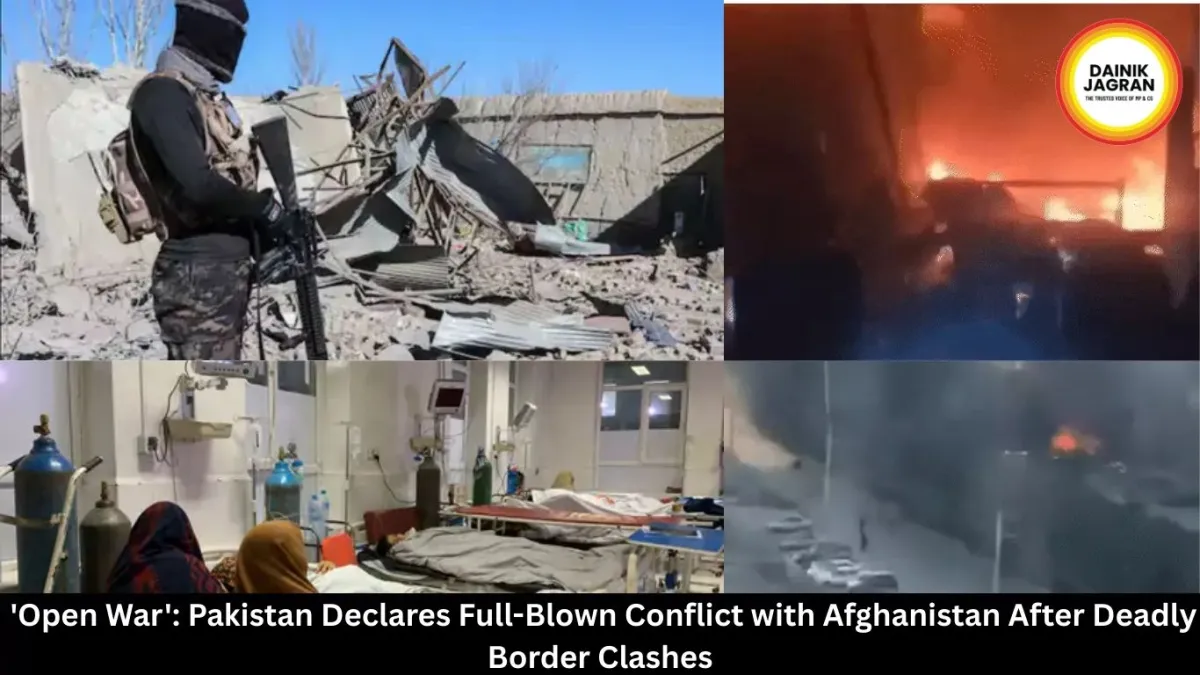
In a dramatic escalation of hostilities, Pakistan's Defence Minister Khawaja Asif has declared an "open war" against Afghanistan's Taliban government, signaling a dangerous new chapter in the long-troubled bilateral relationship. The declaration follows intense cross-border clashes that have already claimed scores of lives and triggered retaliatory airstrikes on both sides .
Pakistan-Afghanistan Conflict: "Our Patience Has Reached Its Limit"
"Our patience has reached its limit. Now it is open war between us and you," Asif posted on social media platform X early Friday, in a stark message directed at Afghanistan's rulers . The defense minister's declaration came hours after what Islamabad describes as an unprovoked attack by Afghan forces along the Kunar border late Thursday night.
The fighting represents the most serious confrontation since the Taliban took control of Kabul in 2021, effectively ending any pretense of diplomatic engagement between the neighboring Islamic states.
Conflicting Casualty Figures Deepen the Crisis
The two capitals have presented wildly divergent accounts of the fighting, a familiar pattern in their troubled history. Afghanistan's Deputy Spokesperson Hamdullah Fitrat claims that Afghan forces killed 55 Pakistani soldiers, capturing some alive and seizing 19 military outposts along with weapons and equipment .
Pakistan has categorically rejected these figures. Information Minister Attaullah Tarar stated that only two Pakistani soldiers were killed, while claiming that 133 Afghan Taliban fighters have been "terminated" in retaliatory strikes, with more than 200 wounded . According to Pakistani officials, Operation Ghazab Lil Haq—translating roughly to "Wrath of God"—has destroyed 27 Taliban outposts and captured nine.
Cross-Border Airstrikes Target Major Cities
The conflict escalated dramatically when Pakistan launched pre-dawn airstrikes Friday against what it termed "important military facilities" in Kabul, Kandahar, and Paktia Province . Pakistani Information Minister Attaullah Tarar shared footage of the operations on X, showing strikes in the Afghan capital as well as Kandahar and Baktika.
The Taliban responded in kind, with spokesperson Zabihullah Mujahid confirming that "wide-ranging retaliatory operations" were launched against Pakistani positions from Kandahar and Helmand Province . Witnesses in Kabul reported blasts and gunfire, though initial reports indicated no casualties from the airstrikes.
Civilian Casualties Draw International Concern
The human cost of the escalating cross-border airstrikes is becoming increasingly apparent. Reports from Afghanistan indicate that civilians have been caught in the crossfire. In Nangarhar Province, wounded Afghan women were hospitalized after a Pakistani mortar struck a returnees' camp near the Torkham border .
The United Nations Assistance Mission in Afghanistan (UNAMA) has confirmed civilian deaths in recent operations and expressed grave concern about the escalating violence. UN Secretary-General António Guterres has appealed to both sides for restraint, emphasizing that civilians must be protected in accordance with international law .
Regional and International Response
The international community has moved quickly to address the crisis. Iran has offered to mediate between the two neighbors, while the United Nations urges both parties to pursue diplomatic solutions .
Notably, India has emerged as the only country to publicly condemn Pakistan's airstrikes, describing them as an attempt to "externalize internal failures." Other regional powers including China, Russia, and Central Asian states have maintained silence, reflecting the complex geopolitical calculations at play .
Historical Context: The Durand Line Dispute
The current crisis cannot be understood without reference to the long-standing dispute over the Durand Line, the 19th-century border demarcation that Afghanistan has never formally recognized. Both nations regularly accuse each other of harboring militant groups and attacking border posts .
Since the Taliban's return to power in 2021, relations have steadily deteriorated. Islamabad accuses the Taliban government of allowing Tehrik-i-Taliban Pakistan (TTP) fighters to operate from Afghan soil—a charge Kabul consistently denies .
What Happens Next?
With both sides claiming military successes and vowing to continue operations, the immediate outlook appears grim. Pakistan's Prime Minister Shehbaz Sharif has declared that the nation stands united behind its armed forces, which he says are fully capable of crushing any aggression .
Afghanistan's former president Hamid Karzai has urged Afghans to defend their homeland with unity and courage, while calling on Pakistan to pursue "good neighborly and civilized relations."
Previous ceasefire attempts, including a Qatar-brokered agreement in October 2025, have failed to produce lasting peace. Unless meaningful diplomatic engagement resumes soon, the Pakistan-Afghanistan conflict seems destined to escalate further, with ordinary civilians on both sides paying the heaviest price.