Total Solar Eclipse 2026: Millions Gather in Spain and Iceland
Digital desk
Millions are gathering in Spain and Iceland for the August 12 total solar eclipse. India is outside the visibility zone; here is how to watch safely.
Millions Gather in Spain and Iceland for Rare Total Solar Eclipse; India Outside Visibility Zone
Up to six million visitors are expected across Spain’s eclipse path, while NASA aircraft and balloons will study the Sun and atmosphere during the brief darkness.
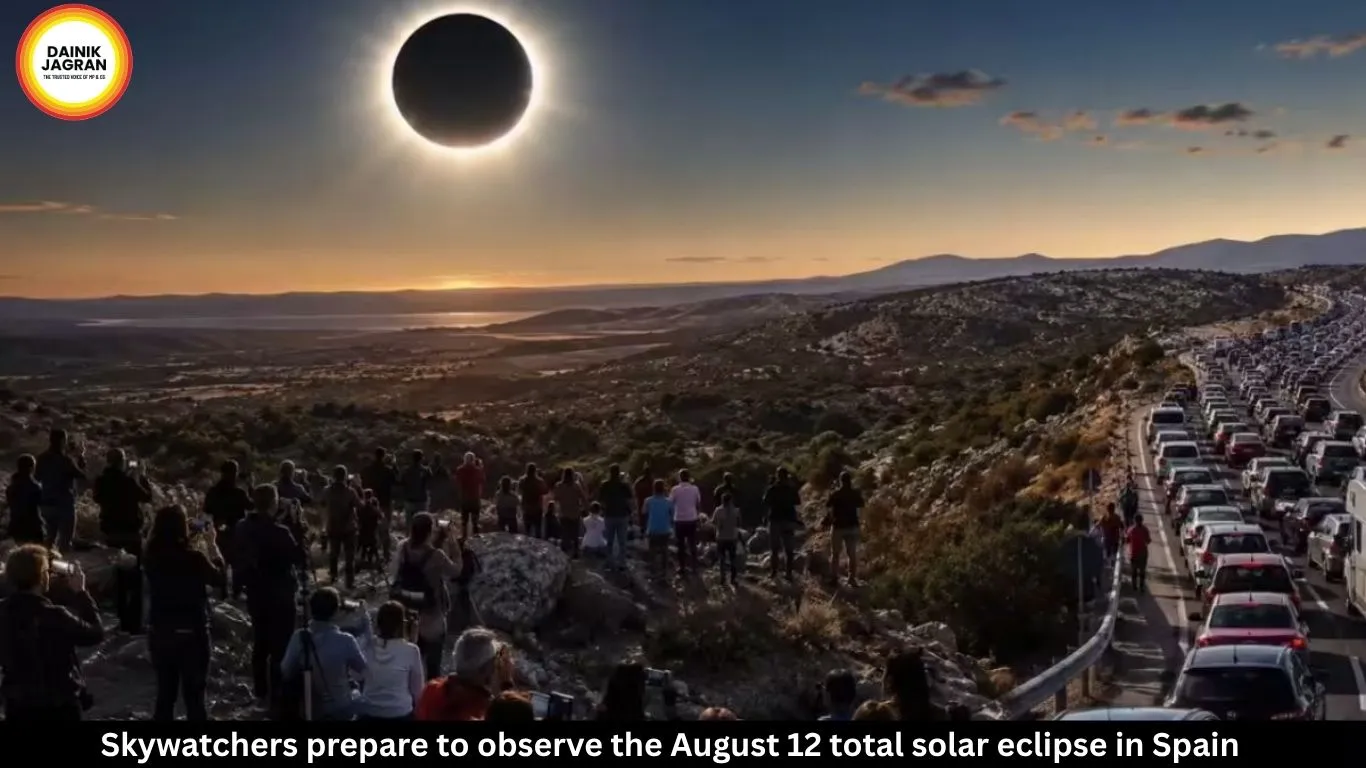
Millions of skywatchers are gathering across Spain and Iceland for Wednesday’s total solar eclipse, a rare celestial event that will briefly turn day into twilight along a narrow path across the Arctic and Western Europe.
Authorities expect as many as six million visitors in areas of northern Spain and the Balearic Islands within the path of totality. Iceland, which has a population of about 400,000, is preparing for up to 80,000 visitors.
The eclipse occurs when the Moon moves directly between Earth and the Sun and completely covers the Sun’s bright face for observers inside the path of totality. Weather permitting, viewers can then see the solar corona, the Sun’s normally hidden outer atmosphere.
NASA calculations put the maximum possible totality at about two minutes and 18 seconds. In far-western Iceland, totality is expected to last up to about two minutes and 13 seconds, although the duration will be shorter in many cities.
Spain increases security amid wildfire danger
The eclipse reaches Spain close to sunset, creating dramatic viewing conditions but also logistical challenges. Large crowds are travelling towards rural areas, placing pressure on roads, emergency services and accommodation.
Spain has launched a major police and public-safety operation because the event coincides with a high-risk period for wildfires. Authorities are trying to prevent illegal parking, uncontrolled gatherings and activities that could start fires in dry landscapes.
The Iberian Peninsula last experienced a total solar eclipse in 1912. Another will cross the region on August 2, 2027, followed by an annular eclipse in January 2028 — a sequence promoted as the “Iberian Eclipse Trio”.
In Iceland, eclipse glasses sold out in several places days before the event. Officials warned of heavy traffic and asked spectators to reach viewing locations early.
NASA to chase the Moon’s shadow
NASA plans to fly a high-altitude WB-57 aircraft from Iceland to observe the eclipse. Research teams supported by the agency will also launch balloons to examine how the sudden reduction in sunlight and temperature affects the lower atmosphere.
The path of totality begins in far northern Russia and moves across the Arctic and North Atlantic before reaching Greenland, Iceland, a small area of Portugal and Spain. Other parts of Europe, Africa and North America will see a partial eclipse.
India is outside the visibility region listed by NASA for this eclipse, so it cannot be watched directly from Madhya Pradesh, Chhattisgarh or elsewhere in the country. Indian viewers can follow authorised live streams and scientific coverage online.
How to watch safely
NASA warns that ordinary sunglasses are not safe for looking at the Sun. During every partial phase, viewers must use certified eclipse glasses or a safe handheld solar viewer that meets the ISO 12312-2 standard.
Cameras, binoculars and telescopes require a special solar filter fixed to the front of the optics. Looking through an optical device while wearing only eclipse glasses can cause serious eye injury because concentrated sunlight may burn through the viewer.
Only people inside the path of totality may briefly remove eye protection when the Sun is completely covered. Glasses must be put back on as soon as any part of the bright Sun reappears. A pinhole projector offers a safe indirect method for observing partial phases.
Beyond the spectacle, eclipses help scientists study the corona and the response of Earth’s atmosphere to sudden darkness. For spectators in Spain and Iceland, the attraction is more immediate: a few extraordinary moments when daylight disappears and the Sun’s outer atmosphere becomes visible.

Total Solar Eclipse 2026: Millions Gather in Spain and Iceland
Digital desk
Millions Gather in Spain and Iceland for Rare Total Solar Eclipse; India Outside Visibility Zone
Up to six million visitors are expected across Spain’s eclipse path, while NASA aircraft and balloons will study the Sun and atmosphere during the brief darkness.
Millions of skywatchers are gathering across Spain and Iceland for Wednesday’s total solar eclipse, a rare celestial event that will briefly turn day into twilight along a narrow path across the Arctic and Western Europe.
Authorities expect as many as six million visitors in areas of northern Spain and the Balearic Islands within the path of totality. Iceland, which has a population of about 400,000, is preparing for up to 80,000 visitors.
The eclipse occurs when the Moon moves directly between Earth and the Sun and completely covers the Sun’s bright face for observers inside the path of totality. Weather permitting, viewers can then see the solar corona, the Sun’s normally hidden outer atmosphere.
NASA calculations put the maximum possible totality at about two minutes and 18 seconds. In far-western Iceland, totality is expected to last up to about two minutes and 13 seconds, although the duration will be shorter in many cities.
Spain increases security amid wildfire danger
The eclipse reaches Spain close to sunset, creating dramatic viewing conditions but also logistical challenges. Large crowds are travelling towards rural areas, placing pressure on roads, emergency services and accommodation.
Spain has launched a major police and public-safety operation because the event coincides with a high-risk period for wildfires. Authorities are trying to prevent illegal parking, uncontrolled gatherings and activities that could start fires in dry landscapes.
The Iberian Peninsula last experienced a total solar eclipse in 1912. Another will cross the region on August 2, 2027, followed by an annular eclipse in January 2028 — a sequence promoted as the “Iberian Eclipse Trio”.
In Iceland, eclipse glasses sold out in several places days before the event. Officials warned of heavy traffic and asked spectators to reach viewing locations early.
NASA to chase the Moon’s shadow
NASA plans to fly a high-altitude WB-57 aircraft from Iceland to observe the eclipse. Research teams supported by the agency will also launch balloons to examine how the sudden reduction in sunlight and temperature affects the lower atmosphere.
The path of totality begins in far northern Russia and moves across the Arctic and North Atlantic before reaching Greenland, Iceland, a small area of Portugal and Spain. Other parts of Europe, Africa and North America will see a partial eclipse.
India is outside the visibility region listed by NASA for this eclipse, so it cannot be watched directly from Madhya Pradesh, Chhattisgarh or elsewhere in the country. Indian viewers can follow authorised live streams and scientific coverage online.
How to watch safely
NASA warns that ordinary sunglasses are not safe for looking at the Sun. During every partial phase, viewers must use certified eclipse glasses or a safe handheld solar viewer that meets the ISO 12312-2 standard.
Cameras, binoculars and telescopes require a special solar filter fixed to the front of the optics. Looking through an optical device while wearing only eclipse glasses can cause serious eye injury because concentrated sunlight may burn through the viewer.
Only people inside the path of totality may briefly remove eye protection when the Sun is completely covered. Glasses must be put back on as soon as any part of the bright Sun reappears. A pinhole projector offers a safe indirect method for observing partial phases.
Beyond the spectacle, eclipses help scientists study the corona and the response of Earth’s atmosphere to sudden darkness. For spectators in Spain and Iceland, the attraction is more immediate: a few extraordinary moments when daylight disappears and the Sun’s outer atmosphere becomes visible.

Recommended For You
--------
π¨ Beat the News Rush β Join Now!
Get breaking alerts, hot exclusives, and game-changing stories instantly on your phone. No delays, no fluff β just the edge you need. β‘
Tap to join:Β
π’ WhatsApp Channel: Dainik Jagran MP CG
Crave more?
π Facebook: Dainik Jagran MP CG English
π § Twitter (X): Dainik Jagran MP CG
π Instagram: Dainik Jagran MP CG
Share the fire β keep your crew ahead! ποΈπ₯