
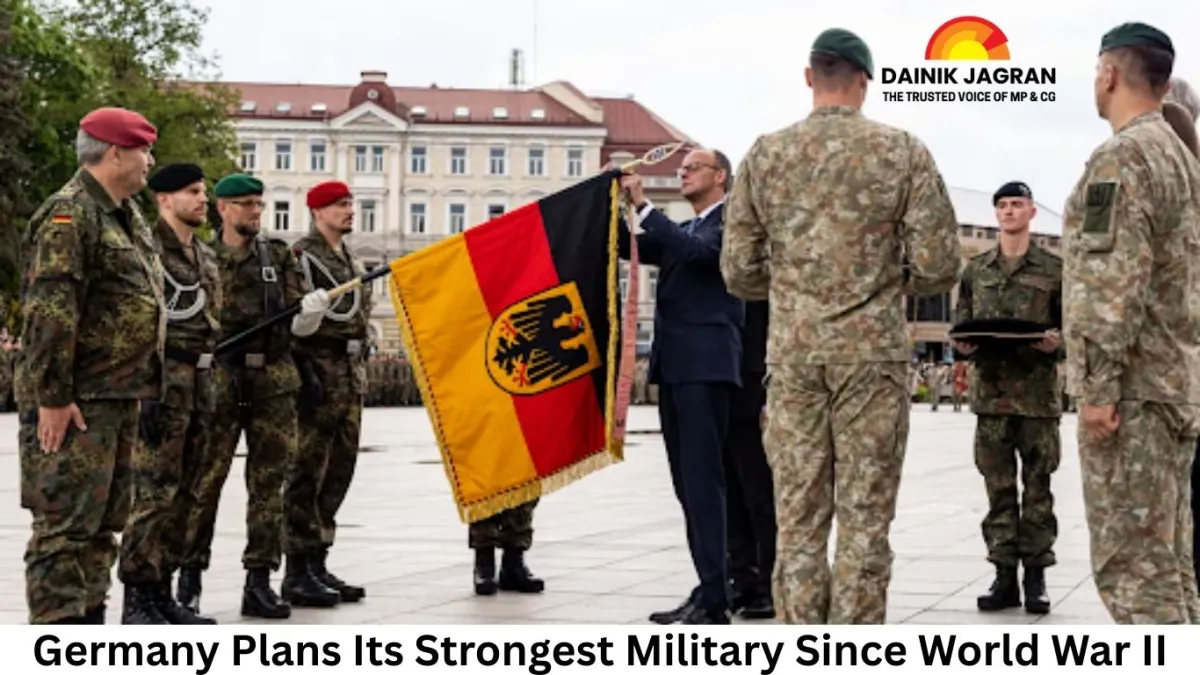

Germany Plans Its Strongest Military Since World War II, Offers High Pay to Youth Amid Rising Russia Fears
Digital Desk
Under the new strategy, the German government is offering monthly salaries of up to €2,600 (around ₹2.5 lakh) to attract young recruits to the Bundeswehr, along with free accommodation, healthcare and other benefits. Even after taxes, recruits can take home about €2,300 per month, an unusually high entry-level income in public service. The incentives are part of a broader effort to rapidly expand troop strength and modernise the armed forces.
As part of the push, Germany last month passed a law requiring 18-year-old boys to fill out mandatory forms declaring their physical and mental fitness for military service. While enlistment remains voluntary for now, the legislation allows the government to reintroduce compulsory conscription if recruitment targets are not met.
Germany currently has about 184,000 active soldiers, but that figure rose by 25,000 between May and November 2025. Chancellor Friedrich Merz told parliament that Germany must become “Europe’s strongest army.” Berlin has committed to NATO that by 2035 it will field 260,000 active troops and 200,000 reservists, pushing total strength close to 500,000, levels last seen at the end of the Cold War.
The expansion has been backed by unprecedented funding. Germany has earmarked €108 billion (₹9.7 trillion) this year for defence restructuring—around 2.5% of GDP—with spending expected to rise to 3.5% of GDP by 2030. Parliament has also relaxed constitutional borrowing limits, accelerating weapons procurement after years of delays.
Russia has criticised the rearmament. Moscow’s ambassador to Berlin said Germany was preparing for war, an accusation rejected by German officials, who cite Russia’s continued military campaign in Ukraine as the primary driver of their decisions.
Public opinion has shifted sharply. Surveys show a growing majority of Germans doubt that the United States would reliably defend Europe under NATO, particularly amid concerns over former President Donald Trump’s stance. Support for a more independent European security framework, including shared nuclear deterrence led by France and the UK, has increased.
Experts caution that challenges remain, including recruitment capacity, training timelines and lingering cultural resistance to militarisation. Still, Germany’s pivot signals a fundamental change in Europe’s security posture, with Berlin preparing for a more uncertain and self-reliant future.
.jpg)




