


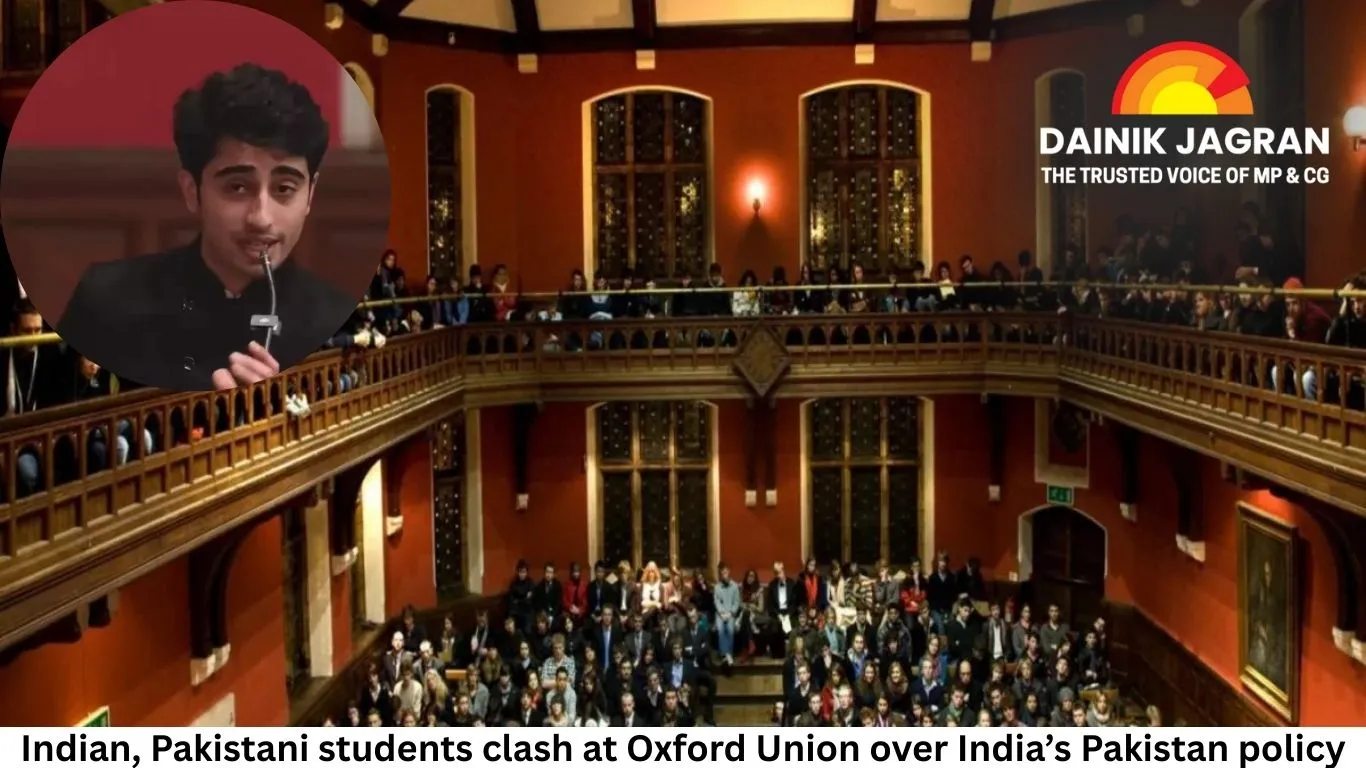
Indian, Pakistani students clash at Oxford Union over India’s Pakistan policy
Digital Desk
Representing India was Viraansh Bhanushali, a Mumbai-born law student at Oxford University, while Moosa Harraj argued the Pakistani position. The motion questioned whether India’s approach towards Pakistan is largely a populist narrative framed as security policy to mobilise domestic support.
Challenging the Indian stance, Harraj argued that Pakistan is routinely blamed whenever violence occurs in India, alleging that fear of Pakistan is used to consolidate public opinion. He questioned whether strict policies were necessary or merely political messaging.
Responding, Bhanushali grounded his argument in personal experience, referring to the 26/11 Mumbai terror attacks. He recalled that members of his family narrowly escaped the assault and said the deaths of 166 people could not be dismissed as political theatre. “You cannot shame a shameless country,” he said, adding that India had learned painful lessons from repeated attacks.
Bhanushali rejected the claim that India’s security posture was election-driven, citing a timeline of major terror incidents — the 1993 Mumbai blasts, 2008 attacks, Pathankot, Uri and Pulwama — and noting that many occurred outside election cycles. “Terrorism was imposed on India,” he said, arguing that defensive measures were a matter of responsibility, not popularity.
When questioned on why India did not go to war after 26/11, Bhanushali said restraint was a conscious choice. He argued that India prioritised diplomacy and evidence-sharing to build international consensus, rather than immediate retaliation.
The debate also touched on recent incidents, with Bhanushali alleging that tourists were targeted in Pahalgam based on their religious identity, underscoring what he described as the continuing security threat.
Concluding, he said India seeks peace, trade and regional cooperation, but cannot ignore terrorism. “If protecting citizens is called popular politics,” he remarked, “then it is a responsibility worth owning.”

.jpg)




