


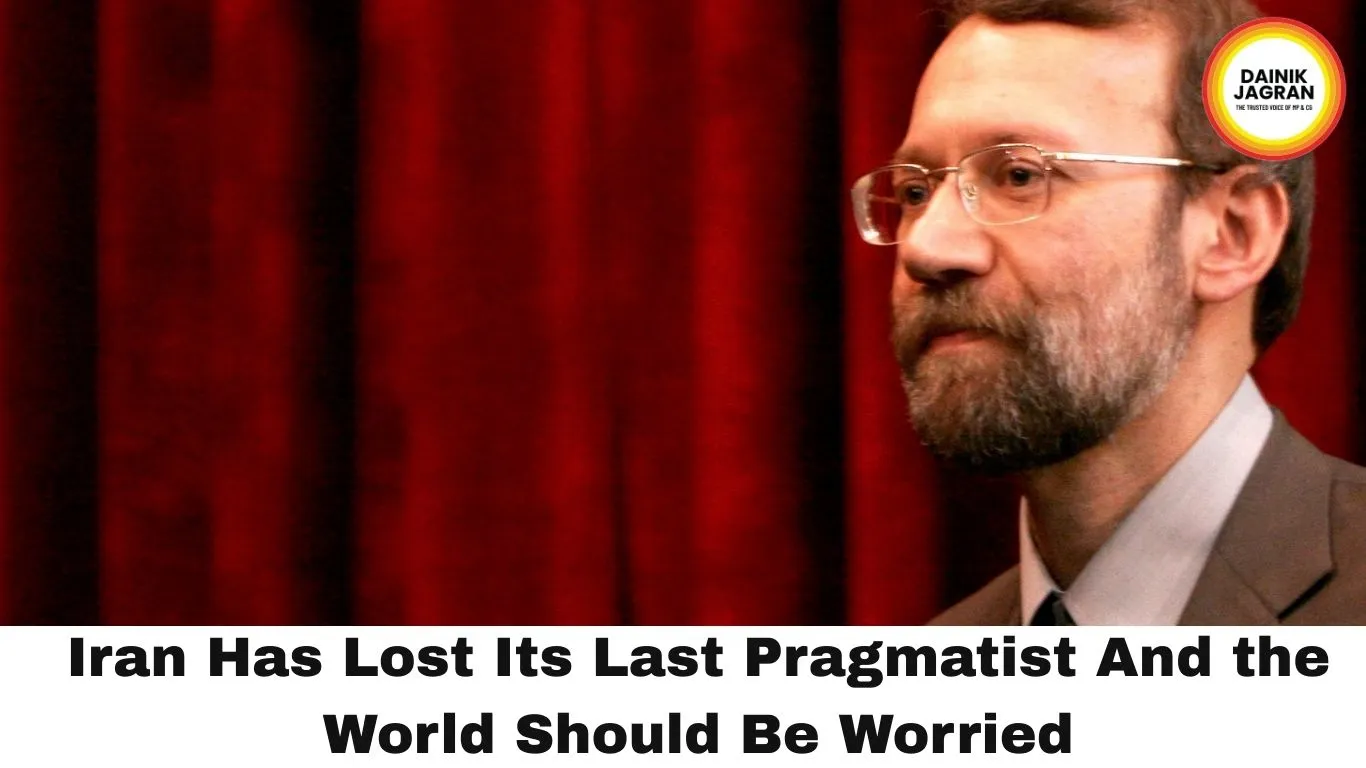
Iran Has Lost Its Last Pragmatist — And the World Should Be Worried
Digital Desk
The Last Man Who Could Have Ended This War Is Gone
On the night of March 17, 2026, Israeli airstrikes killed Ali Larijani — the Secretary of Iran's Supreme National Security Council, former speaker of the Iranian parliament, former chief nuclear negotiator with the West, and the single most powerful figure left standing in the Iranian government after Supreme Leader Ayatollah Ali Khamenei was assassinated on the first day of the war, February 28.
Iran's Supreme National Security Council confirmed Larijani's death in a formal statement, saying he had attained "the exalted rank of martyrdom." The statement confirmed that his son Morteza Larijani, the head of his office Alireza Bayat, and several of his personal guards were also killed in the same strike. In the same overnight operation, Israeli forces killed Brigadier General Gholamreza Soleimani — the commander of Iran's Basij paramilitary force, the internal militia used to suppress civilian protests across the Islamic Republic.
Israeli Defence Minister Israel Katz confirmed both killings publicly, saying the leaders of the regime were "being killed and their capabilities terminated." Prime Minister Benjamin Netanyahu framed the killing of Larijani as part of an explicit strategy to give ordinary Iranians the chance to overthrow their government.
The world should understand what has actually been lost here — because it is not only a man. It is the last realistic pathway to a negotiated end to this war.
Who Was Ali Larijani — and Why His Death Changes Everything
To understand the full weight of what happened on the night of March 17, you must understand who Ali Larijani actually was — not in propaganda terms from either side, but in the terms of how modern Iran actually functioned.
Born in 1958 in Najaf, Iraq, to a family so influential that journalists once called them the "Kennedys of Iran," Larijani combined the rarest of qualities in the Iranian establishment: genuine intellectual depth, decades of operational experience inside the security state, and the diplomatic fluency to engage the outside world on its own terms. He studied philosophy and wrote serious academic work on the German philosopher Immanuel Kant. He ran Iran's state broadcaster. He served as the country's chief nuclear negotiator during the most sensitive years of the P5+1 talks. He was speaker of the Iranian parliament for over a decade. He was, in the truest sense, the grey matter of the Iranian regime — the man who understood both how to wage the fight and how to find a door out of it.
When Khamenei was killed on February 28, the burden of holding Iran together fell disproportionately on Larijani. The new Supreme Leader, Mojtaba Khamenei — Ayatollah Khamenei's son — has made no public appearance since assuming the position. The presidency of Masoud Pezeshkian, while legitimate, lacks the deep security establishment ties needed to manage a war of this scale. It was Larijani who sat at the intersection of military command, intelligence coordination, and political decision-making. It was Larijani who had the credibility inside the Revolutionary Guards, the parliament, the judiciary — his brothers have held senior positions across every branch of Iranian power — and with the international community simultaneously.
Just five days ago, on March 13, he was photographed walking through the streets of Tehran in the annual Al-Quds Day rally alongside President Pezeshkian — a deliberate act of public defiance, projecting an image of an unbroken government continuing to function under bombardment. He rebuked Muslim-majority nations for their silence on the war, appealing for Islamic solidarity. He publicly rejected claims that he was seeking new talks with Washington. And yet people who had watched him for decades understood that behind the defiant rhetoric was a man who had spent his entire career believing that Iran's survival ultimately required diplomacy, not only military resistance.
He warned Trump only weeks ago that Iran did not fear empty threats — that those greater than Trump had tried and failed to erase the Iranian nation. Days later, he was gone.
The Decapitation Strategy: Is It Working?
Israel and the United States have pursued what military strategists call a decapitation strategy in this war — the systematic targeting of Iran's senior leadership on the calculation that removing the heads of the regime will either cause its collapse or force it to the negotiating table.
On the surface, the results look significant. Ayatollah Khamenei is dead. The IRGC commander is dead. The head of the Basij is dead. The Secretary of the Supreme National Security Council is dead. Iran has lost more senior leadership in eighteen days than in the preceding forty years combined.
But the evidence that this strategy is producing the desired outcome — either regime collapse or a ceasefire — is, at best, mixed. Iran has continued to strike. Its missiles and drones are still flying. The Strait of Hormuz remains restricted. And each killing of a senior leader appears to harden public sentiment inside Iran rather than fracture it, feeding a narrative of national martyrdom that the regime's remaining leaders are actively cultivating.
An independent analyst put it precisely: Israel and the US are playing a version of a replacement game. There is always another leader. The question is not whether Iran can produce another secretary of the Supreme National Security Council. It can, and it will. The question is whether the replacement will have anything close to Larijani's combination of internal credibility and external diplomatic capacity — the very qualities that made him, paradoxically, both a target and the best hope for an eventual ceasefire.
The answer is almost certainly no.
What His Death Means for a Potential Ceasefire
This is the most consequential geopolitical implication of Larijani's killing, and it has received far less attention than the tactical news of his death.
Larijani was, in the words of those who have tracked Iranian politics for decades, one of the few insiders who could help manage not just how this war was fought but how it ended. He had the nuclear negotiation experience to understand the architecture of a deal. He had the security establishment trust to sell a compromise to the Revolutionary Guards. He had the parliamentary history to manage the political layer of any agreement. He was, in the bluntest terms, the man on the Iranian side of the table at the moment a ceasefire conversation became possible.
That man is now dead. His son is dead. His office chief is dead. And the institutional memory, the relationship networks, and the particular brand of pragmatic realism he embodied — qualities that are genuinely rare in any government's security establishment — have died with him.
Netanyahu said the killing would give Iranians a chance to take their fate into their own hands. But the Iranians most capable of steering their country toward a sustainable political future are precisely the ones being eliminated. What remains is a leadership that is either hardline by conviction or has learned from watching the pragmatists die that moderation is fatal.
Killing the Peacemakers Does Not Make Peace
The logic of the decapitation strategy assumes that removing leaders accelerates collapse or capitulation. Sometimes it does. History offers examples both ways. But in Iran's specific case — a revolutionary state with deep institutional roots, a population accustomed to sacrifice, and a new Supreme Leader who has every incentive to prove his legitimacy through defiance — the assassination of every senior figure capable of managing a negotiated exit may be producing the opposite of its intended effect.
Ali Larijani was not a good man in any simple sense. He was a product of a system that has caused immense suffering to its own people and to the region. But he was a pragmatist — and in the specific, urgent context of a war that is pushing global oil prices above 100 dollars per barrel, choking India's LPG supply, threatening the entire Gulf's economic stability, and consuming lives on multiple sides — a pragmatist on the Iranian side of the table was the world's best hope for a way out.
That hope died in a strike on the night of March 17.
What fills the vacuum Larijani leaves behind will determine whether this war ends in weeks or in months — and whether it ends at a negotiating table or in the rubble of further escalation that nobody, anywhere, has a clear plan for surviving.
.jpg)




