


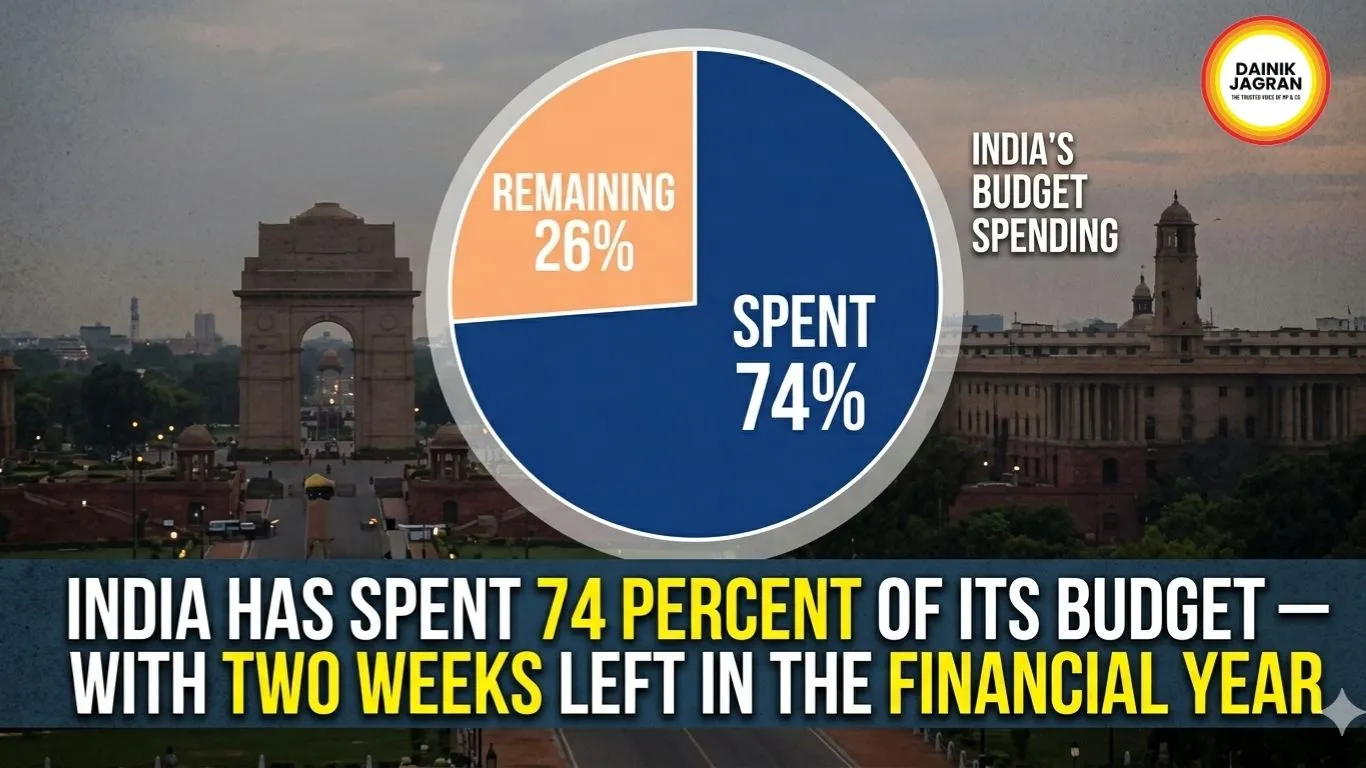
India Has Spent 74 Percent of Its Budget — With Two Weeks Left in the Financial Year
Digital Desk
The Clock Is Ticking on ₹50 Lakh Crore
Two weeks. That is all that remains of the financial year 2025-26. And as of January 31, the Government of India had spent approximately 74 percent of its total annual budget — leaving roughly 26 to 30 percent of the entire year's planned expenditure to be deployed, processed, or accounted for in the final sprint to March 31.
This is not a crisis. In India's budget cycle, the final quarter — particularly the last few weeks of March — has historically been the most financially intense period of the entire year, when government departments race to utilise allocated funds before the year closes and unspent money lapses back to the treasury. What the current numbers tell us is a story of a government that is, in some areas, on track and even ahead of pace — and in others, still has significant work to do before the books close.
Here is what the data actually shows — and what it means for the economy heading into the new financial year beginning April 1.
The Revenue Side: Ahead of Target
The receipts picture for FY 2025-26 is, by any reasonable measure, strong. By the end of January, total government receipts had risen 12.8 percent year-on-year to reach 79.5 percent of the full-year annual target. Net tax revenues came in at approximately ₹20.94 lakh crore compared to ₹19 lakh crore in the same period last year — a meaningful 10 percent improvement that reflects both economic expansion and improved tax compliance through GST and income tax reforms.
This is significant for a simple reason: a government that collects more revenue than it expected has more room to manage its fiscal deficit without either cutting spending or borrowing more. The tax collection momentum — driven by buoyant corporate tax receipts, personal income tax collections boosted by formalisation of the economy, and continued GST compliance improvement — gives the Finance Ministry more comfort heading into the year-end than it had twelve months ago.
Nirmala Sitharaman, presenting her ninth consecutive budget in February 2026 — equalling P. Chidambaram's record — announced a total expenditure target of ₹53.47 lakh crore for FY 2026-27, a 7.7 percent increase over this year's revised estimates. That number is only credible if the receipts trajectory of this year continues into next year. The January data suggests it will.
The Spending Side: Cautious Revenue, Aggressive Capital
Total expenditure through April to January reached ₹36.90 lakh crore — approximately 74.3 percent of the full-year target of ₹50.65 lakh crore. Roughly ₹13.75 lakh crore remained to be deployed across February and March combined. That is an enormous amount of money moving through government channels in eight weeks — and it is, in some form, normal for the Indian budget cycle.
But the more interesting story is inside that headline number. Revenue expenditure — the money the government spends on running itself: salaries, subsidies, interest payments, pensions — has been comparatively restrained through the year. This is actually good news for the fiscal deficit, because revenue spending that slips means fewer structural obligations being built in. The concerning kind of year-end splurge is on revenue items — hiring binges, subsidy increases — rather than on capital assets.
Capital expenditure, by contrast, has been running ahead of pace. By January end, capital spending had reached ₹8.42 lakh crore — approximately 76.9 percent of the annual capital expenditure target, ahead of the same period last year when it stood at 69 percent of target. Infrastructure-led capital spending — roads, railways, ports, defence, urban projects — has been the Modi government's signature economic lever since 2021, and the January numbers confirm that the commitment to infrastructure-first spending has been maintained even through a year complicated by a global energy crisis, state elections, and the West Asia conflict disrupting commodity prices.
The Fiscal Deficit: Narrowing, But the Final Miles Are the Hardest
India's fiscal deficit — the gap between what the government earns and what it spends, bridged by borrowing — narrowed to ₹9.81 lakh crore by January end, representing 63 percent of the full-year target of ₹15.7 lakh crore. This is significantly better than the same period last year, when the deficit had already reached 74.5 percent of the annual target by January.
The government has committed to bringing the fiscal deficit down to 4.4 percent of GDP for FY 2025-26, from 4.8 percent in the previous year. With the full-year target at ₹15.7 lakh crore and ₹9.81 lakh crore consumed through January, the remaining ₹5.89 lakh crore of deficit headroom must cover February and March's net expenditure over receipts.
Whether the government hits the 4.4 percent target will depend critically on two things in the next two weeks: how much of the year-end spending rush is capitalised expenditure that adds productive assets to the economy versus revenue spending that merely adds to recurring obligations — and whether March tax collections come in at or above expectation.
Early signs on both fronts are encouraging. But two weeks is enough time for surprises.
What the 30 Percent Remaining Means — Sector by Sector
The 26 to 30 percent of budget spending still to be deployed in the closing weeks is not evenly distributed across ministries. Some departments have been spending steadily through the year. Others — particularly those dependent on state-level implementation machinery, land acquisition clearances, or tender processes — have been slower and will be accelerating sharply in March.
The Ministry of Road Transport and Highways, which has been the single largest recipient of capital budget in recent years, has been consistently among the fastest spenders — with highway construction proceeding at a pace that has kept its utilisation rate among the highest in the government. The Railways capital budget has also been on track.
Where the year-end pressure is most acute is in social sector schemes: Pradhan Mantri Awas Yojana Urban — housing for urban poor — had its revised estimate for 2025-26 significantly cut from its original budget estimate, suggesting the physical delivery machinery could not absorb the original allocation. Jal Jeevan Mission similarly saw its revised estimate drop sharply from budget estimate — a gap between ambition and execution that the 2026-27 budget has now attempted to correct with a massive allocation increase.
This pattern — where capital infrastructure spending runs on time and social sector scheme spending struggles with last-mile delivery — is India's most persistent budget execution challenge. It is not new. But it is worth naming clearly as the year closes, because the ₹50,000 crore or more in social sector allocation that will not reach its intended beneficiaries this year is not an accounting rounding error. It is roads not built, houses not handed over, water connections not installed.
The Numbers Are Good — The Story They Do Not Tell Is Better
India's FY 2025-26 budget performance, with twelve days to go, tells a story of disciplined fiscal management under genuinely difficult conditions. A 12.8 percent increase in receipts. Capital expenditure running ahead of last year's pace. A fiscal deficit trajectory that appears likely to hit the 4.4 percent target. A new budget passed in February that maintains capital investment momentum while projecting a further deficit reduction to 4.1 percent in FY 2026-27.
These are, by the standards of India's fiscal history, good numbers. They deserve acknowledgement — especially from those who predicted, in the early weeks of the West Asia conflict and the LPG crisis, that India's fiscal position would deteriorate sharply under the combined weight of global commodity inflation and election-year populism.
But the number that the data does not easily capture is the one that matters most to ordinary citizens: the quality of the spending, not just its quantity. A government that deploys 100 percent of its capital budget but builds roads that wash away in the first monsoon, or constructs hospitals that sit unstaffed, has not actually done the job. The fiscal numbers are a floor, not a ceiling. What happens above that floor — whether the ₹53.47 lakh crore planned for FY 2026-27 reaches the people it is meant to reach, in the form of infrastructure they can use and services they can access — is the real measure of whether India's budget is working.
Thirteen days left. Make them count.
.jpg)




