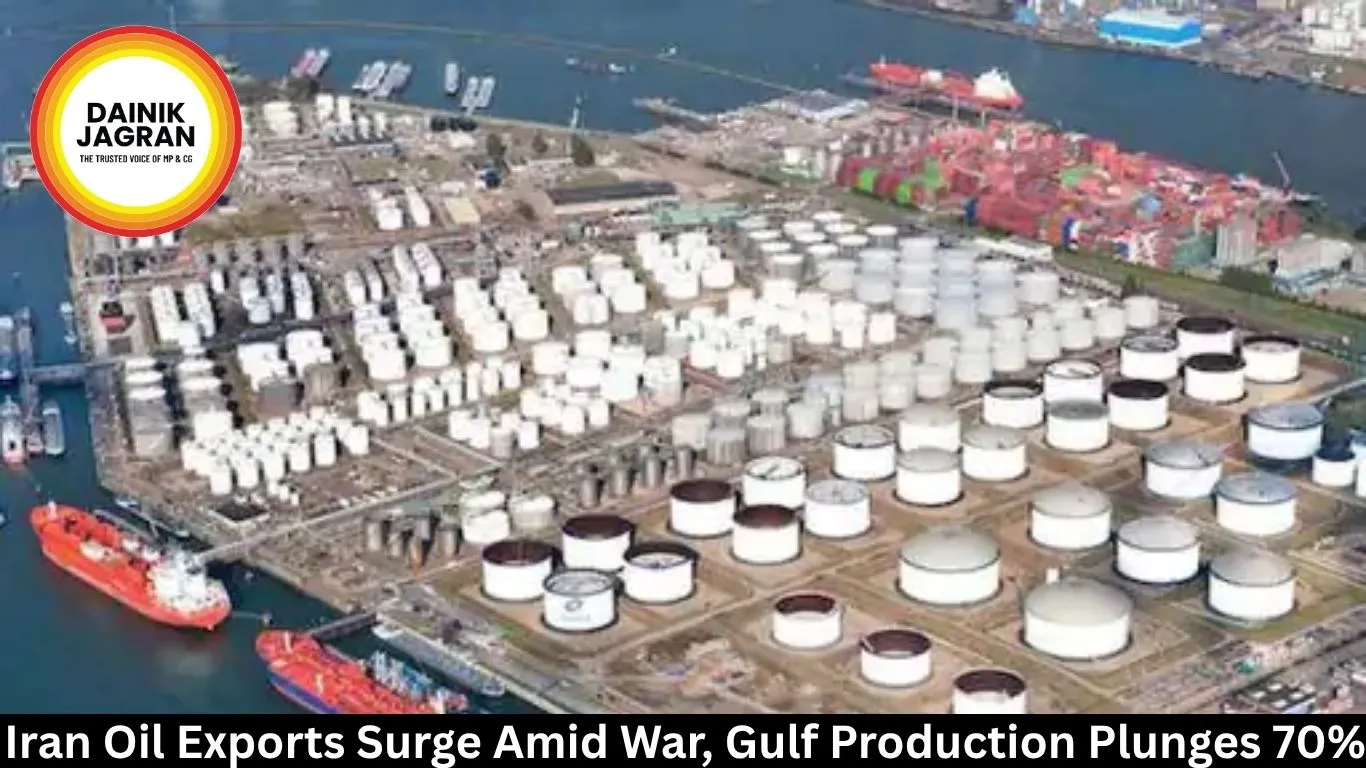
Iran Oil Exports Surge Amid War, Gulf Production Plunges 70%
Digital Desk
Iran continues oil exports from Kharg Terminal despite conflict, with production in Gulf nations like Saudi Arabia and Iraq dropping up to 70%. Get the latest news update.
Iran’s Oil Exports Surge Amid West Asia Conflict
As the military conflict between Iran and US-Israeli forces escalates, Tehran appears to have turned a geopolitical crisis into an economic advantage. Despite ongoing hostilities, the country’s oil exports have not only sustained but seen a strategic surge, capitalising on global supply fears and a calculated avoidance of attacks on its primary export hub.
Kharg Terminal Remains Operational
According to officials and data from the International Energy Agency (IEA) and S&P Global, Iran is currently exporting between 1.7 to 2 million barrels of crude oil daily. A staggering 90% of this volume continues to originate from the Kharg Terminal, the nation’s largest oil export facility. While US forces have targeted military infrastructure near Kharg Island, they have avoided direct strikes on the terminal itself. Sources indicate this restraint stems from fears of triggering a global oil crisis, a loophole Tehran has exploited to maintain steady supply lines to China via its network of ‘ghost fleet’ tankers.
War Tax and Gas Field Impact
While the Kharg Terminal remains largely unaffected, the conflict has taken a toll on other energy infrastructure. Attacks near the South Pars gas field have impacted exports, though supplies have not been completely halted. In a significant development, Iranian authorities are reportedly levying a “war tax” of approximately âš16.5 crore per ship on foreign vessels navigating the Strait of Hormuz, adding a new layer of complexity to regional maritime trade.
Gulf States See Production Collapse
In stark contrast to Iran’s stable output, the conflict has crippled production in key Gulf nations. With Iran controlling the Strait of Hormuz—a vital chokepoint for global energy—supply routes for Saudi Arabia, Iraq, Qatar, Kuwait, and the UAE have been severely compromised. Industry estimates show total production from these nations has plummeted by up to 70%.
Saudi Arabia’s output has reportedly fallen from 10 million barrels per day (bpd) to around 8 million bpd, with storage tanks filling up due to export bottlenecks. In Iraq, production has crashed from 4.3 million bpd to just 1.3 million bpd. International oil majors like BP and TotalEnergies have evacuated staff, and major fields like West Qurna have slowed operations as storage capacity is maxed out. Qatar has declared ‘force majeure’ at its Ras Laffan gas facility, with LNG exports down by 17%, threatening global gas supplies.
US Grants Temporary Sanctions Exemption
The rapid rise in global energy prices has prompted a significant policy shift in Washington. On March 20, the US Treasury announced a 30-day exemption on sanctions specifically for the purchase of Iranian oil already located on tankers at sea. Treasury Minister Scott Bessant stated that the move aims to release approximately 140 million barrels into the market, easing supply pressures.
What Next: Crude Prices and India’s Inflation
The immediate impact of the crisis is already visible in global markets. On Friday, Brent crude surged 3.26% to $112.19 per barrel, its highest level since July 2022. For India, a nation heavily reliant on energy imports, sustained prices above $100 pose a significant risk. Analysts warn that such levels will likely increase domestic inflation, pressure the rupee, and impact broader market stability. The coming weeks will be crucial as the world watches whether the Strait of Hormuz remains partially open or if further escalation leads to a complete blockade.
Iran Oil Exports Surge Amid War, Gulf Production Plunges 70%
Digital Desk
Iran’s Oil Exports Surge Amid West Asia Conflict
As the military conflict between Iran and US-Israeli forces escalates, Tehran appears to have turned a geopolitical crisis into an economic advantage. Despite ongoing hostilities, the country’s oil exports have not only sustained but seen a strategic surge, capitalising on global supply fears and a calculated avoidance of attacks on its primary export hub.
Kharg Terminal Remains Operational
According to officials and data from the International Energy Agency (IEA) and S&P Global, Iran is currently exporting between 1.7 to 2 million barrels of crude oil daily. A staggering 90% of this volume continues to originate from the Kharg Terminal, the nation’s largest oil export facility. While US forces have targeted military infrastructure near Kharg Island, they have avoided direct strikes on the terminal itself. Sources indicate this restraint stems from fears of triggering a global oil crisis, a loophole Tehran has exploited to maintain steady supply lines to China via its network of ‘ghost fleet’ tankers.
War Tax and Gas Field Impact
While the Kharg Terminal remains largely unaffected, the conflict has taken a toll on other energy infrastructure. Attacks near the South Pars gas field have impacted exports, though supplies have not been completely halted. In a significant development, Iranian authorities are reportedly levying a “war tax” of approximately âš16.5 crore per ship on foreign vessels navigating the Strait of Hormuz, adding a new layer of complexity to regional maritime trade.
Gulf States See Production Collapse
In stark contrast to Iran’s stable output, the conflict has crippled production in key Gulf nations. With Iran controlling the Strait of Hormuz—a vital chokepoint for global energy—supply routes for Saudi Arabia, Iraq, Qatar, Kuwait, and the UAE have been severely compromised. Industry estimates show total production from these nations has plummeted by up to 70%.
Saudi Arabia’s output has reportedly fallen from 10 million barrels per day (bpd) to around 8 million bpd, with storage tanks filling up due to export bottlenecks. In Iraq, production has crashed from 4.3 million bpd to just 1.3 million bpd. International oil majors like BP and TotalEnergies have evacuated staff, and major fields like West Qurna have slowed operations as storage capacity is maxed out. Qatar has declared ‘force majeure’ at its Ras Laffan gas facility, with LNG exports down by 17%, threatening global gas supplies.
US Grants Temporary Sanctions Exemption
The rapid rise in global energy prices has prompted a significant policy shift in Washington. On March 20, the US Treasury announced a 30-day exemption on sanctions specifically for the purchase of Iranian oil already located on tankers at sea. Treasury Minister Scott Bessant stated that the move aims to release approximately 140 million barrels into the market, easing supply pressures.
What Next: Crude Prices and India’s Inflation
The immediate impact of the crisis is already visible in global markets. On Friday, Brent crude surged 3.26% to $112.19 per barrel, its highest level since July 2022. For India, a nation heavily reliant on energy imports, sustained prices above $100 pose a significant risk. Analysts warn that such levels will likely increase domestic inflation, pressure the rupee, and impact broader market stability. The coming weeks will be crucial as the world watches whether the Strait of Hormuz remains partially open or if further escalation leads to a complete blockade.