
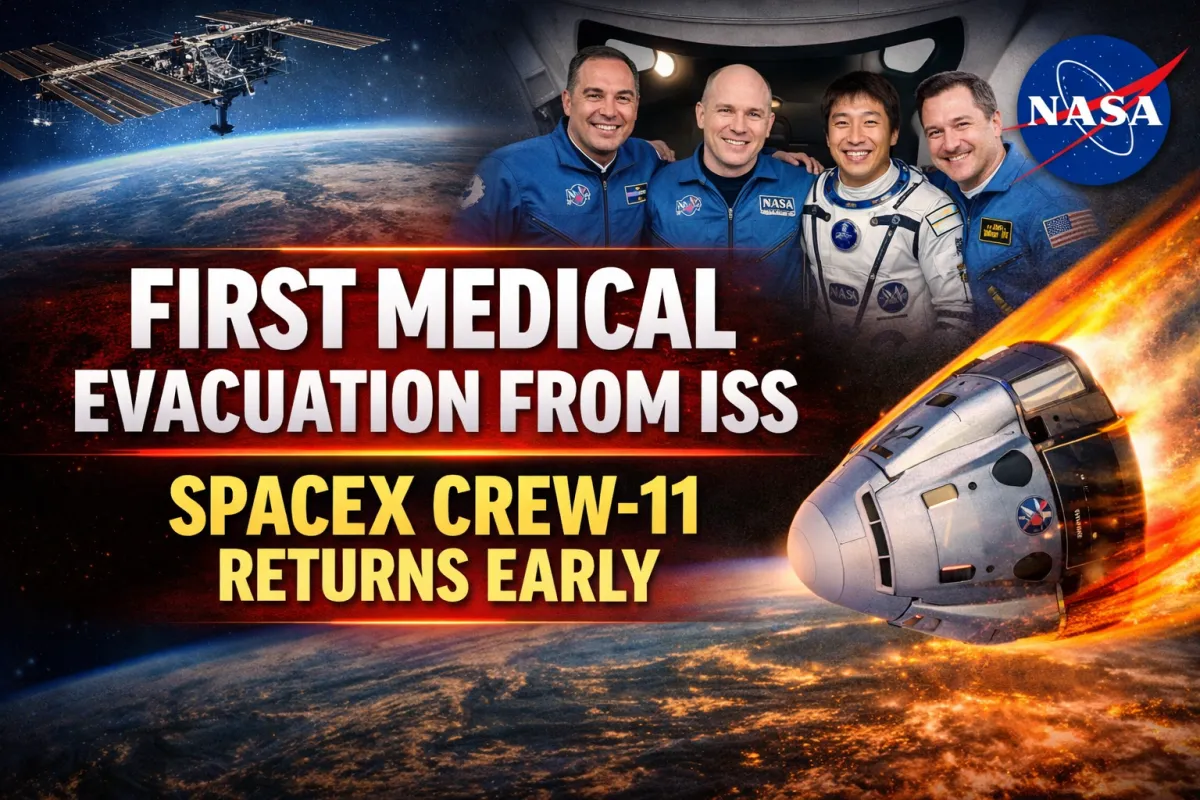

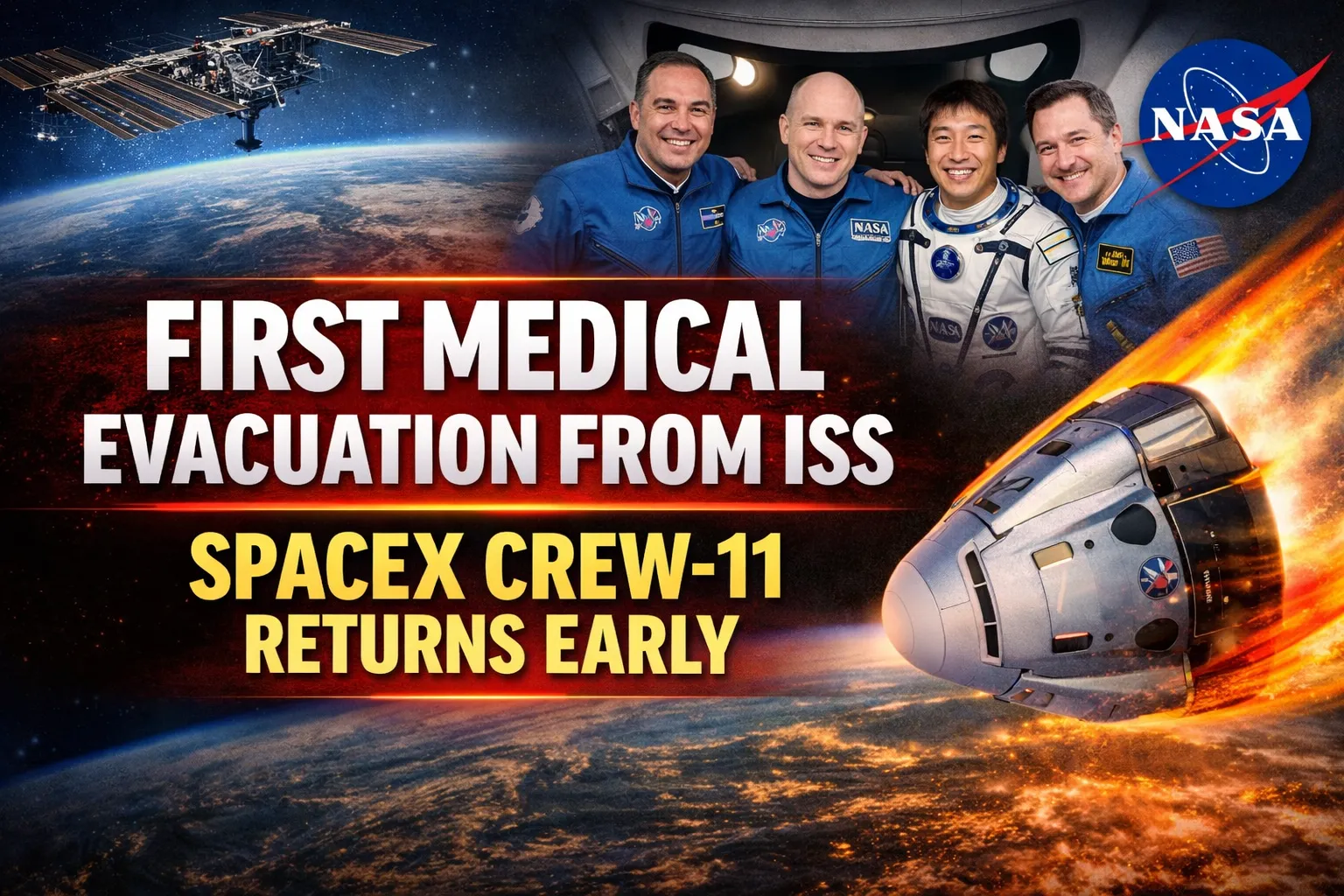
NASA to Carry Out First Medical Evacuation From ISS as SpaceX Crew-11 Returns Early
Digital Desk
NASA confirmed on January 8 that a Crew-11 astronaut developed a medical condition while on the station. The astronaut is reported to be stable, but flight surgeons determined that a return to Earth would allow comprehensive medical evaluation and treatment that is not possible in orbit. The agency has not disclosed details of the condition, citing strict medical privacy protocols.
Crew-11, comprising NASA astronauts Zena Cardman and Mike Fincke, Japan Aerospace Exploration Agency (JAXA) astronaut Kimiya Yui, and Roscosmos cosmonaut Oleg Platonov, arrived at the ISS on August 2 for a planned six-month science mission. NASA has not identified which crew member is affected.
The decision marks the first time astronauts have been brought back early from the ISS for medical reasons. While NASA emphasized that the situation is not an emergency, officials said the move reflects a precautionary approach. “Medical capabilities on the station are limited,” the agency said in a statement, adding that returning the crew member to Earth is the safest course of action.
According to NASA and SpaceX, the Crew Dragon spacecraft will undock after final checks of weather conditions, sea state, spacecraft systems and recovery team readiness. Splashdown timing remains subject to last-minute adjustments, but mission managers expect the capsule to return within hours of undocking.
Crew-11 was conducting a wide range of experiments focused on human health in microgravity, station maintenance, and technology demonstrations supporting future missions to the Moon and Mars. Long-duration ISS missions are critical for understanding how spaceflight affects bone density, muscle mass, cardiovascular health and vision.
Following Crew-11’s departure, three astronauts—NASA’s Chris Williams and Russian cosmonauts Sergey Kud-Sverchkov and Sergei Mikayev—will remain aboard the ISS. NASA described the reduced complement as a “skeleton crew” but said station operations will continue safely. Three-person crews were standard during the ISS’s early years, with mission control providing continuous ground support.
A replacement crew under the Crew-12 mission is expected to arrive by mid-February, restoring normal staffing levels.
Spaceflight experts say the episode underscores a key challenge in human space exploration. While astronauts on the ISS can return to Earth within hours, such options will not exist for future missions to the Moon or Mars. NASA officials said lessons from Crew-11 will inform medical monitoring, risk assessment and emergency planning for deep-space missions.




.jpg)




