


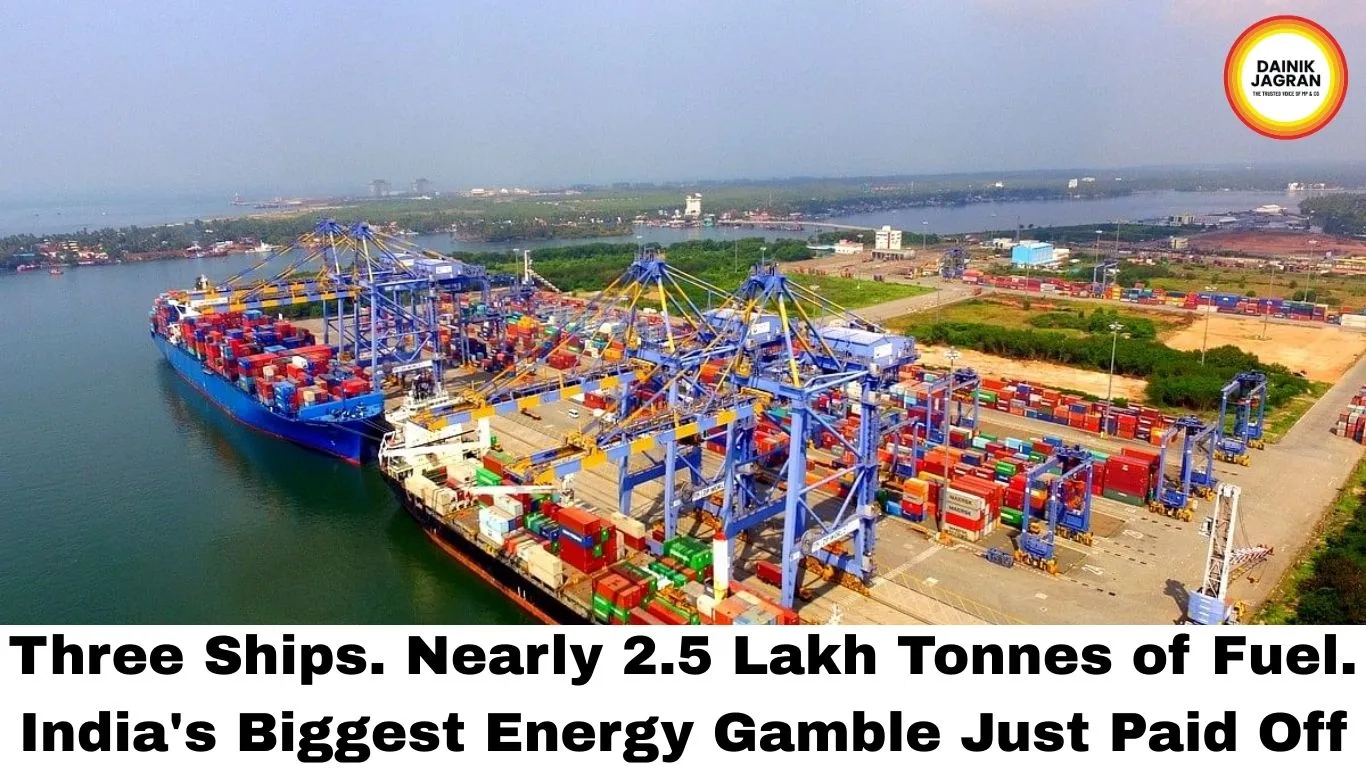
Three Ships. Nearly 2.5 Lakh Tonnes of Fuel. India's Biggest Energy Gamble Just Paid Off
Digital Desk
The Ships That Kept India's Kitchens Alive
For eighteen days, they waited. Anchored in the Persian Gulf, hemmed in by a war they had no part in, twenty-four Indian-flagged vessels carrying energy cargo India desperately needed sat west of the Strait of Hormuz while missiles and drones redrew the rules of maritime passage in the region. Six hundred and eleven Indian sailors — engineers, captains, deckhands — waited with them.
Then, in the span of seventy-two hours between March 16 and 18, three ships moved. And in doing so, they changed the story.
Shivalik docked at Mundra Port in Gujarat on Monday carrying 40,000 metric tonnes of LPG. Nanda Devi arrived at Vadinar Port on Tuesday with 46,500 metric tonnes more. And on Wednesday, Jag Laadki — an oil tanker carrying 80,800 metric tonnes of Murban crude from the UAE — docked at Mundra to complete a trio of arrivals that together represent the most significant single energy delivery India has received since the West Asia conflict began on February 28.
Between the two LPG carriers alone, India received enough gas to fill approximately 68 lakh domestic cooking cylinders — slightly more than the country's average daily consumption. It is a start. It is not enough. But it is proof that the route can work — and that India's diplomacy, for once, delivered something tangible before the crisis became irreversible.
How the Ships Got Through: Diplomacy in Real Time
The passage of Shivalik and Nanda Devi through the Strait of Hormuz did not happen by accident or by luck. It happened because India negotiated it — directly, persistently, and with a level of engagement that has characterised External Affairs Minister S. Jaishankar's approach to the West Asia crisis from day one.
Iran had placed the Strait of Hormuz under effective restrictive control following the US-Israeli strikes on February 28, allowing only a fraction of normal commercial vessel traffic to pass. For India — which imports approximately 88 percent of its crude oil, 50 percent of its natural gas, and 60 percent of its LPG through or from the Gulf region — this was not a distant geopolitical problem. It was a domestic emergency arriving on a very specific timetable.
Jaishankar held multiple rounds of direct talks with Iranian Foreign Minister Abbas Araghchi. Prime Minister Narendra Modi personally called Iranian President Masoud Pezeshkian. Iran's representative of the Supreme Leader in India publicly confirmed that Indian vessels would be permitted safe passage. And when the two LPG carriers finally moved, the Indian Navy provided an escort through the volatile stretch — a quiet, professional piece of hard security to back up the diplomatic assurances with real capability.
The Chief Officer of the Nanda Devi confirmed that the operation was coordinated by the Ministry of Ports, Shipping and Waterways and the Shipping Corporation of India, with both the Indian and Iranian navies providing assistance at the critical junctures of the crossing.
Jaishankar, never one to understate a genuine success, described the approach as direct talks already yielding results — and for once, the results were visible, dockside, in Gujarat.
What Arrived and Where It Goes Next
The logistics of what has arrived this week are worth understanding, because the cargo does not simply stay in Gujarat. It is already moving toward the rest of India.
Shivalik's 40,000 metric tonnes at Mundra has been split: 20,000 MT unloaded at Mundra itself for distribution across western India, with the remaining portion scheduled for Mangalore on the southern coast. Nanda Devi's 46,500 metric tonnes at Vadinar is being transferred to a daughter vessel named BW Birch at a rate of 1,000 tonnes per hour — a two-day process — which will then carry the LPG to Ennore in Tamil Nadu and Haldia in West Bengal, directly feeding two of India's most densely populated coastal states.
Kandla Port Authority Chairman Sushil Kumar Singh confirmed that maximum operational efficiency has been directed by the Ministry of Ports for this unloading process, with priority berthing granted to all LPG-carrying ships to minimise the time between arrival and distribution.
Jag Laadki's 80,800 metric tonnes of Murban crude from the UAE — the first major crude oil delivery since the conflict began — goes directly into the refining pipeline, easing the pressure on refineries that had been running down buffer stocks and provides a vital signal to global oil markets that India's supply lines, however strained, have not been severed.
What Remains: 22 Ships, 611 Sailors, and an Open Question
The arrival of three vessels is good news. It is not the end of the story.
As of Wednesday, 22 Indian-flagged vessels carrying a combined hundreds of thousands of tonnes of energy cargo remain stranded in the Persian Gulf, west of the Strait of Hormuz. Six hundred and eleven Indian seafarers are aboard those ships. The diplomatic arrangement that allowed Shivalik and Nanda Devi through was specific, negotiated, and not yet a general reopening of the strait to commercial traffic.
Iran's Foreign Minister has stated explicitly that the Strait will remain restricted for US and Israeli vessels — while indicating openness to discussions with other nations on safe passage. The crucial distinction is between Iran allowing specific Indian ships through as a diplomatic gesture and Iran reopening the Strait as a general maritime corridor. The first has happened. The second has not.
Global oil prices have crossed 100 dollars per barrel multiple times since the conflict began and remain significantly elevated. India's domestic LPG buffer, while replenished slightly by this week's arrivals, was estimated at just 22 days of national supply before Shivalik and Nanda Devi docked.
And the conflict itself shows no sign of ending quickly. US President Trump has publicly stated the war could last four to five weeks with capability to extend further. Iran has not asked for a ceasefire. The Strait of Hormuz remains the world's most dangerous waterway this week.
A Win That Must Not Be Mistaken for a Solution
India's diplomatic success in securing the passage of three vessels through the Strait of Hormuz deserves genuine acknowledgement. Jaishankar's strategy of direct, reasoned engagement with Tehran — rather than joining Western condemnation or hiding behind strategic ambiguity — produced a real and measurable result. Ships moved. Fuel arrived. Cylinders will be filled.
But a country that imports 88 percent of its crude oil through a single, narrow, conflict-vulnerable maritime corridor does not have an energy security policy. It has an energy security prayer. What this week's crisis has revealed — with clarity that should not be allowed to fade once the next tanker docks — is that India's entire economic stability can be disrupted by a war it did not start, cannot control, and had no vote on.
The long-term answer involves domestic LPG production, strategic reserves sized to absorb a 90-day shock rather than a 22-day one, faster development of alternative import routes through Central Asia and the eastern coast, and a serious national push on renewable energy that reduces liquid fuel dependency year by year.
Three ships docking in Gujarat this week bought India time. What India does with that time — whether it builds the energy independence it needs or simply waits for the next crisis — will define the country's economic trajectory for the next generation.
The Shivalik and Nanda Devi did their part. Now it is the government's turn.
.jpg)




