

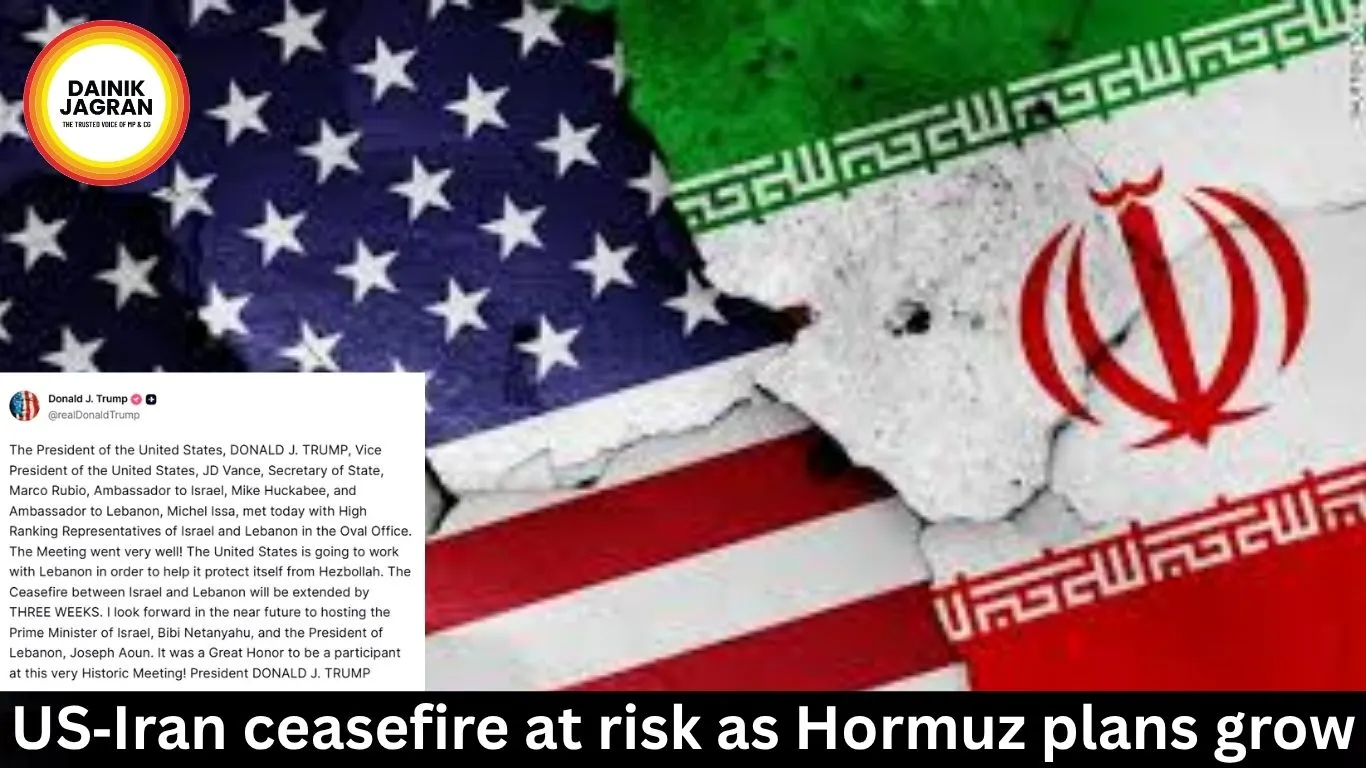
US‑Iran ceasefire at risk as Hormuz plans grow
Digital Desk
US officials are preparing new military options around the Strait of Hormuz if the Iran ceasefire fails, as Trump seeks congressional approval for the war and global markets stay on edge.
US‑Iran ceasefire on edge as Hormuz targeting plans emerge
Washington is preparing new military options focused on Iranian capabilities in the Strait of Hormuz if the fragile ceasefire with Iran collapses, sources indicate.
US eyes new Hormuz plans
Senior US defence officials are developing fresh sets of contingency strike plans targeting Iranian military assets around the Strait of Hormuz, southern Arabian Gulf and Gulf of Oman, three people familiar with the planning told CNN. The options include “dynamic targeting” of small fast attack boats, minelaying vessels and other asymmetric platforms used by Iran’s Islamic Revolutionary Guard Corps (IRGC) to threaten shipping in one of the world’s busiest energy corridors.
The planning is being framed as war‑contingency preparation, not an immediate order to attack, but comes amid growing concern that the current ceasefire between the United States and Iran could falter within days. Officials said working groups are reviewing targeting lists, launch windows and possible escalation thresholds, in coordination with the Pentagon’s Central Command and regional allies.
Clock ticking for Trump
President Donald Trump has seven days to secure formal congressional approval for the US‑Israel war on Iran under the War Powers Resolution, which requires any hostilities to be authorised within 60 days of the first strike. Trump declared the war on 28 February and notified Congress on 2 March, leaving him until 1 May to obtain legislative backing, sources in Washington said.
The law allows just one 30‑day extension beyond that point, but only to facilitate the safe return of US troops, not to perpetuate combat. Several attempts by senators to curtail Trump’s war‑making powers have already failed, with the latest proposal turned down 51‑to‑46 in the Senate, underscoring how deeply the White House’s Middle East strategy remains entrenched for now.
Ceasefire patchwork in the region
The fragile Israel‑Lebanon ceasefire, brokered by Washington, has been extended by three weeks after Trump hosted Lebanese and Israeli envoys at the White House. The extension is meant to give time for a broader deal that could reduce Hezbollah’s forward presence near the border and limit cross‑border fire, but senior Israeli officials have said the pause is “not 100 percent” and that clashes continue at low intensity.
In parallel, Iran has effectively shut the Strait of Hormuz to most commercial traffic, exploiting fast boats and mine‑laying threats to block scores of vessels. The closure has already disrupted global energy flows, pushed benchmark Brent crude above 106 dollars per barrel and sent shipping firms scrambling to reroute or wait out the standoff. European officials estimate that the conflict is shaving 0.2–0.6 percentage points off the EU’s growth, while injecting fresh inflation via higher gas and jet‑fuel prices.
Indian response and stranded vessels
The Ministry of External Affairs has strongly advised Indian citizens against travelling to Iran and urged those already there to exit via designated land‑border routes, citing ongoing regional instability and suspended international flights. The MEA reiterated that India supports the unimpeded passage of merchant ships through the Strait of Hormuz, but acknowledged that 14 Indian vessels remain in the Persian Gulf while 10 have safely exited.
According to officials, all 22 Indian crew members on two Iranian‑seized ships—the Epaminodes and another vessel—are reported safe, with the government in continuous contact with Tehran. Indian shipping companies, meanwhile, have begun diversifying routes and bookings, while global insurers have sharply hiked premiums for voyages near the Strait, further straining trade costs.
Broader regional and economic fallout
The US‑Israel war on Iran has already triggered a cascade of knock‑on effects. The International Energy Agency projects that liquefied natural gas (LNG) markets will stay tight through 2027 due to infrastructure damage and supply‑chain disruptions, with a potential cumulative loss of around 120 billion cubic metres of LNG by 2030.
In Europe, share prices have dipped and the STOXX 600 is on track for a weekly loss as investors weigh the risk of prolonged conflict. Spain has proposed an EU‑wide windfall tax on energy firms to cushion the impact of soaring electricity and gas bills, while EU leaders are preparing a “blueprint” for mutual military assistance under Article 42.7, partly in response to doubts about Washington’s long‑term NATO commitment.
What lies ahead
If the US‑Iran ceasefire holds, Washington may pivot toward a phased easing of naval pressure and limited opening of Hormuz, perhaps in exchange for Iranian concessions on weapons transfers and missile programmes. But if the truce breaks, US military planners are preparing to escalate with precision targeting of Iranian naval assets, IRGC leadership nodes and selected missile stockpiles—moves that could broaden the conflict and further destabilise Gulf trade.
For India, the immediate focus remains on safeguarding citizen safety, clearing stranded ships and minimising economic spillovers, while quietly pushing for an early diplomatic resolution in West Asia. With the war clock ticking toward the 1 May deadline and markets watching every headline, the coming days are likely to determine whether the region edges toward disengagement—or slides deeper into a protracted confrontation.
--------
🚨 Beat the News Rush – Join Now!
Get breaking alerts, hot exclusives, and game-changing stories instantly on your phone. No delays, no fluff – just the edge you need. ⚡
Tap to join:
🟢 WhatsApp Channel: Dainik Jagran MP CG
Crave more?
🅕 Facebook: Dainik Jagran MP CG English
🅧 Twitter (X): Dainik Jagran MP CG
🅘 Instagram: Dainik Jagran MP CG
Share the fire – keep your crew ahead! 🗞️🔥
US‑Iran ceasefire at risk as Hormuz plans grow
Digital Desk
US‑Iran ceasefire on edge as Hormuz targeting plans emerge
Washington is preparing new military options focused on Iranian capabilities in the Strait of Hormuz if the fragile ceasefire with Iran collapses, sources indicate.
US eyes new Hormuz plans
Senior US defence officials are developing fresh sets of contingency strike plans targeting Iranian military assets around the Strait of Hormuz, southern Arabian Gulf and Gulf of Oman, three people familiar with the planning told CNN. The options include “dynamic targeting” of small fast attack boats, minelaying vessels and other asymmetric platforms used by Iran’s Islamic Revolutionary Guard Corps (IRGC) to threaten shipping in one of the world’s busiest energy corridors.
The planning is being framed as war‑contingency preparation, not an immediate order to attack, but comes amid growing concern that the current ceasefire between the United States and Iran could falter within days. Officials said working groups are reviewing targeting lists, launch windows and possible escalation thresholds, in coordination with the Pentagon’s Central Command and regional allies.
Clock ticking for Trump
President Donald Trump has seven days to secure formal congressional approval for the US‑Israel war on Iran under the War Powers Resolution, which requires any hostilities to be authorised within 60 days of the first strike. Trump declared the war on 28 February and notified Congress on 2 March, leaving him until 1 May to obtain legislative backing, sources in Washington said.
The law allows just one 30‑day extension beyond that point, but only to facilitate the safe return of US troops, not to perpetuate combat. Several attempts by senators to curtail Trump’s war‑making powers have already failed, with the latest proposal turned down 51‑to‑46 in the Senate, underscoring how deeply the White House’s Middle East strategy remains entrenched for now.
Ceasefire patchwork in the region
The fragile Israel‑Lebanon ceasefire, brokered by Washington, has been extended by three weeks after Trump hosted Lebanese and Israeli envoys at the White House. The extension is meant to give time for a broader deal that could reduce Hezbollah’s forward presence near the border and limit cross‑border fire, but senior Israeli officials have said the pause is “not 100 percent” and that clashes continue at low intensity.
In parallel, Iran has effectively shut the Strait of Hormuz to most commercial traffic, exploiting fast boats and mine‑laying threats to block scores of vessels. The closure has already disrupted global energy flows, pushed benchmark Brent crude above 106 dollars per barrel and sent shipping firms scrambling to reroute or wait out the standoff. European officials estimate that the conflict is shaving 0.2–0.6 percentage points off the EU’s growth, while injecting fresh inflation via higher gas and jet‑fuel prices.
Indian response and stranded vessels
The Ministry of External Affairs has strongly advised Indian citizens against travelling to Iran and urged those already there to exit via designated land‑border routes, citing ongoing regional instability and suspended international flights. The MEA reiterated that India supports the unimpeded passage of merchant ships through the Strait of Hormuz, but acknowledged that 14 Indian vessels remain in the Persian Gulf while 10 have safely exited.
According to officials, all 22 Indian crew members on two Iranian‑seized ships—the Epaminodes and another vessel—are reported safe, with the government in continuous contact with Tehran. Indian shipping companies, meanwhile, have begun diversifying routes and bookings, while global insurers have sharply hiked premiums for voyages near the Strait, further straining trade costs.
Broader regional and economic fallout
The US‑Israel war on Iran has already triggered a cascade of knock‑on effects. The International Energy Agency projects that liquefied natural gas (LNG) markets will stay tight through 2027 due to infrastructure damage and supply‑chain disruptions, with a potential cumulative loss of around 120 billion cubic metres of LNG by 2030.
In Europe, share prices have dipped and the STOXX 600 is on track for a weekly loss as investors weigh the risk of prolonged conflict. Spain has proposed an EU‑wide windfall tax on energy firms to cushion the impact of soaring electricity and gas bills, while EU leaders are preparing a “blueprint” for mutual military assistance under Article 42.7, partly in response to doubts about Washington’s long‑term NATO commitment.
What lies ahead
If the US‑Iran ceasefire holds, Washington may pivot toward a phased easing of naval pressure and limited opening of Hormuz, perhaps in exchange for Iranian concessions on weapons transfers and missile programmes. But if the truce breaks, US military planners are preparing to escalate with precision targeting of Iranian naval assets, IRGC leadership nodes and selected missile stockpiles—moves that could broaden the conflict and further destabilise Gulf trade.
For India, the immediate focus remains on safeguarding citizen safety, clearing stranded ships and minimising economic spillovers, while quietly pushing for an early diplomatic resolution in West Asia. With the war clock ticking toward the 1 May deadline and markets watching every headline, the coming days are likely to determine whether the region edges toward disengagement—or slides deeper into a protracted confrontation.


