Vietnam Airlines Boeing 787 Tail Strike, Four Tyres Burst During Munich Take-Off
Digital desk
A Vietnam Airlines Boeing 787-9 suffered a tail strike and four burst tyres during take-off from Munich after its speed dropped twice. All 287 people aboard were safe.
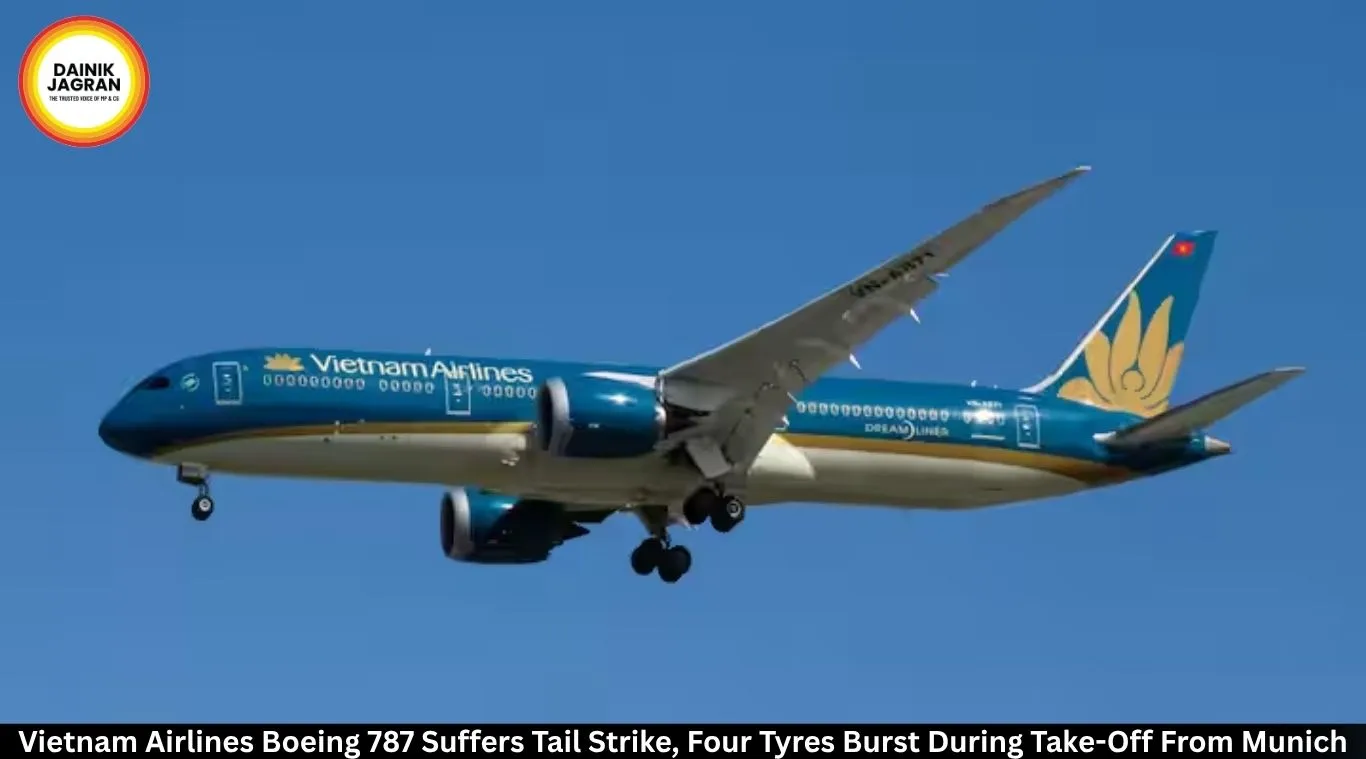
A Vietnam Airlines Boeing 787-9 suffered substantial damage during take-off from Munich Airport on August 15 after its speed dropped twice during the take-off roll, forcing the pilots to continue the departure despite limited runway remaining. The aircraft later returned safely to Munich after dumping fuel, with all 271 passengers and 16 crew members reported safe.
The incident involved Vietnam Airlines flight VN34, which was operating from Munich to Hanoi. The aircraft, registered as VN-A867, took off at around 1:45 pm local time but encountered technical problems shortly after becoming airborne.
Speed Drops During Take-Off
A preliminary report from Vietnam's Civil Aviation Authority (CAAV), cited by Vietnamese media, has provided details of the incident.
According to the report, the aircraft's speed stopped increasing for around two seconds when it was approximately halfway along runway 26L. The aircraft then accelerated again and reached V1, the speed at which pilots must decide whether to continue or reject a take-off.
The aircraft's speed subsequently dropped for a second time. By then, the pilots determined that there was insufficient runway remaining to safely abort the take-off.
Boeing 787 Takes Off Near Runway End
With the aircraft already committed to the departure, the crew increased engine thrust to maximum. The report said the aircraft had only about 91 metres of runway remaining when the pilot raised the nose and the Boeing 787 became airborne.
Videos circulating online appeared to show the aircraft continuing along the runway for an unusually long distance before lifting off, with dust visible behind the aircraft.
The incident has prompted investigators to examine the cause of the two speed reductions and the aircraft's take-off performance.
Tail Strike Warning Triggered
Shortly after becoming airborne, the aircraft generated warnings indicating a possible tail strike and low tyre pressure.
The crew informed air traffic control and decided to return to Munich Airport. The aircraft climbed to approximately 9,000 feet before beginning to dump fuel to reduce its weight and prepare for landing.
The plane then remained in the vicinity of Munich for more than an hour. It also made low-altitude circuits that allowed air traffic controllers to visually assess its landing gear before the aircraft returned to the airport.
Passengers Brace for Landing
Passengers quoted in local media described a tense situation inside the cabin after the captain informed them that the aircraft had developed a technical problem.
Cabin crew later instructed passengers to adopt the brace position as the aircraft prepared to land.
The Boeing 787-9 eventually landed safely on runway 26R at around 3:57 pm local time, roughly two hours after departing Munich.
Four Main Gear Tyres Burst
A preliminary inspection found that four of the aircraft's eight main landing-gear tyres had burst during the incident. Three damaged tyres were located on the left side, while one was on the right.
Investigators also discovered scrape marks on the underside of the rear fuselage and damage to the aircraft's outer skin, indicating that the tail had struck the runway during take-off.
Despite the extent of the damage, there were no reports of injuries or fire among passengers or crew.
The aircraft was unable to taxi away from the runway under its own power, temporarily affecting airport operations. It remains grounded at Munich Airport while further technical inspections are carried out.
Germany Leads Investigation
Germany's Federal Bureau of Aircraft Accident Investigation (BFU) is leading the investigation into the incident.
Investigators have recovered the aircraft's flight data recorder and cockpit voice recorder. Both have been taken to the BFU headquarters in Braunschweig for examination.
Authorities are expected to investigate why the aircraft's speed dropped twice during the take-off roll and whether the issue was related to the aircraft's engines, systems, runway conditions or other operational factors.
Vietnam's CAAV is assisting German investigators. Vietnam Airlines is also cooperating with the investigation along with Boeing and the aircraft's engine manufacturer.
The investigation is expected to establish the precise sequence of events and determine what caused the aircraft to lose speed during the critical stages of its departure.
Vietnam Airlines Boeing 787 Tail Strike, Four Tyres Burst During Munich Take-Off
Digital desk
A Vietnam Airlines Boeing 787-9 suffered substantial damage during take-off from Munich Airport on August 15 after its speed dropped twice during the take-off roll, forcing the pilots to continue the departure despite limited runway remaining. The aircraft later returned safely to Munich after dumping fuel, with all 271 passengers and 16 crew members reported safe.
The incident involved Vietnam Airlines flight VN34, which was operating from Munich to Hanoi. The aircraft, registered as VN-A867, took off at around 1:45 pm local time but encountered technical problems shortly after becoming airborne.
Speed Drops During Take-Off
A preliminary report from Vietnam's Civil Aviation Authority (CAAV), cited by Vietnamese media, has provided details of the incident.
According to the report, the aircraft's speed stopped increasing for around two seconds when it was approximately halfway along runway 26L. The aircraft then accelerated again and reached V1, the speed at which pilots must decide whether to continue or reject a take-off.
The aircraft's speed subsequently dropped for a second time. By then, the pilots determined that there was insufficient runway remaining to safely abort the take-off.
Boeing 787 Takes Off Near Runway End
With the aircraft already committed to the departure, the crew increased engine thrust to maximum. The report said the aircraft had only about 91 metres of runway remaining when the pilot raised the nose and the Boeing 787 became airborne.
Videos circulating online appeared to show the aircraft continuing along the runway for an unusually long distance before lifting off, with dust visible behind the aircraft.
The incident has prompted investigators to examine the cause of the two speed reductions and the aircraft's take-off performance.
Tail Strike Warning Triggered
Shortly after becoming airborne, the aircraft generated warnings indicating a possible tail strike and low tyre pressure.
The crew informed air traffic control and decided to return to Munich Airport. The aircraft climbed to approximately 9,000 feet before beginning to dump fuel to reduce its weight and prepare for landing.
The plane then remained in the vicinity of Munich for more than an hour. It also made low-altitude circuits that allowed air traffic controllers to visually assess its landing gear before the aircraft returned to the airport.
Passengers Brace for Landing
Passengers quoted in local media described a tense situation inside the cabin after the captain informed them that the aircraft had developed a technical problem.
Cabin crew later instructed passengers to adopt the brace position as the aircraft prepared to land.
The Boeing 787-9 eventually landed safely on runway 26R at around 3:57 pm local time, roughly two hours after departing Munich.
Four Main Gear Tyres Burst
A preliminary inspection found that four of the aircraft's eight main landing-gear tyres had burst during the incident. Three damaged tyres were located on the left side, while one was on the right.
Investigators also discovered scrape marks on the underside of the rear fuselage and damage to the aircraft's outer skin, indicating that the tail had struck the runway during take-off.
Despite the extent of the damage, there were no reports of injuries or fire among passengers or crew.
The aircraft was unable to taxi away from the runway under its own power, temporarily affecting airport operations. It remains grounded at Munich Airport while further technical inspections are carried out.
Germany Leads Investigation
Germany's Federal Bureau of Aircraft Accident Investigation (BFU) is leading the investigation into the incident.
Investigators have recovered the aircraft's flight data recorder and cockpit voice recorder. Both have been taken to the BFU headquarters in Braunschweig for examination.
Authorities are expected to investigate why the aircraft's speed dropped twice during the take-off roll and whether the issue was related to the aircraft's engines, systems, runway conditions or other operational factors.
Vietnam's CAAV is assisting German investigators. Vietnam Airlines is also cooperating with the investigation along with Boeing and the aircraft's engine manufacturer.
The investigation is expected to establish the precise sequence of events and determine what caused the aircraft to lose speed during the critical stages of its departure.

Recommended For You
--------
🚨 Beat the News Rush – Join Now!
Get breaking alerts, hot exclusives, and game-changing stories instantly on your phone. No delays, no fluff – just the edge you need. ⚡
Tap to join:
🟢 WhatsApp Channel: Dainik Jagran MP CG
Crave more?
🅕 Facebook: Dainik Jagran MP CG English
🅧 Twitter (X): Dainik Jagran MP CG
🅘 Instagram: Dainik Jagran MP CG
Share the fire – keep your crew ahead! 🗞️🔥