The five-day visit, held from May 30 to June 3 at the invitation of Prime Minister Narendra Modi, began with a pilgrimage to the Mahabodhi Temple in Bodh Gaya, highlighting the centuries-old Buddhist links between India and Myanmar. However, the core discussions centered on enhancing regional connectivity and addressing shared security concerns along their 1,643-kilometer border.
Connectivity at the Core of Act East Policy
Myanmar remains a crucial link in India’s Act East Policy, serving as the gateway between India’s Northeast and Southeast Asia. Two major infrastructure projects dominated bilateral discussions.
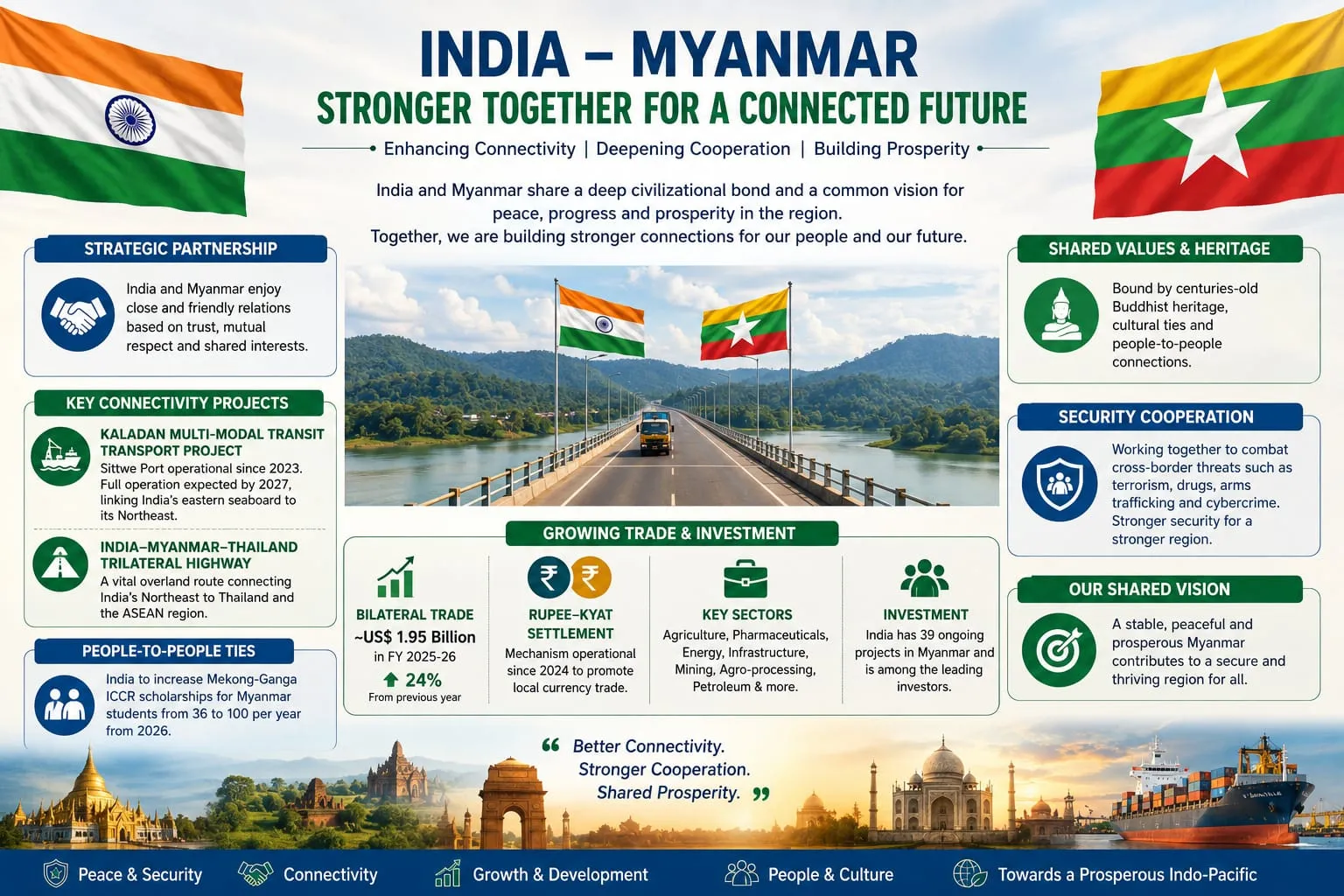
The Kaladan Multi-Modal Transit Transport Project, whose Sittwe Port has been operational since 2023, is expected to become fully functional by 2027. The project will provide an alternative route connecting India’s eastern coast with its Northeastern states through Myanmar, reducing dependence on the narrow Siliguri Corridor.
The second major initiative, the India-Myanmar-Thailand Trilateral Highway, aims to establish a seamless road network connecting India with Thailand and the broader ASEAN region. While progress has been affected by challenging terrain and security concerns, both sides pledged to accelerate implementation.
President Droupadi Murmu described Myanmar as India’s “gateway to Southeast Asia,” underscoring the strategic significance of these projects.
Security Cooperation Takes Centre Stage
Security emerged as a key pillar of the discussions. President Min Aung Hlaing assured Indian leaders that Myanmar’s territory would not be used for activities detrimental to India’s interests.
The assurance is particularly significant given the history of insurgent groups from India’s Northeast operating from camps in Myanmar’s border regions. Continued unrest in parts of Myanmar has also contributed to refugee inflows into Indian states such as Mizoram and Manipur, complicating border management.
Both nations agreed to strengthen cooperation against cross-border threats, including narcotics trafficking, arms smuggling, militant movements, and cybercrime networks. National Security Adviser Ajit Doval held separate discussions with the visiting delegation, resulting in commitments to deepen intelligence sharing and operational coordination.
Expanding Trade and Investment
Economic cooperation also featured prominently during the visit. Bilateral trade reached approximately US$1.95 billion in FY 2025-26, reflecting nearly 24 percent growth compared to the previous year and making India Myanmar’s fourth-largest trading partner.
Addressing the India-Myanmar Business Conclave, President Min Aung Hlaing invited Indian businesses to invest in agriculture, pharmaceuticals, energy, infrastructure, and technology sectors.
Both countries agreed to promote greater use of the Rupee-Kyat settlement mechanism, introduced in 2024, to facilitate trade without relying on the US dollar. Discussions also focused on critical minerals and rare earth resources, areas of increasing strategic importance for India.
India currently operates 39 investment projects in Myanmar and ranks among its leading foreign investors. Additionally, New Delhi announced an increase in Mekong-Ganga ICCR scholarships for Myanmar students from 36 to 100 annually beginning in 2026.
Cultural Bonds and Future Prospects
The visit also highlighted the deep cultural and civilizational links between the two countries. India has supported the restoration of several important Buddhist heritage sites in Myanmar, including the historic Ananda Temple in Bagan.
President Min Aung Hlaing’s visit to Bodh Gaya symbolized the enduring spiritual connection between the two nations while complementing the broader strategic partnership.
Analysts view the visit as a significant diplomatic milestone that strengthens India’s influence in Myanmar amid evolving regional dynamics. Enhanced connectivity, stronger security cooperation, and growing economic engagement are expected to support India’s broader Neighbourhood First and Act East policies while contributing to regional stability and prosperity.
Although challenges remain in implementing several ambitious projects, the visit has injected fresh momentum into bilateral relations. Prime Minister Narendra Modi has also been invited to undertake a reciprocal visit to Myanmar, though no dates have yet been announced.

Myanmar President’s India Visit Strengthens Strategic Partnership and Connectivity Agenda
New Delhi
The five-day visit, held from May 30 to June 3 at the invitation of Prime Minister Narendra Modi, began with a pilgrimage to the Mahabodhi Temple in Bodh Gaya, highlighting the centuries-old Buddhist links between India and Myanmar. However, the core discussions centered on enhancing regional connectivity and addressing shared security concerns along their 1,643-kilometer border.
Connectivity at the Core of Act East Policy
Myanmar remains a crucial link in India’s Act East Policy, serving as the gateway between India’s Northeast and Southeast Asia. Two major infrastructure projects dominated bilateral discussions.
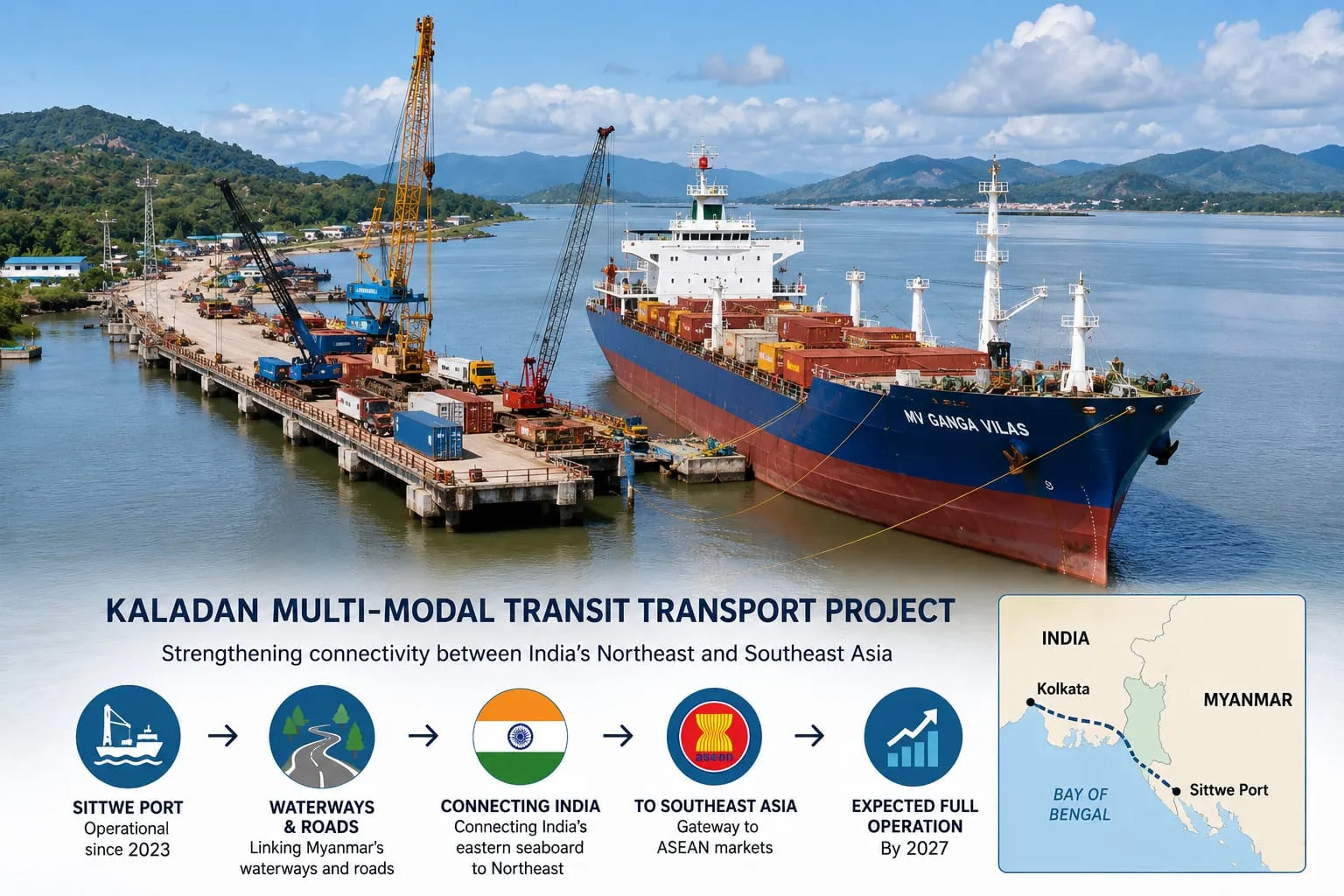
The Kaladan Multi-Modal Transit Transport Project, whose Sittwe Port has been operational since 2023, is expected to become fully functional by 2027. The project will provide an alternative route connecting India’s eastern coast with its Northeastern states through Myanmar, reducing dependence on the narrow Siliguri Corridor.
The second major initiative, the India-Myanmar-Thailand Trilateral Highway, aims to establish a seamless road network connecting India with Thailand and the broader ASEAN region. While progress has been affected by challenging terrain and security concerns, both sides pledged to accelerate implementation.
President Droupadi Murmu described Myanmar as India’s “gateway to Southeast Asia,” underscoring the strategic significance of these projects.
Security Cooperation Takes Centre Stage
Security emerged as a key pillar of the discussions. President Min Aung Hlaing assured Indian leaders that Myanmar’s territory would not be used for activities detrimental to India’s interests.
The assurance is particularly significant given the history of insurgent groups from India’s Northeast operating from camps in Myanmar’s border regions. Continued unrest in parts of Myanmar has also contributed to refugee inflows into Indian states such as Mizoram and Manipur, complicating border management.
Both nations agreed to strengthen cooperation against cross-border threats, including narcotics trafficking, arms smuggling, militant movements, and cybercrime networks. National Security Adviser Ajit Doval held separate discussions with the visiting delegation, resulting in commitments to deepen intelligence sharing and operational coordination.
Expanding Trade and Investment
Economic cooperation also featured prominently during the visit. Bilateral trade reached approximately US$1.95 billion in FY 2025-26, reflecting nearly 24 percent growth compared to the previous year and making India Myanmar’s fourth-largest trading partner.
Addressing the India-Myanmar Business Conclave, President Min Aung Hlaing invited Indian businesses to invest in agriculture, pharmaceuticals, energy, infrastructure, and technology sectors.
Both countries agreed to promote greater use of the Rupee-Kyat settlement mechanism, introduced in 2024, to facilitate trade without relying on the US dollar. Discussions also focused on critical minerals and rare earth resources, areas of increasing strategic importance for India.
India currently operates 39 investment projects in Myanmar and ranks among its leading foreign investors. Additionally, New Delhi announced an increase in Mekong-Ganga ICCR scholarships for Myanmar students from 36 to 100 annually beginning in 2026.
Cultural Bonds and Future Prospects
The visit also highlighted the deep cultural and civilizational links between the two countries. India has supported the restoration of several important Buddhist heritage sites in Myanmar, including the historic Ananda Temple in Bagan.
President Min Aung Hlaing’s visit to Bodh Gaya symbolized the enduring spiritual connection between the two nations while complementing the broader strategic partnership.
Analysts view the visit as a significant diplomatic milestone that strengthens India’s influence in Myanmar amid evolving regional dynamics. Enhanced connectivity, stronger security cooperation, and growing economic engagement are expected to support India’s broader Neighbourhood First and Act East policies while contributing to regional stability and prosperity.
Although challenges remain in implementing several ambitious projects, the visit has injected fresh momentum into bilateral relations. Prime Minister Narendra Modi has also been invited to undertake a reciprocal visit to Myanmar, though no dates have yet been announced.