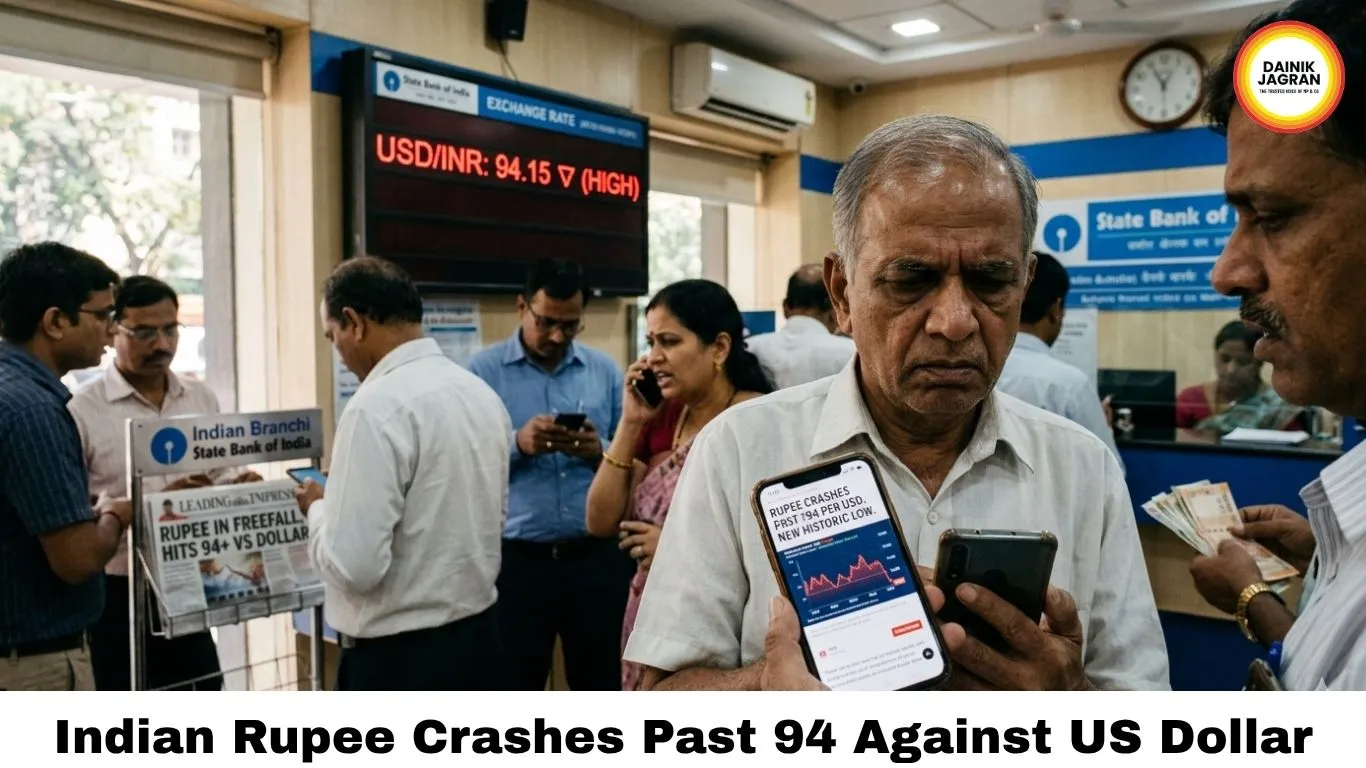
Indian Rupee Crashes Past 94 Against US Dollar: Will the Free Fall Worsen Amid Middle East Crisis?
Digital Desk
The Indian rupee hits a record low past 94/USD, marking its worst fiscal year drop in over a decade. We analyze the energy crisis, RBI tactics, and what this means for your money.
Rupee Crashes Past 94 Per Dollar: Is This Just the Beginning?
If you are planning a foreign trip or have a child studying abroad, the numbers flashing on the screen this morning are enough to cause a heart attack. The Indian rupee has plunged to a record low, breaching the psychological barrier of 94 against the US dollar.
As of March 27, the domestic currency hit a staggering 94.7875 per dollar, erasing any hopes of a near-term recovery. For the average Indian, this isn’t just a number on a financial ticker; it’s the rising cost of petrol, cooking gas, and even your morning cereal.
With the fiscal year coming to a close, the rupee is staring down its worst annual performance in over a decade and a half. As a digital journalist covering the markets, I can tell you that the calm we are seeing from the central bank might actually be the most worrying sign of all.
Why the Rupee is Falling: The Energy Nightmare
To understand this free fall, you have to look at the map—specifically the Middle East.
The ongoing war in the region is causing the most severe energy supply disruption in decades. India, which imports nearly 85% of its oil needs, is caught in the crossfire. As oil prices surge, the demand for dollars to pay for that oil skyrockets.
The impact is immediate:
-
Trade Deficit: We are paying more for the same amount of oil, widening the gap between imports and exports.
-
Inflation: Energy costs spill over into everything—from plastics to transportation—hitting household budgets.
-
Investor Confidence: Global investors are pulling money out of emerging markets like India to seek safety in the US dollar.
Since the war began last month alone, the rupee has lost nearly 4% of its value. Compared to last year, the loss is a painful 10%.
The RBI’s New Strategy: Letting Go?
Historically, when the rupee falls, the Reserve Bank of India (RBI) steps in aggressively to defend it, selling dollars from its massive war chest to stabilize the currency. But this time, something feels different.
Traders on the ground in Mumbai report that state-run banks—often the RBI’s proxies—were present in the market offering dollars, but their intervention was described as "quite mild."
This has led to a shift in market chatter. The RBI appears to have changed its priority. With the economy facing a potential slowdown, the central bank might be prioritizing the bond market.
According to analysts, the RBI’s focus seems to be shifting towards capping the 10-year government bond yield below 7% rather than protecting a specific rupee level. In simple English: they are letting the currency fall to save the cost of borrowing for the government and corporations.
What Happens Next? Brace for 98?
The worst may not be over. Global brokerage firm Bernstein has warned that there is a "realistic chance" the rupee could breach the 98 per dollar level this year if the conflict drags on.
Societe Generale is even more direct. The firm is recommending traders "short the rupee"—meaning they are betting it will fall further—with a target of 96 in the near term.
For the common man, this means:
-
Higher Inflation: Expect fuel and edible oil prices to remain elevated.
-
Expensive EMIs: While the RBI hasn’t hiked rates yet, the pressure to control inflation might force their hand soon.
-
Stock Market Jitters: The Nifty 50 fell 1.7% today. A weak rupee typically scares foreign institutional investors (FIIs).
The Bottom Line
We are living through a perfect storm. The Indian rupee is caught between a geopolitical crisis overseas and a delicate balancing act at home.
While a weaker rupee helps exporters (like IT and textiles), it is a hammer blow to importers and the average consumer. For now, analysts are advising caution. Unless there is a sudden de-escalation in the Middle East or a massive intervention by the RBI, the rupee hitting new lows might become the new normal for the next fiscal year.
--------
🚨 Beat the News Rush – Join Now!
Get breaking alerts, hot exclusives, and game-changing stories instantly on your phone. No delays, no fluff – just the edge you need. ⚡
Tap to join:
🟢 WhatsApp Channel: https://whatsapp.com/channel/0029VbAeWYG72WTxso1CFr2g
Crave more?
🅕 Facebook: English Dainik Jagran MP CG
🅧 Twitter (X): Jagran MP CG
🅘 Instagram: Dainik Jagran MP CG
Share the fire – keep your crew ahead! 🗞️🔥
Indian Rupee Crashes Past 94 Against US Dollar: Will the Free Fall Worsen Amid Middle East Crisis?
Digital Desk
Rupee Crashes Past 94 Per Dollar: Is This Just the Beginning?
If you are planning a foreign trip or have a child studying abroad, the numbers flashing on the screen this morning are enough to cause a heart attack. The Indian rupee has plunged to a record low, breaching the psychological barrier of 94 against the US dollar.
As of March 27, the domestic currency hit a staggering 94.7875 per dollar, erasing any hopes of a near-term recovery. For the average Indian, this isn’t just a number on a financial ticker; it’s the rising cost of petrol, cooking gas, and even your morning cereal.
With the fiscal year coming to a close, the rupee is staring down its worst annual performance in over a decade and a half. As a digital journalist covering the markets, I can tell you that the calm we are seeing from the central bank might actually be the most worrying sign of all.
Why the Rupee is Falling: The Energy Nightmare
To understand this free fall, you have to look at the map—specifically the Middle East.
The ongoing war in the region is causing the most severe energy supply disruption in decades. India, which imports nearly 85% of its oil needs, is caught in the crossfire. As oil prices surge, the demand for dollars to pay for that oil skyrockets.
The impact is immediate:
-
Trade Deficit: We are paying more for the same amount of oil, widening the gap between imports and exports.
-
Inflation: Energy costs spill over into everything—from plastics to transportation—hitting household budgets.
-
Investor Confidence: Global investors are pulling money out of emerging markets like India to seek safety in the US dollar.
Since the war began last month alone, the rupee has lost nearly 4% of its value. Compared to last year, the loss is a painful 10%.
The RBI’s New Strategy: Letting Go?
Historically, when the rupee falls, the Reserve Bank of India (RBI) steps in aggressively to defend it, selling dollars from its massive war chest to stabilize the currency. But this time, something feels different.
Traders on the ground in Mumbai report that state-run banks—often the RBI’s proxies—were present in the market offering dollars, but their intervention was described as "quite mild."
This has led to a shift in market chatter. The RBI appears to have changed its priority. With the economy facing a potential slowdown, the central bank might be prioritizing the bond market.
According to analysts, the RBI’s focus seems to be shifting towards capping the 10-year government bond yield below 7% rather than protecting a specific rupee level. In simple English: they are letting the currency fall to save the cost of borrowing for the government and corporations.
What Happens Next? Brace for 98?
The worst may not be over. Global brokerage firm Bernstein has warned that there is a "realistic chance" the rupee could breach the 98 per dollar level this year if the conflict drags on.
Societe Generale is even more direct. The firm is recommending traders "short the rupee"—meaning they are betting it will fall further—with a target of 96 in the near term.
For the common man, this means:
-
Higher Inflation: Expect fuel and edible oil prices to remain elevated.
-
Expensive EMIs: While the RBI hasn’t hiked rates yet, the pressure to control inflation might force their hand soon.
-
Stock Market Jitters: The Nifty 50 fell 1.7% today. A weak rupee typically scares foreign institutional investors (FIIs).
The Bottom Line
We are living through a perfect storm. The Indian rupee is caught between a geopolitical crisis overseas and a delicate balancing act at home.
While a weaker rupee helps exporters (like IT and textiles), it is a hammer blow to importers and the average consumer. For now, analysts are advising caution. Unless there is a sudden de-escalation in the Middle East or a massive intervention by the RBI, the rupee hitting new lows might become the new normal for the next fiscal year.