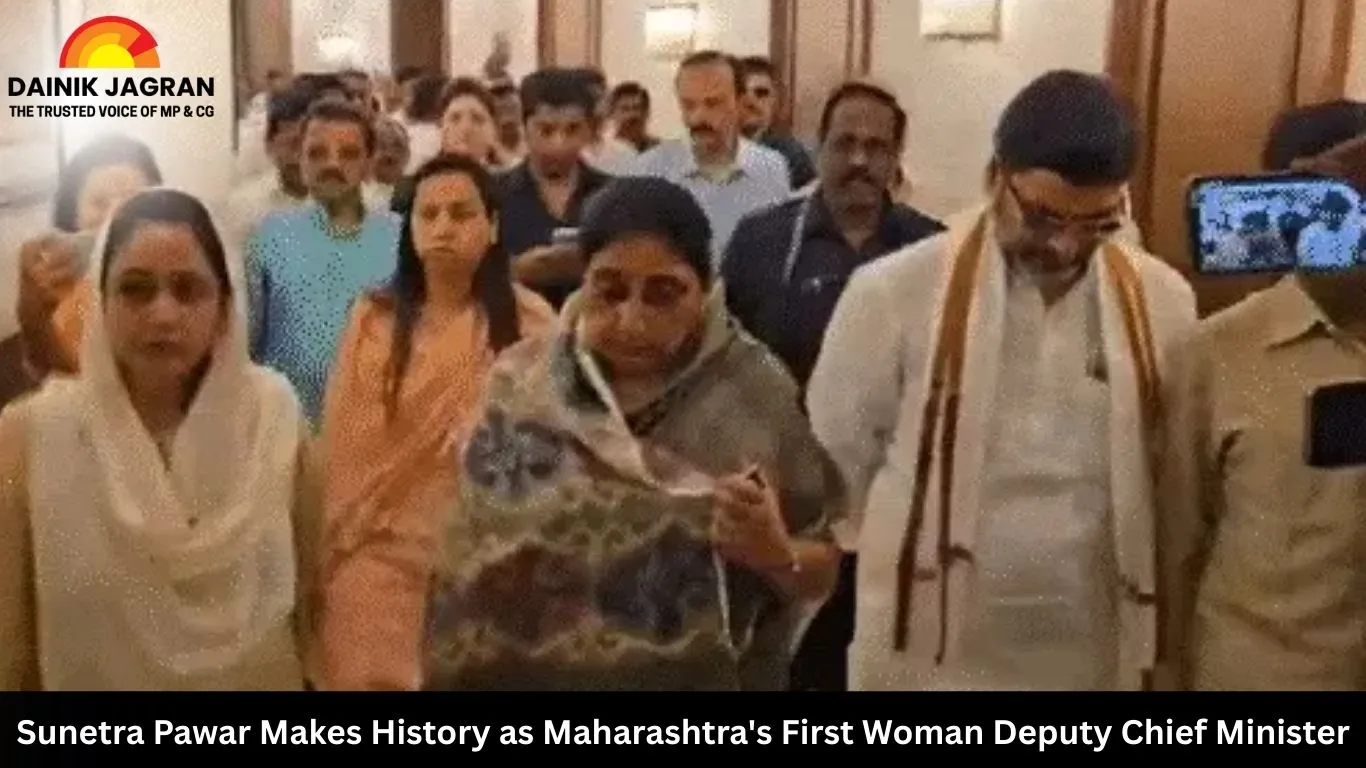
Sunetra Pawar Makes History as Maharashtra's First Woman Deputy Chief Minister
Digital Desk
The oath was administered by Governor Acharya Devvrat at Mumbai's Lok Bhavan. In her first administrative assignments, she was given charge of State Excise Duty, Sports and Youth Welfare, and the Minorities Development & Aukaf ministries. Notably, the crucial Finance portfolio, previously held by Ajit Pawar, has been retained by Chief Minister Devendra Fadnavis.
- Historic Appointment: Sunetra Pawar breaks the glass ceiling as Maharashtra's first woman Deputy CM.
- Immediate Portfolios: Assigned key departments including State Excise and Sports, but not Finance.
- Political Context: Swearing-in occurs amid intense speculation about a possible reunification of the fractured Nationalist Congress Party (NCP).
A Reluctant Politician's Swift Ascent
Until recently, Sunetra Pawar maintained a distance from electoral politics. Born in 1963 into a political family in the Dharashiv district, she is the sister of former minister Padamsinh Patil. After marrying Ajit Pawar in 1985, she carved a distinct identity through social and environmental work in the Baramati region rather than political campaigning.
Her most notable contributions include transforming Kathewadi village into Maharashtra's first 'eco-village' and chairing the Baramati Hi-Tech Textile Park, which employs around 15,000 workers, primarily women. She founded the Environmental Forum of India and has served as a trustee for the educational institute Vidya Pratishthan.
Her formal political journey began abruptly. In 2024, she was fielded as the NCP candidate against her sister-in-law, Supriya Sule, in the high-stakes Baramati Lok Sabha battle, which she lost. She was subsequently elected to the Rajya Sabha in June 2024. Her rapid transition from Parliament to the Deputy CM's office in Mantralaya underscores the unique political circumstances following her husband's sudden death.
Navigating Alliance Politics and a Key Portfolio
Sunetra Pawar steps into a complex tripartite alliance—the Mahayuti—comprising the BJP, Eknath Shinde's Shiv Sena, and the Ajit Pawar-led NCP. Her husband was seen as a key negotiator who balanced the alliance dynamics, particularly with the Shiv Sena. Political observers will now watch how the new Deputy CM manages these relationships.
The allocation of portfolios is telling. While she inherits ministries like Excise, which is a significant revenue generator for the state, the retention of the Finance Department by CM Fadnavis indicates the BJP's intention to keep control over the state's fiscal machinery. This setup presents both an opportunity and a challenge: she must deliver on administratively demanding departments while establishing her authority within the coalition.
The Shadow of the Unfinished NCP Merger
A pivotal backdrop to this appointment is the confirmed but unfinished plan to reunite the two factions of the NCP. Multiple reports, including detailed accounts from Frontline magazine, indicate that Ajit Pawar had initiated reconciliation with his uncle, Sharad Pawar, and a merger was slated for announcement on February 12.
According to these reports, the reunification plan had progressed through several stages:
- Approval Sought: Ajit Pawar reportedly discussed the merger with Union Home Minister Amit Shah and received an in-principle nod from Prime Minister Narendra Modi.
- Structure Finalized: A post-merger power-sharing structure was discussed, with Ajit Pawar as national president and Supriya Sule as working president.
- Family Endorsement: Sunetra Pawar herself reportedly expressed happiness about the family reuniting during a meeting on January 17.
Senior NCP (Sharad Pawar faction) leader Jayant Patil stated that "Ajit Pawar wished for the two factions... to unite," and that the late leader had entrusted him with finalizing the date. However, NCP state president Sunil Tatkare has refuted claims that merger talks were on the agenda of recent meetings.
The swift installation of Sunetra Pawar as Deputy CM is widely interpreted as a move by sections within the NCP and the BJP to consolidate control and potentially stall the merger, which would have significantly altered the state's political equations. Sharad Pawar's ambiguous statement on Saturday—"I am not aware whether Sunetra Pawar is taking oath as Deputy CM"—hints at the underlying tensions.
Challenges and the Road Ahead
As a self-described "political novice," Sunetra Pawar faces immediate and formidable challenges:
| Challenge Area | Specific Considerations |
| Party Leadership | Managing veteran NCP heavyweights like Praful Patel, Sunil Tatkare, and Chhagan Bhujbal within her own faction. |
| Merger Decision | Determining whether to pursue her husband's reconciliation plan with the Sharad Pawar faction or keep the parties separate. |
| Administrative Delivery | Proving her administrative mettle in her assigned portfolios, which have high public visibility and revenue importance. |
| Electoral Mandate | She must become a member of the state legislature within six months, likely through a by-election from the Baramati assembly seat. |
Her work in social development, particularly with women and rural communities, may inform her governance approach. However, navigating the turbulent waters of Maharashtra's politics, where she is now a central figure, will be her ultimate test.
Sunetra Pawar's ascension is more than a personal political milestone; it is a strategic event that stabilizes the ruling alliance in the short term while setting the stage for a decisive phase in Maharashtra's politics. Her actions in the coming weeks, especially regarding the proposed NCP merger, will determine whether she emerges as a bridge for family and party unity or becomes a figurehead in a deeply fractured political landscape. The journey of 'Vahini' from the social fields of Baramati to the corridors of power in Mumbai has truly begun.