

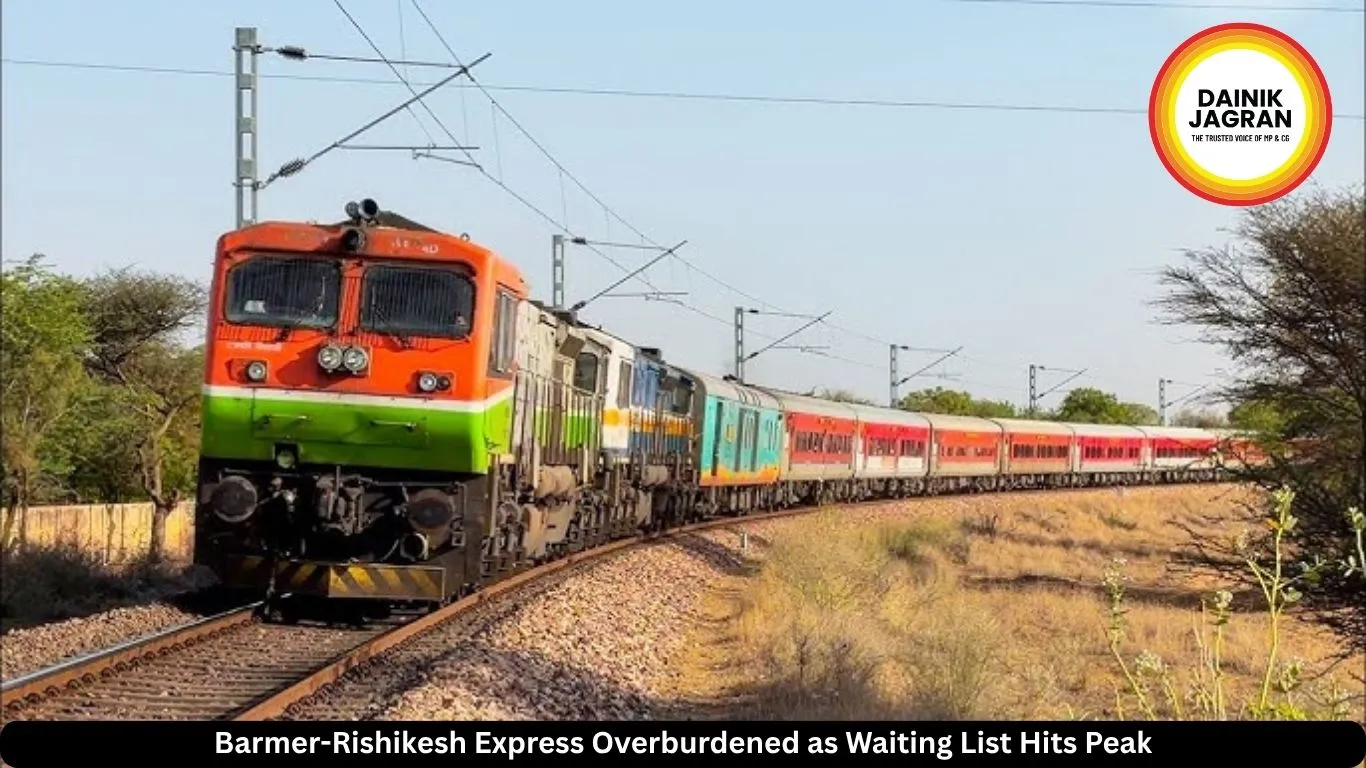
Barmer-Rishikesh Express Overburdened as Waiting List Hits Peak

National Desk

Barmer-Rishikesh Express Overburdened as Waiting List Hits Peak

Barmer-Rishikesh Express is facing severe overcrowding and long waiting lists as passengers from three states push demand beyond capacity.

The Barmer-Rishikesh Express, one of the oldest long-distance trains operated under North Western Railway, is facing severe passenger pressure as demand continues to outstrip capacity on the 48-year-old route. The train, which connects western Rajasthan to Uttarakhand, has emerged as the primary rail link for thousands of passengers from Rajasthan, Haryana and Punjab, especially for religious travel and long-distance journeys.

With no parallel service introduced on the route, the Barmer-Rishikesh Express is now operating under heavy strain, leaving passengers to contend with long waiting lists and overcrowded coaches.

Reservations Under Stress

According to current booking trends, reservations on the Barmer-Rishikesh Express remain full for nearly two months ahead. Railway booking data shows sleeper class waiting lists ranging between 120 and 180 on most dates between late April and June, while third AC waiting lists remain between 40 and 70.

The pressure is more severe in general coaches, where passengers often travel standing for long hours. Many are forced to sit near toilets or on coach entry steps due to a lack of space, highlighting the growing mismatch between demand and available capacity.

Three States Depend

The train serves as a crucial transport link for passengers from Rajasthan, Haryana and Punjab, many of whom rely on it for pilgrimages to Haridwar and Rishikesh. It is widely used by devotees travelling for Ganga snan, temple visits and ritual ceremonies, including pind daan and asthi visarjan.

With no additional train introduced on the sector, the entire passenger load from these regions continues to fall on a single service. Railway users and local passenger groups say the route has remained underserved despite sustained demand over several years.

A 48-Year Legacy

The Barmer-Rishikesh Express began operations in 1978 and has remained one of the most significant long-distance trains for northern and western India. It was later operated as the Barmer-Haridwar-Kalka Link Express, with linked coaches for Chandigarh and Kalka.

The train used to split at Ambala, allowing passengers direct access to Chandigarh and onward connectivity. After the Kalka link was withdrawn following the Covid-19 period, the entire passenger flow was diverted to the Barmer-Rishikesh section, significantly increasing the load on the existing service.

Reserved Seats Affected

Passengers say overcrowding has now begun affecting even reserved classes. According to regular travellers, sleeper and AC coaches often become congested after the train enters Punjab, with unreserved passengers boarding despite confirmed reservations.

This has led to frequent complaints from passengers who, despite booking confirmed seats well in advance, struggle to access their berths. Railway users say the crowding has made reserved travel increasingly difficult and uncomfortable, particularly during the summer and festive rush.

Railway Cites Constraints

Railway officials have acknowledged the demand pressure but cited operational limitations. Bhupesh Yadav, Senior Divisional Commercial Manager, Bikaner division, said adding more coaches to the existing train is not feasible at present because the platform at Rishikesh can accommodate only 16 coaches.

He said a proposal would be sent to North Western Railway headquarters for introducing a new train between Bikaner and Haridwar to ease pressure on the route.

Demand For Relief

Passenger groups have renewed their demand for an additional train, arguing that a fresh service is the only practical solution to ease congestion on the Barmer-Rishikesh Express. Lakshman Sharma of the Citizen Struggle Committee for Rail, Suratgarh, said passengers are being forced to travel in extremely difficult conditions because of limited capacity and the absence of a second train. The demand is likely to gain traction as summer travel peaks and religious movement increases further.

--------

๐Ÿšจ Beat the News Rush โ€“ Join Now!

Get breaking alerts, hot exclusives, and game-changing stories instantly on your phone. No delays, no fluff โ€“ just the edge you need. โšก

Tap to join:ย 

๐ŸŸข WhatsApp Channel: Dainik Jagran MP CG

Crave more?

๐Ÿ…• Facebook: Dainik Jagran MP CG English

๐Ÿ…ง Twitter (X): Dainik Jagran MP CG

๐Ÿ…˜ Instagram: Dainik Jagran MP CG

Share the fire โ€“ keep your crew ahead! ๐Ÿ—ž๏ธ๐Ÿ”ฅ

english.dainikjagranmpcg.com
27 Apr 2026 By ROHIT

Barmer-Rishikesh Express Overburdened as Waiting List Hits Peak

National Desk

The Barmer-Rishikesh Express, one of the oldest long-distance trains operated under North Western Railway, is facing severe passenger pressure as demand continues to outstrip capacity on the 48-year-old route. The train, which connects western Rajasthan to Uttarakhand, has emerged as the primary rail link for thousands of passengers from Rajasthan, Haryana and Punjab, especially for religious travel and long-distance journeys.

With no parallel service introduced on the route, the Barmer-Rishikesh Express is now operating under heavy strain, leaving passengers to contend with long waiting lists and overcrowded coaches.

Reservations Under Stress

According to current booking trends, reservations on the Barmer-Rishikesh Express remain full for nearly two months ahead. Railway booking data shows sleeper class waiting lists ranging between 120 and 180 on most dates between late April and June, while third AC waiting lists remain between 40 and 70.

The pressure is more severe in general coaches, where passengers often travel standing for long hours. Many are forced to sit near toilets or on coach entry steps due to a lack of space, highlighting the growing mismatch between demand and available capacity.

Three States Depend

The train serves as a crucial transport link for passengers from Rajasthan, Haryana and Punjab, many of whom rely on it for pilgrimages to Haridwar and Rishikesh. It is widely used by devotees travelling for Ganga snan, temple visits and ritual ceremonies, including pind daan and asthi visarjan.

With no additional train introduced on the sector, the entire passenger load from these regions continues to fall on a single service. Railway users and local passenger groups say the route has remained underserved despite sustained demand over several years.

A 48-Year Legacy

The Barmer-Rishikesh Express began operations in 1978 and has remained one of the most significant long-distance trains for northern and western India. It was later operated as the Barmer-Haridwar-Kalka Link Express, with linked coaches for Chandigarh and Kalka.

The train used to split at Ambala, allowing passengers direct access to Chandigarh and onward connectivity. After the Kalka link was withdrawn following the Covid-19 period, the entire passenger flow was diverted to the Barmer-Rishikesh section, significantly increasing the load on the existing service.

Reserved Seats Affected

Passengers say overcrowding has now begun affecting even reserved classes. According to regular travellers, sleeper and AC coaches often become congested after the train enters Punjab, with unreserved passengers boarding despite confirmed reservations.

This has led to frequent complaints from passengers who, despite booking confirmed seats well in advance, struggle to access their berths. Railway users say the crowding has made reserved travel increasingly difficult and uncomfortable, particularly during the summer and festive rush.

Railway Cites Constraints

Railway officials have acknowledged the demand pressure but cited operational limitations. Bhupesh Yadav, Senior Divisional Commercial Manager, Bikaner division, said adding more coaches to the existing train is not feasible at present because the platform at Rishikesh can accommodate only 16 coaches.

He said a proposal would be sent to North Western Railway headquarters for introducing a new train between Bikaner and Haridwar to ease pressure on the route.

Demand For Relief

Passenger groups have renewed their demand for an additional train, arguing that a fresh service is the only practical solution to ease congestion on the Barmer-Rishikesh Express. Lakshman Sharma of the Citizen Struggle Committee for Rail, Suratgarh, said passengers are being forced to travel in extremely difficult conditions because of limited capacity and the absence of a second train. The demand is likely to gain traction as summer travel peaks and religious movement increases further.

https://english.dainikjagranmpcg.com/national/69ef1e54a7df0/article-17445

Latest News


