More Than a Gift: How Etikoppaka Took Centre Stage During the President's Andhra Visit
Digital Desk
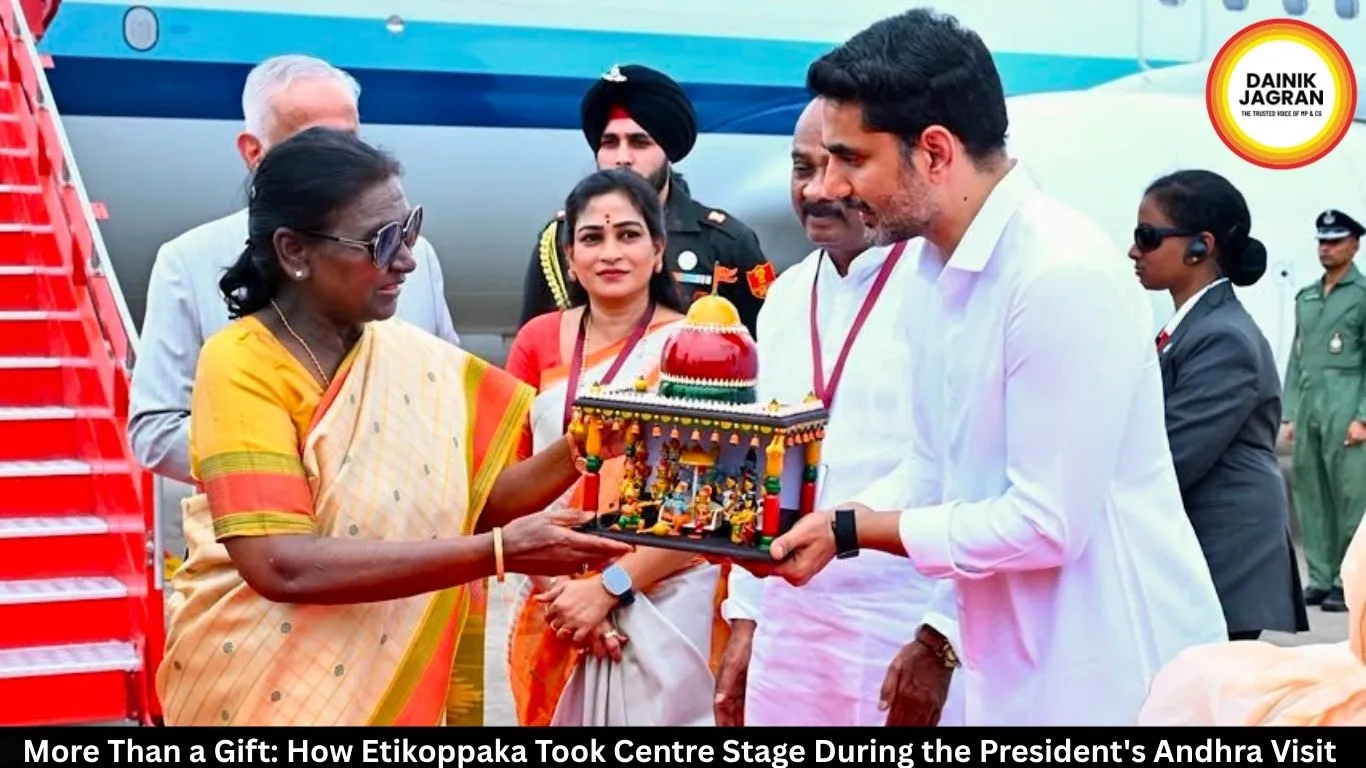
When President Droupadi Murmu arrived at INS Dega in Visakhapatnam on Tuesday, the official welcome carried with it a story that stretched far beyond protocol. In the hands of State IT and HRD Minister Nara Lokesh was a handcrafted Sri Rama Pattabhishekam idol from Etikoppaka, a quiet village in Anakapalli district whose centuries-old wood-lacquer tradition found itself in the national spotlight.
Along with Lokesh joined the Governor Syed Abdul Nazeer, Assembly Speaker of the Legislative, Chintakayala Ayyanna Patrudu, and Home Minister Vangalapudi Anitha.
The presentation was more than a ceremonial exchange. It reflected the Telugu Desam Party (TDP) government's continuing effort to use nationally significant occasions to showcase Andhra Pradesh's traditional arts and crafts. Coming soon after the promotion of Mangalagiri handloom, the choice of an Etikoppaka craft signals a broader attempt to position the state's indigenous heritage as a cultural ambassador before the country.
The idol itself carried a symbolism of its own. Depicting Lord Rama's coronation after his return to Ayodhya, the Sri Rama Pattabhishekam artwork brought together one of India's most enduring cultural narratives with one of Andhra Pradesh's oldest living craft traditions. In presenting it to the President, the government highlighted not only a handcrafted masterpiece but also the generations of artisans who have kept the tradition alive.
Nestled on the banks of the Varaha River, Etikoppaka has been producing handcrafted wooden artefacts for nearly four centuries. The village is known for its traditional Tharini technique, in which the soft wood of the Ankudu tree (Wrightia tinctoria) is shaped on hand-operated lathes and coloured using natural lac dyes extracted from roots, bark, seeds and leaves. Free from synthetic paints, the resulting products are eco-friendly, non-toxic and safe for children. From mythological figurines and Raja-Rani dolls to spinning tops, musical instruments and home décor, every piece reflects a craft passed down through generations.
The village's artisans have steadily gained wider recognition over the years. Prime Minister Narendra Modi highlighted Etikoppaka in his Mann Ki Baat programme in 2020, helping revive national interest in the craft. Earlier, it had received a Geographical Indication (GI) tag in 2017 following an application filed by the then TDP government in 2014, giving legal recognition to one of Andhra Pradesh's oldest handicraft traditions.
For the TDP government, the presentation of the Etikoppaka idol was part of a larger cultural narrative. Following its promotion of Mangalagiri handloom, the government has continued to use high-profile public occasions to bring Andhra Pradesh's traditional crafts into the national conversation, ensuring that the state's artisan communities receive visibility alongside its political and economic aspirations.
--------
🚨 Beat the News Rush – Join Now!
Get breaking alerts, hot exclusives, and game-changing stories instantly on your phone. No delays, no fluff – just the edge you need. ⚡
Tap to join:
🟢 WhatsApp Channel: Dainik Jagran MP CG
Crave more?
🅕 Facebook: Dainik Jagran MP CG English
🅧 Twitter (X): Dainik Jagran MP CG
🅘 Instagram: Dainik Jagran MP CG
Share the fire – keep your crew ahead! 🗞️🔥
More Than a Gift: How Etikoppaka Took Centre Stage During the President's Andhra Visit
Digital Desk
Along with Lokesh joined the Governor Syed Abdul Nazeer, Assembly Speaker of the Legislative, Chintakayala Ayyanna Patrudu, and Home Minister Vangalapudi Anitha.
The presentation was more than a ceremonial exchange. It reflected the Telugu Desam Party (TDP) government's continuing effort to use nationally significant occasions to showcase Andhra Pradesh's traditional arts and crafts. Coming soon after the promotion of Mangalagiri handloom, the choice of an Etikoppaka craft signals a broader attempt to position the state's indigenous heritage as a cultural ambassador before the country.
The idol itself carried a symbolism of its own. Depicting Lord Rama's coronation after his return to Ayodhya, the Sri Rama Pattabhishekam artwork brought together one of India's most enduring cultural narratives with one of Andhra Pradesh's oldest living craft traditions. In presenting it to the President, the government highlighted not only a handcrafted masterpiece but also the generations of artisans who have kept the tradition alive.
Nestled on the banks of the Varaha River, Etikoppaka has been producing handcrafted wooden artefacts for nearly four centuries. The village is known for its traditional Tharini technique, in which the soft wood of the Ankudu tree (Wrightia tinctoria) is shaped on hand-operated lathes and coloured using natural lac dyes extracted from roots, bark, seeds and leaves. Free from synthetic paints, the resulting products are eco-friendly, non-toxic and safe for children. From mythological figurines and Raja-Rani dolls to spinning tops, musical instruments and home décor, every piece reflects a craft passed down through generations.
The village's artisans have steadily gained wider recognition over the years. Prime Minister Narendra Modi highlighted Etikoppaka in his Mann Ki Baat programme in 2020, helping revive national interest in the craft. Earlier, it had received a Geographical Indication (GI) tag in 2017 following an application filed by the then TDP government in 2014, giving legal recognition to one of Andhra Pradesh's oldest handicraft traditions.
For the TDP government, the presentation of the Etikoppaka idol was part of a larger cultural narrative. Following its promotion of Mangalagiri handloom, the government has continued to use high-profile public occasions to bring Andhra Pradesh's traditional crafts into the national conversation, ensuring that the state's artisan communities receive visibility alongside its political and economic aspirations.