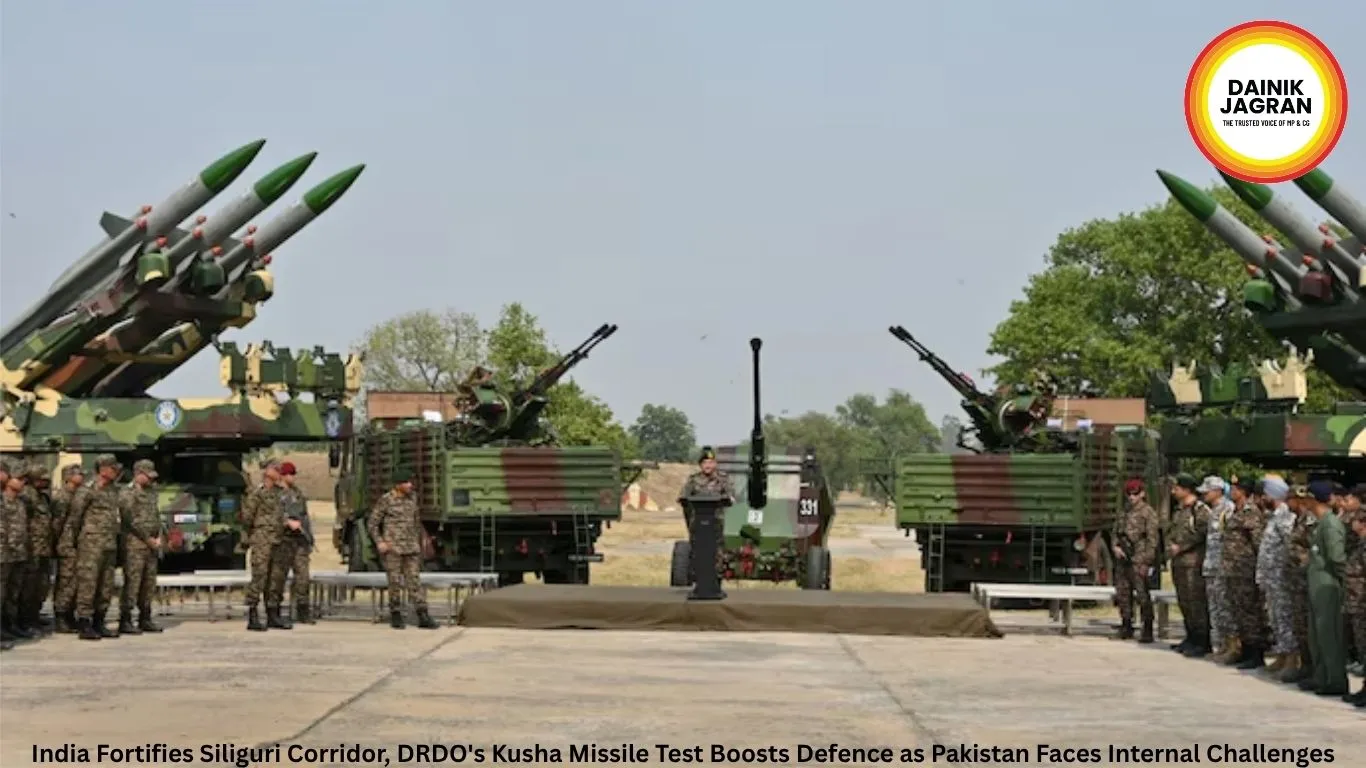
India Fortifies Siliguri Corridor, DRDO's Kusha Missile Test Boosts Defence as Pakistan Faces Internal Challenges

Digital Desk

India Fortifies Siliguri Corridor, DRDO's Kusha Missile Test Boosts Defence as Pakistan Faces Internal Challenges

India has stepped up security along the strategic Siliguri Corridor with new military bases and advanced air defence systems, while DRDO successfully tested the Kusha missile interceptor. At the same time, Pakistan is grappling with political unrest in Pakistan-occupied Kashmir (PoK) and escalating insurgency in Balochistan.

India has significantly strengthened the security of the strategically vital Siliguri Corridor, long known as the country's "Chicken's Neck," through new military deployments, advanced air defence systems and infrastructure upgrades. The developments come as the Defence Research and Development Organisation (DRDO) successfully tested its Kusha air defence missile system, while neighbouring Pakistan faces growing political and security challenges in Pakistan-occupied Kashmir (PoK) and Balochistan.

The latest military and strategic developments underline India's focus on enhancing border security amid evolving regional security dynamics.

Siliguri Corridor Gets Stronger Military Shield

The Siliguri Corridor, a narrow stretch of land in West Bengal that connects India's northeastern states with the rest of the country, has long been regarded as one of India's most sensitive strategic zones.

At its narrowest point, the corridor measures only about 22 kilometres and is surrounded by Nepal, Bhutan, Bangladesh, and China's Chumbi Valley.

To reinforce the region, the Indian Army has established three new military stations:

  • Lachit Borphukan Military Station (Assam): Strengthens logistics for the eastern theatre.
  • Kishanganj Military Station (Bihar): Monitors the western approach towards the corridor.
  • Chopra Military Station (West Bengal): Enhances surveillance close to the international border.

These facilities complement existing Border Security Force (BSF) deployments, significantly improving monitoring and operational readiness.

Army officials are increasingly referring to the corridor as the "Elephant's Trunk," reflecting greater confidence in its strengthened defences.

Advanced Weapons Deployed Near Chumbi Valley

India has also enhanced military capabilities in the region by deploying advanced assets under the Trishakti Corps.

These include:

  • S-400 air defence missile systems
  • BrahMos supersonic cruise missile regiments
  • Rafale fighter aircraft operating from Hasimara Air Base

The deployments are aimed at strengthening India's preparedness along the China-facing frontier, particularly around the strategically significant Chumbi Valley, which was at the centre of the 2017 Doklam standoff.

Military planners believe the combination of long-range missiles, integrated radar coverage and modern fighter aircraft substantially improves India's defensive posture.

Alternative Connectivity Reduces Strategic Vulnerability

India has also developed alternate connectivity routes to reduce dependence on the Siliguri Corridor.

Projects such as the Kaladan Multi-Modal Transit Transport Project through Myanmar, along with new railway and highway links to the Northeast, provide additional logistical options should the corridor ever face disruption.

These alternate routes enhance strategic flexibility and reduce the risks associated with relying on a single land corridor.

DRDO Successfully Tests Kusha Air Defence Missile

In another major defence milestone, DRDO successfully conducted a test of the indigenous Kusha air defence missile system.

The interceptor reportedly achieved a direct hit on its intended target, demonstrating India's growing capability in developing long-range air defence technologies.

The Kusha system is being developed as India's indigenous long-range air defence platform and is expected to strengthen protection against enemy aircraft, cruise missiles and certain ballistic missile threats once fully operational.

The successful trial represents another step toward greater self-reliance in defence technology under India's indigenous defence programmes.

Pakistan Faces Political Turmoil in PoK

While India continues strengthening its defence capabilities, Pakistan is dealing with growing political unrest in Pakistan-occupied Kashmir (PoK).

Reports suggest former Prime Minister Nawaz Sharif is seeking a leadership role in PoK, a move that has sparked political debate because of constitutional provisions concerning domicile requirements.

The issue comes amid continuing protests, economic grievances and security restrictions in the region.

India has consistently maintained that the entire Union Territories of Jammu & Kashmir and Ladakh, including areas under Pakistan's control, are integral parts of India.

Balochistan Remains Under Pressure

Pakistan is also facing intensified insurgent activity in Balochistan, where militant attacks targeting security forces have increased in recent months.

The violence has reportedly prompted calls for additional security measures and renewed discussions over the province's stability.

Analysts believe the deteriorating security situation poses another major challenge for Islamabad as it simultaneously deals with political tensions and economic pressures.

India Reiterates Position on Kashmir and Terrorism

At the United Nations Security Council, India recently reaffirmed its long-standing position that Jammu and Kashmir is an internal matter and rejected Pakistan's attempts to internationalise the issue.

India also reiterated that meaningful dialogue cannot proceed while cross-border terrorism continues.

On the Indus Waters Treaty, New Delhi maintained that restoring trust requires credible action against terrorism before normal engagement can resume.


--------

🚨 Beat the News Rush – Join Now!

Get breaking alerts, hot exclusives, and game-changing stories instantly on your phone. No delays, no fluff – just the edge you need. ⚡

Tap to join: 

🟢 WhatsApp Channel: Dainik Jagran MP CG

Crave more?

🅕 Facebook: Dainik Jagran MP CG English

🅧 Twitter (X): Dainik Jagran MP CG

🅘 Instagram: Dainik Jagran MP CG

Share the fire – keep your crew ahead! 🗞️🔥

english.dainikjagranmpcg.com
25 Jul 2026 By Rishita

India Fortifies Siliguri Corridor, DRDO's Kusha Missile Test Boosts Defence as Pakistan Faces Internal Challenges

Digital Desk

India has significantly strengthened the security of the strategically vital Siliguri Corridor, long known as the country's "Chicken's Neck," through new military deployments, advanced air defence systems and infrastructure upgrades. The developments come as the Defence Research and Development Organisation (DRDO) successfully tested its Kusha air defence missile system, while neighbouring Pakistan faces growing political and security challenges in Pakistan-occupied Kashmir (PoK) and Balochistan.

The latest military and strategic developments underline India's focus on enhancing border security amid evolving regional security dynamics.

Siliguri Corridor Gets Stronger Military Shield

The Siliguri Corridor, a narrow stretch of land in West Bengal that connects India's northeastern states with the rest of the country, has long been regarded as one of India's most sensitive strategic zones.

At its narrowest point, the corridor measures only about 22 kilometres and is surrounded by Nepal, Bhutan, Bangladesh, and China's Chumbi Valley.

To reinforce the region, the Indian Army has established three new military stations:

  • Lachit Borphukan Military Station (Assam): Strengthens logistics for the eastern theatre.
  • Kishanganj Military Station (Bihar): Monitors the western approach towards the corridor.
  • Chopra Military Station (West Bengal): Enhances surveillance close to the international border.

These facilities complement existing Border Security Force (BSF) deployments, significantly improving monitoring and operational readiness.

Army officials are increasingly referring to the corridor as the "Elephant's Trunk," reflecting greater confidence in its strengthened defences.

Advanced Weapons Deployed Near Chumbi Valley

India has also enhanced military capabilities in the region by deploying advanced assets under the Trishakti Corps.

These include:

  • S-400 air defence missile systems
  • BrahMos supersonic cruise missile regiments
  • Rafale fighter aircraft operating from Hasimara Air Base

The deployments are aimed at strengthening India's preparedness along the China-facing frontier, particularly around the strategically significant Chumbi Valley, which was at the centre of the 2017 Doklam standoff.

Military planners believe the combination of long-range missiles, integrated radar coverage and modern fighter aircraft substantially improves India's defensive posture.

Alternative Connectivity Reduces Strategic Vulnerability

India has also developed alternate connectivity routes to reduce dependence on the Siliguri Corridor.

Projects such as the Kaladan Multi-Modal Transit Transport Project through Myanmar, along with new railway and highway links to the Northeast, provide additional logistical options should the corridor ever face disruption.

These alternate routes enhance strategic flexibility and reduce the risks associated with relying on a single land corridor.

DRDO Successfully Tests Kusha Air Defence Missile

In another major defence milestone, DRDO successfully conducted a test of the indigenous Kusha air defence missile system.

The interceptor reportedly achieved a direct hit on its intended target, demonstrating India's growing capability in developing long-range air defence technologies.

The Kusha system is being developed as India's indigenous long-range air defence platform and is expected to strengthen protection against enemy aircraft, cruise missiles and certain ballistic missile threats once fully operational.

The successful trial represents another step toward greater self-reliance in defence technology under India's indigenous defence programmes.

Pakistan Faces Political Turmoil in PoK

While India continues strengthening its defence capabilities, Pakistan is dealing with growing political unrest in Pakistan-occupied Kashmir (PoK).

Reports suggest former Prime Minister Nawaz Sharif is seeking a leadership role in PoK, a move that has sparked political debate because of constitutional provisions concerning domicile requirements.

The issue comes amid continuing protests, economic grievances and security restrictions in the region.

India has consistently maintained that the entire Union Territories of Jammu & Kashmir and Ladakh, including areas under Pakistan's control, are integral parts of India.

Balochistan Remains Under Pressure

Pakistan is also facing intensified insurgent activity in Balochistan, where militant attacks targeting security forces have increased in recent months.

The violence has reportedly prompted calls for additional security measures and renewed discussions over the province's stability.

Analysts believe the deteriorating security situation poses another major challenge for Islamabad as it simultaneously deals with political tensions and economic pressures.

India Reiterates Position on Kashmir and Terrorism

At the United Nations Security Council, India recently reaffirmed its long-standing position that Jammu and Kashmir is an internal matter and rejected Pakistan's attempts to internationalise the issue.

India also reiterated that meaningful dialogue cannot proceed while cross-border terrorism continues.

On the Indus Waters Treaty, New Delhi maintained that restoring trust requires credible action against terrorism before normal engagement can resume.

https://english.dainikjagranmpcg.com/national/6a64911461a87/article-23534

Trending News