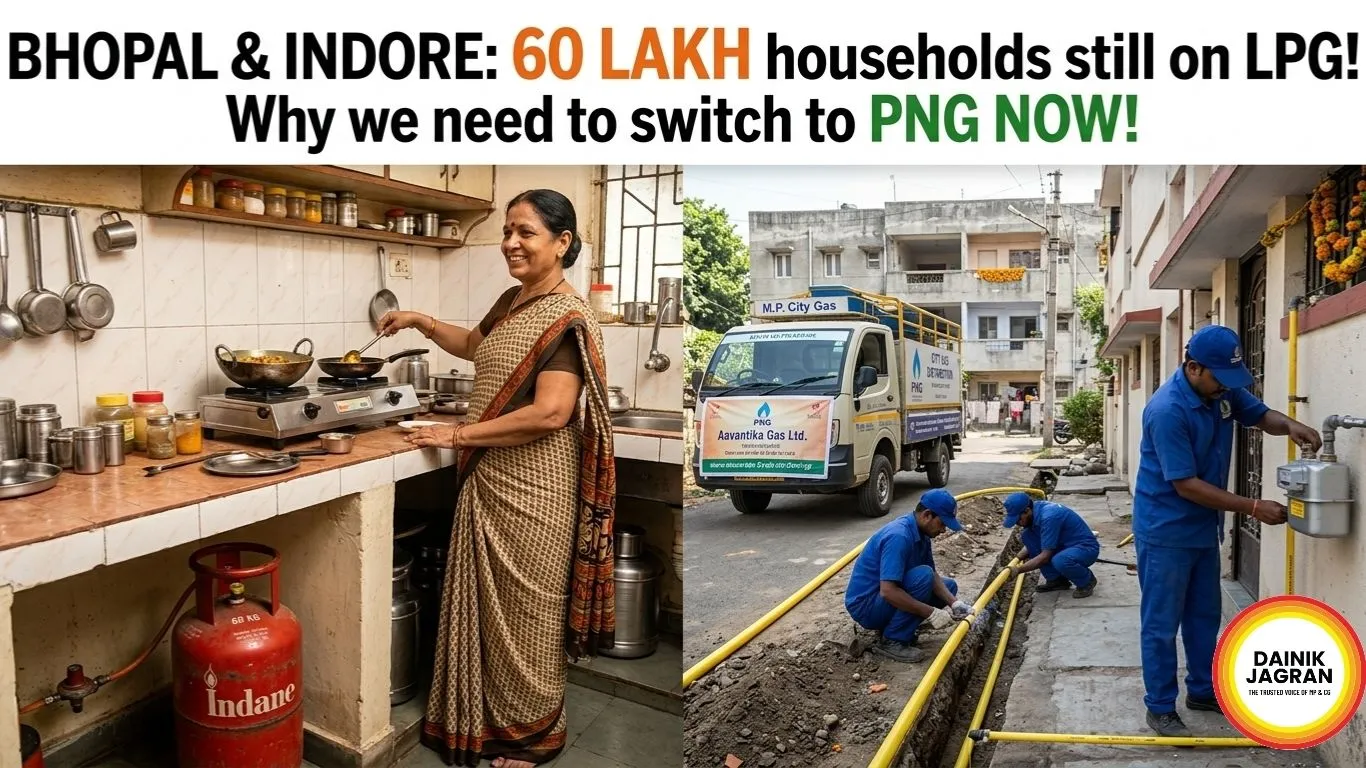
Bhopal and Indore Have 60 Lakh PNG-Ready Households Still on LPG — Here Is Why That Has to Change Now
Digital Desk
The Answer Was Already Laid Under Bhopal's Streets. Nobody Was Using It.
While families in Kolar Colony queued since 5 AM for cylinders that never arrived. While 2,000 hotels in Bhopal shut their commercial burners. While the iconic vendors at Indore's Chappan Dukan cooked poha and jalebi on electric induction coils for the first time in decades — a parallel reality was quietly unfolding a few streets away.
Households connected to Piped Natural Gas in Bhopal and Indore cooked normally. Their gas flowed without interruption. They paid their monthly bill. They did not queue. They did not panic-book. They did not know what a black market cylinder looked like at ₹5,000 because they had no reason to find out.
That contrast — between the chaos on the LPG side and the complete normalcy on the PNG side — is the sharpest possible argument for why Madhya Pradesh must treat the expansion of piped natural gas as the single most urgent energy infrastructure priority it has, starting today.
The Numbers MP Cannot Ignore
Madhya Pradesh has 89 lakh registered beneficiaries under Pradhan Mantri Ujjwala Yojana alone — making it the fourth largest LPG-dependent state in India. Add the non-PMUY domestic consumers, the 50,000 commercial establishments, and the industrial users, and the total LPG dependency picture becomes a portrait of almost total vulnerability to any disruption in the supply chain.
Against that 89 lakh PMUY number, the PNG penetration in Madhya Pradesh tells a stark story. Across the country, approximately 60 lakh households have PNG connectivity available in their immediate vicinity — meaning the pipeline infrastructure exists near their homes — but are not using it. A significant portion of this 60 lakh sits in MP's two major cities: Bhopal and Indore, where city gas distribution networks have been laid by IGL, Avantika Gas, and their CGD partners, but last-mile household conversion has lagged badly behind the pipeline's reach.
Additional Chief Secretary of MP's Food and Civil Supplies Department, Rashmi Arun Shami, reviewed the LPG situation at Mantralaya on Monday and issued directives to ensure smooth supply of cylinders while simultaneously appealing to industrial and commercial units in the state to take PNG connections wherever pipeline infrastructure is available. The government's message to the business community was direct: PNG supply is uninterrupted and guaranteed. LPG supply is not. Make the switch now, not later.
What the Government Has Directed — and What It Has Seized
The MP administration has been running a two-track response to the crisis: enforcement on one side, infrastructure push on the other.
On the enforcement side, state teams have now seized 1,825 LPG cylinders from 1,116 locations across Madhya Pradesh, with FIRs filed in eight cases involving the most egregious violations. Among the seizures specifically reported was a recovery in Chhatarpur district — 38 cylinders found hoarded in a location far beyond any legitimate household or commercial need. The seizures span Bhopal, Indore, Jabalpur, Gwalior, and smaller district centres, reflecting both the geographic spread of the black market and the state administration's determination to disrupt it.
On the infrastructure side, the directive to industrial and commercial users to shift to PNG is not merely advisory. It is backed by the Essential Commodities Act framework and the Natural Gas Control Order of March 9, which established a clear national priority sequence: domestic PNG and CNG vehicles receive 100 percent uninterrupted supply, while commercial and industrial LPG consumers are now being regulated and directed toward PNG alternatives. The government has simultaneously asked all local bodies, highway authorities, and state agencies across MP to expedite clearances for pipeline laying requests from city gas distribution companies — removing the bureaucratic friction that has historically slowed PNG network expansion.
Bhopal's PNG Landscape: What Exists and What Is Still Missing
Bhopal has an active city gas distribution network operated by Avantika Gas Limited — a joint venture that covers significant parts of the capital and extends into adjacent areas. The network serves domestic, commercial, and CNG vehicle consumers across several zones of the city.
But Bhopal is also a city of expanding peripheries — the newer colonies of Ayodhya Nagar, Bairagarh, Berasia Road, and the residential extensions along the Raisen corridor — where pipeline infrastructure either does not reach or has been laid for trunk lines without the last-mile connections into individual housing societies and apartment buildings. These are precisely the areas where the LPG crisis has hit hardest. The households most dependent on cylinder delivery are often the furthest from existing PNG connections.
The government's crisis-time directive to fast-track pipeline approvals is the right call. But fast-tracking an approval that was already pending is not the same as commissioning a pipeline that has not yet been planned. The real acceleration needed in Bhopal is the extension of PNG trunk infrastructure into the city's growing western and southern zones — work that requires capital allocation, right-of-way clearances, and sustained attention from the MP Urban Development Authority alongside the CGD companies.
Indore's Opportunity: The City That Leads Must Lead on This Too
Indore — India's cleanest city for seven consecutive years, a model of civic governance and urban management that other cities travel to study — has a particular responsibility and a particular opportunity in this crisis.
The city's street food culture, its Chappan Dukan, its breakfast culture, its dense commercial kitchen ecosystem are all built on reliable cooking fuel. The sight of induction coils on poha stalls and jalebi kadhaais during the LPG shortage was not just inconvenient. It was an indignity to a food culture that Indore has built with enormous pride. And it was entirely preventable for the commercial establishments that could have had PNG connections years ago.
Indore's CGD operator has existing infrastructure across significant parts of the city. The crisis has generated a genuine rush of commercial connection requests — restaurants, caterers, hotels — that the gas company is now processing on priority. The administration's job in the coming weeks is to ensure that the bureaucratic apparatus that typically slows connection approvals — building permissions, society NOCs, road-cutting permissions — moves at the pace the crisis demands rather than the pace it normally manages.
The Induction Parallel: MP Households Are Voting With Their Wallets
Alongside the PNG push, Madhya Pradesh households are driving a parallel shift that deserves its own attention. Induction cooktop sales across Bhopal and Indore have surged sevenfold since the crisis began, with prices nearly doubling on major e-commerce platforms as stock ran low. Consumer electronics retailers on MP Nagar and Vijay Nagar in Indore have reported selling a month's worth of induction cooktops in three days.
This is not panic purchasing of a deprivation good. It is a rational household response to supply uncertainty — and many of the families who bought induction cooktops during this crisis will continue using them after it ends. The versatility, speed, and zero-indoor-pollution advantage of induction cooking means that first-time users frequently do not abandon it when their LPG returns.
The state government would do well to recognise this shift formally: a small targeted subsidy on induction cooktops for street vendors and small food businesses — who cannot afford PNG connections in rented commercial spaces — would both ease the immediate crisis and permanently reduce LPG dependence in the sector most visibly disrupted by the shortage.
MP Has 89 Lakh Reasons to Build This Infrastructure Yesterday
Madhya Pradesh's LPG vulnerability is not just a number. It is 89 lakh Ujjwala households who were promised clean cooking fuel and are now standing in queues because the geopolitical event they never heard of happened in a strait they could not find on a map.
The state government's response — Mantralaya reviews, cylinder seizures, commercial PNG directives — is appropriate and necessary. But it is crisis management, not structural reform. Structural reform means treating city gas distribution pipeline expansion in Bhopal, Indore, Jabalpur, Gwalior, and MP's Tier 2 cities as Category A infrastructure — in the same planning and funding priority as roads and water supply — and driving it to completion with the same administrative attention.
The 60 lakh households nationally who have PNG available nearby but are not connected are not lazy or indifferent. They face connection costs they cannot easily absorb, society-level approvals that take months, and a default inertia that keeps them with the cylinder they know. The state can break that inertia through connection subsidies, fast-track society approvals, and a dedicated district-level PNG conversion programme that runs through the next 12 months.
This crisis will pass. The next one will not warn MP in advance. The pipeline needs to be in the ground before it does.