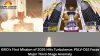
India’s space ambitions for the new year faced an unexpected hurdle this morning as the ISRO PSLV-C62 mission encountered a technical glitch shortly after liftoff. Launched from the Satish Dhawan Space Centre in Sriharikota at 10:18 a.m., the Polar Satellite Launch Vehicle (PSLV) was carrying the high-stakes Anvesha satellite and 15 other payloads. While the initial phases of the flight appeared nominal, the mission hit critical "turbulence" during the final moments of its third-stage burn, leading to a deviation in the flight path.
A Technical Glitch in the "Workhorse"
The PSLV has long been celebrated as ISRO’s most reliable "workhorse," but the C62 mission marks a rare and concerning setback. According to ISRO Chairman V. Narayanan, the vehicle performed as expected through the first two stages. However, near the end of the PS3 (third stage), mission control observed unusual disturbances and a subsequent drop in altitude and speed.
"Performance of the vehicle close to the end of the third stage was as expected. However, we are seeing more disturbance in the vehicle and a deviation in the flight path. We are currently analysing the data," stated Chairman Narayanan.
This incident is particularly sensitive as it mirrors a similar third-stage failure during the PSLV-C61 mission in May 2025. The space agency has now launched a high-level probe to determine if there is a systemic issue with the solid-fuel motors used in this stage.
The Loss of "Anvesha": India’s New Eye in the Sky
The primary casualty of this anomaly is the Anvesha satellite (also known as EOS-N1), a cutting-edge hyperspectral imaging satellite developed by the DRDO. This was not just another satellite; it was designed to be a strategic "spy" asset for India’s defense forces.
Key capabilities of Anvesha included:
-
Hyperspectral Remote Sensing (HRS): Technology that allows the satellite to see beyond visible light, detecting hidden bunkers, camouflaged weapons, and troop movements through dense forest cover.
-
Terrain Analysis: The ability to distinguish soil types, helping military planners determine if heavy machinery like tanks can pass through specific border terrains.
-
3D Simulations: Providing data to create high-resolution battle simulations for real-time strategic planning.
The loss of this payload is a significant blow to India’s border surveillance and maritime security efforts.
Commercial and International Impact
Beyond national security, the ISRO PSLV-C62 mission was a major commercial endeavor for NewSpace India Limited (NSIL). The rocket was carrying a diverse manifest of 15 satellites, including:
-
7 Indian Satellites: Including innovative projects from startups like Dhruva Space and OrbitAID.
-
8 Foreign Satellites: Payloads from France, Nepal, Brazil, and the UK.
-
Experimental Tech: The mission included AayulSAT, a pioneer test for "space gas stations" (orbital refueling), and a Spanish re-entry capsule (KID).
The current trajectory deviation suggests these satellites may not have reached their intended orbits, potentially rendering them lost.
What’s Next for ISRO?
The failure analysis committee (FAC) is expected to work around the clock to decode the telemetry data. For a digital audience, this event highlights the inherent risks of space exploration—where even a 94% success rate leaves room for heart-wrenching "what-ifs."
As the global space race intensifies, ISRO’s ability to quickly identify and fix this recurring third-stage issue will be critical for maintaining its reputation as a cost-effective and reliable launch provider.