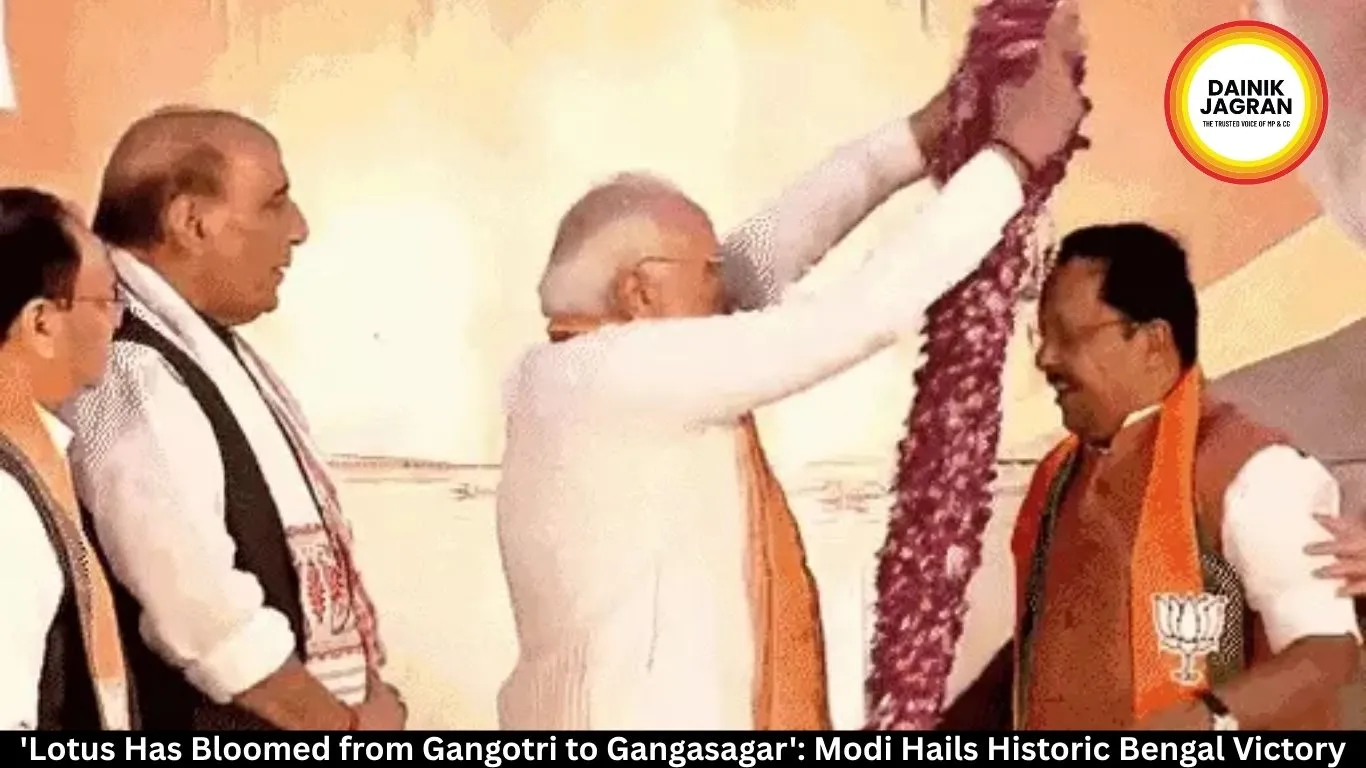
'Lotus Has Bloomed from Gangotri to Gangasagar': Modi Hails Historic Bengal Victory

Digital Desk

'Lotus Has Bloomed from Gangotri to Gangasagar': Modi Hails Historic Bengal Victory

PM highlights women's safety, employment focus in maiden BJP Bengal government; addresses workers at party HQ in traditional Bengali dhoti

Prime Minister Narendra Modi arrived at the BJP headquarters in New Delhi on Monday evening, dressed in a Bengali dhoti, to address party workers following the party's historic victory in West Bengal. In a 47-minute speech brimming with religious symbolism and political assertion, Modi declared that the lotus has finally bloomed across India's eastern heartland.

The address came hours after the party president Nitin Nabin briefed workers on the sweep that saw BJP-led governments form in West Bengal, Assam, and Puducherry in consecutive electoral rounds. The party headquarters buzzed with energy as Modi took the stage, visibly moved by the energy of workers who had laboured for years in states once dominated by Left and regional parties.

Ganga's Blessing, Democracy's Victory

Invoking spiritual imagery that has become his political signature, Modi traced the party's expansion along the Ganga basin. "On November 14th last year, I said the Ganga flows from Bihar to Gangasagar," Modi recalled. "Today, with Bengal's victory, the lotus has bloomed from Gangotri to Gangasagar."

He linked this geographical sweep to a deeper historical narrative. Uttarakhand, Uttar Pradesh, Bihar, and now West Bengal—all states along Mother Ganga's course—now have BJP-NDA governments, he emphasized. Modi referenced his 2013 moment at Varanasi, when he filed his prime ministerial candidacy. "I felt Mother Ganga had called me," he said, weaving together personal political history with the party's regional consolidation.

The historic 93 percent voter turnout in West Bengal provided Modi fresh ammunition to champion Indian democracy. Women's participation, he noted, had reached unprecedented levels across the five states where elections were held—Kerala, Tamil Nadu, Assam, and Puducherry alongside Bengal. "The mother of democracy has shown the world what democratic participation truly means," Modi told the crowd.

From Fear to Development

Bengal's transition forms the centrepiece of Modi's political messaging. The state, he said, had broken free from an era of political violence and intimidation that had defined electoral cycles for over a decade. "For the first time, democracy has triumphed, not fear," Modi stated flatly, directing a pointed appeal at Bengal's political establishment.

What came next revealed his balancing act. Modi urged all parties—not just the defeated Left and TMC—to abandon the politics of vendetta. "We should talk about development, not revenge. We should talk about the future, not fear," he said, extending an olive branch that also served as a warning against repetitions of the violence that had marked previous elections.

Peaceful polling across West Bengal, Modi stressed, stood in stark contrast to the state's recent electoral history. "Not a single innocent life was lost to violence," he said, a striking claim given Bengal's reputation for poll-related brutality.

Women Power and Infiltration

The immediate priorities of the new Bengal government took shape in Modi's address. The Ayushman Bharat health scheme would receive cabinet approval at the first meeting, he announced. Action against illegal infiltration would be the government's second major focus.

Women's safety emerged as a third pillar. Modi seized on the rejection of the Women's Reservation Amendment by the Congress and allies, using it to attack opposition parties. "Those opposing women's reservations will face the anger of women," he said, adding that Kerala voters would soon teach the Congress a similar lesson for its role in blocking the amendment.

The Samajwadi Party in Uttar Pradesh faced similar criticism for what Modi termed an "anti-women stance," though results in UP were not part of Monday's electoral round.

The Communist Question

A recurring theme in Modi's address was the near-complete erasure of Communist parties from India's electoral map. "There is not a single state with a Communist government today," Modi said. "This isn't merely a political shift. It's a shift in thinking."

He cast this as a broader civilisational choice, distinguishing between the Congress—which he accused of embracing Left ideology—and the rest of the country moving toward development-focused politics. "Today's India wants development, trust, and progress. It wants politics that move the country forward," Modi said.

Historical Resonance

Modi invoked Bengal's historical grandeur to frame the party's victory as restoration. When India was prosperous, he said, three pillars stood strong: Anga (present-day Bihar), Banga (present-day Bengal), and Kalinga (present-day Odisha). "Banga was the cultural land from which the voice of India's soul arose," he said, positioning BJP's Bengal victory as reclaiming lost glory.

The reference to Gurudev Rabindranath Tagore—Bengal's cultural icon—followed naturally. Modi's guarantee to create a "fear-free environment" where minds could flourish echoed Tagore's vision, he claimed, even as the invocation underscored the party's attempt to claim Bengal's intellectual inheritance.

Global Context

In a brief departure from domestic politics, Modi noted the timing of India's election results amidst global turbulence. West Asia's ongoing crisis and economic strain worldwide had shadowed the polling period. Yet India had voted for stability and unity, Modi argued, signalling the country's resilience even amid international headwinds.

The emphasis on stability, development, and moving past political divisions formed the consistent thread through Modi's evening address—a pitch not just to Bengal, but to India's broader electoral narrative.
 

--------

🚨 Beat the News Rush – Join Now!

Get breaking alerts, hot exclusives, and game-changing stories instantly on your phone. No delays, no fluff – just the edge you need. ⚡

Tap to join: 

🟢 WhatsApp Channel: Dainik Jagran MP CG

Crave more?

🅕 Facebook: Dainik Jagran MP CG English

🅧 Twitter (X): Dainik Jagran MP CG

🅘 Instagram: Dainik Jagran MP CG

Share the fire – keep your crew ahead! 🗞️🔥

english.dainikjagranmpcg.com
05 May 2026 By Abhishek Joshi

'Lotus Has Bloomed from Gangotri to Gangasagar': Modi Hails Historic Bengal Victory

Digital Desk

PM highlights women's safety, employment focus in maiden BJP Bengal government; addresses workers at party HQ in traditional Bengali dhoti

Prime Minister Narendra Modi arrived at the BJP headquarters in New Delhi on Monday evening, dressed in a Bengali dhoti, to address party workers following the party's historic victory in West Bengal. In a 47-minute speech brimming with religious symbolism and political assertion, Modi declared that the lotus has finally bloomed across India's eastern heartland.

The address came hours after the party president Nitin Nabin briefed workers on the sweep that saw BJP-led governments form in West Bengal, Assam, and Puducherry in consecutive electoral rounds. The party headquarters buzzed with energy as Modi took the stage, visibly moved by the energy of workers who had laboured for years in states once dominated by Left and regional parties.

Ganga's Blessing, Democracy's Victory

Invoking spiritual imagery that has become his political signature, Modi traced the party's expansion along the Ganga basin. "On November 14th last year, I said the Ganga flows from Bihar to Gangasagar," Modi recalled. "Today, with Bengal's victory, the lotus has bloomed from Gangotri to Gangasagar."

He linked this geographical sweep to a deeper historical narrative. Uttarakhand, Uttar Pradesh, Bihar, and now West Bengal—all states along Mother Ganga's course—now have BJP-NDA governments, he emphasized. Modi referenced his 2013 moment at Varanasi, when he filed his prime ministerial candidacy. "I felt Mother Ganga had called me," he said, weaving together personal political history with the party's regional consolidation.

The historic 93 percent voter turnout in West Bengal provided Modi fresh ammunition to champion Indian democracy. Women's participation, he noted, had reached unprecedented levels across the five states where elections were held—Kerala, Tamil Nadu, Assam, and Puducherry alongside Bengal. "The mother of democracy has shown the world what democratic participation truly means," Modi told the crowd.

From Fear to Development

Bengal's transition forms the centrepiece of Modi's political messaging. The state, he said, had broken free from an era of political violence and intimidation that had defined electoral cycles for over a decade. "For the first time, democracy has triumphed, not fear," Modi stated flatly, directing a pointed appeal at Bengal's political establishment.

What came next revealed his balancing act. Modi urged all parties—not just the defeated Left and TMC—to abandon the politics of vendetta. "We should talk about development, not revenge. We should talk about the future, not fear," he said, extending an olive branch that also served as a warning against repetitions of the violence that had marked previous elections.

Peaceful polling across West Bengal, Modi stressed, stood in stark contrast to the state's recent electoral history. "Not a single innocent life was lost to violence," he said, a striking claim given Bengal's reputation for poll-related brutality.

Women Power and Infiltration

The immediate priorities of the new Bengal government took shape in Modi's address. The Ayushman Bharat health scheme would receive cabinet approval at the first meeting, he announced. Action against illegal infiltration would be the government's second major focus.

Women's safety emerged as a third pillar. Modi seized on the rejection of the Women's Reservation Amendment by the Congress and allies, using it to attack opposition parties. "Those opposing women's reservations will face the anger of women," he said, adding that Kerala voters would soon teach the Congress a similar lesson for its role in blocking the amendment.

The Samajwadi Party in Uttar Pradesh faced similar criticism for what Modi termed an "anti-women stance," though results in UP were not part of Monday's electoral round.

The Communist Question

A recurring theme in Modi's address was the near-complete erasure of Communist parties from India's electoral map. "There is not a single state with a Communist government today," Modi said. "This isn't merely a political shift. It's a shift in thinking."

He cast this as a broader civilisational choice, distinguishing between the Congress—which he accused of embracing Left ideology—and the rest of the country moving toward development-focused politics. "Today's India wants development, trust, and progress. It wants politics that move the country forward," Modi said.

Historical Resonance

Modi invoked Bengal's historical grandeur to frame the party's victory as restoration. When India was prosperous, he said, three pillars stood strong: Anga (present-day Bihar), Banga (present-day Bengal), and Kalinga (present-day Odisha). "Banga was the cultural land from which the voice of India's soul arose," he said, positioning BJP's Bengal victory as reclaiming lost glory.

The reference to Gurudev Rabindranath Tagore—Bengal's cultural icon—followed naturally. Modi's guarantee to create a "fear-free environment" where minds could flourish echoed Tagore's vision, he claimed, even as the invocation underscored the party's attempt to claim Bengal's intellectual inheritance.

Global Context

In a brief departure from domestic politics, Modi noted the timing of India's election results amidst global turbulence. West Asia's ongoing crisis and economic strain worldwide had shadowed the polling period. Yet India had voted for stability and unity, Modi argued, signalling the country's resilience even amid international headwinds.

The emphasis on stability, development, and moving past political divisions formed the consistent thread through Modi's evening address—a pitch not just to Bengal, but to India's broader electoral narrative.


https://english.dainikjagranmpcg.com/national/lotus-has-bloomed-from-gangotri-to-gangasagar-modi-hails-historic/article-17826
Tags:

Latest News

Mahasamund LPG Scam: 2 Food Officers, Gas Agency Operator Arrested Mahasamund LPG Scam: 2 Food Officers, Gas Agency Operator Arrested
Chhattisgarh police arrest District Food Officer Ajay Yadav, Assistant Manish Yadav and Pankaj Chandrakar in Mahasamund LPG gas diversion case...
Balod Road Accident: Three Friends Killed in High-Speed Crash
BJP MLA Porte Blasts Officials at Sushasan Tihaar Balrampur
Korba Disneyland Fair Assault Video Sparks Police Action
Durg Municipal Corp staffer thrashed over religious comments
35 Women From Chhattisgarh Trapped in Jharkhand Nursing Centre
Rewa Youth Suicide After Mumbai Return