


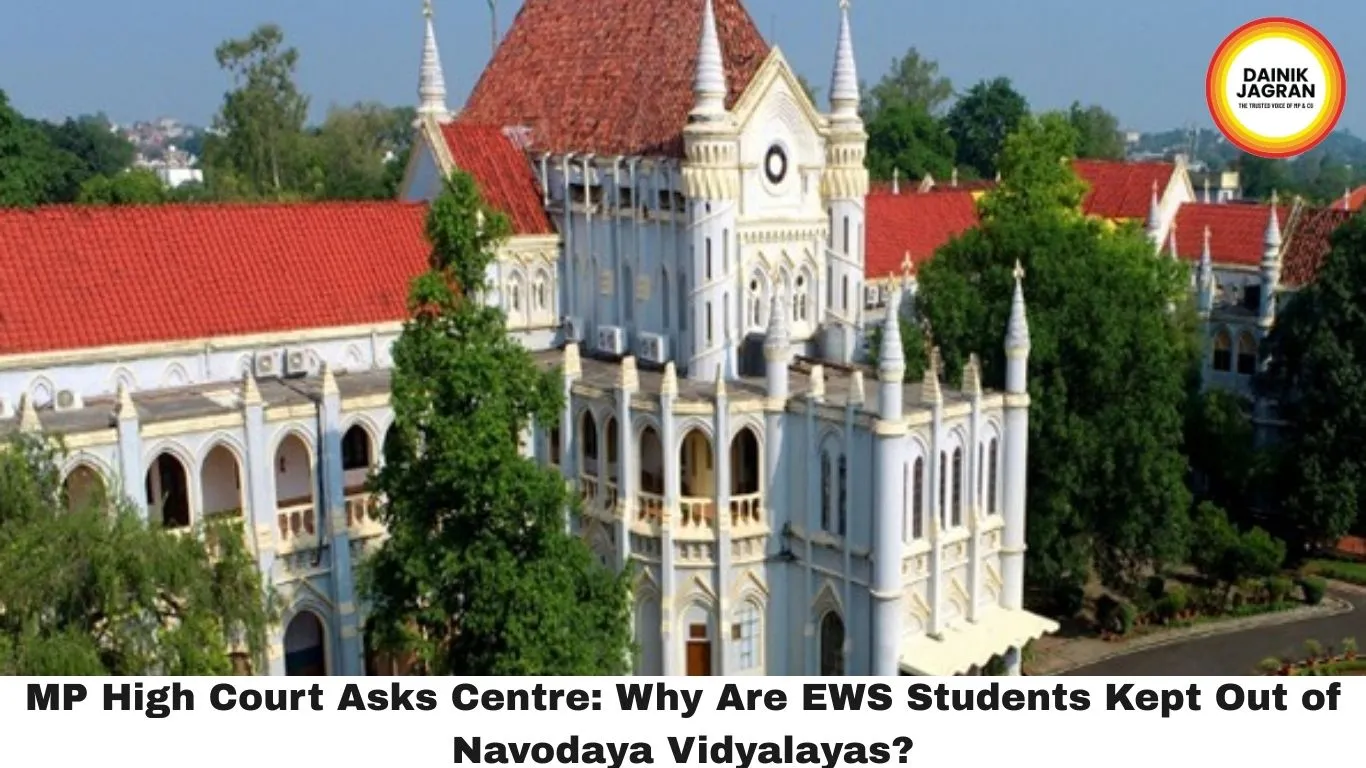
MP High Court Asks Centre: Why Are EWS Students Kept Out of Navodaya Vidyalayas?
Digital Desk
A Constitution That Promises 10 Percent — and Schools That Give Zero
On Tuesday, March 17, the Madhya Pradesh High Court's principal bench at Jabalpur did something that the Central government perhaps hoped would go unnoticed for a little while longer. It issued a formal notice demanding a reply within one week on a question that is, at its core, both legally straightforward and deeply uncomfortable: why are students from Economically Weaker Sections being denied admission through the 10 percent EWS quota in Jawahar Navodaya Vidyalayas — government-funded residential schools that serve some of India's most rural and educationally underserved children?
The question is not a technicality. It is a constitutional one. And the answer the Central government gives — or fails to give — in the next seven days will say something significant about how seriously India's educational establishment takes its own foundational law.
What the Petition Says — and Why It Has Standing
The petition before the MP High Court makes a precisely targeted constitutional argument. Article 15(6) of the Constitution of India, inserted through the 103rd Constitutional Amendment in January 2019, explicitly provides for the reservation of up to 10 percent of seats in educational institutions for Economically Weaker Sections — defined broadly as citizens from general category families with an annual income below ₹8 lakh and meeting specific asset criteria.
This amendment was passed by both houses of Parliament with an overwhelming majority. It was upheld by a five-judge bench of the Supreme Court in November 2022, in a landmark judgement that confirmed the constitutional validity of EWS reservation by a 3-2 majority. The law is settled. The reservation exists. The Constitution is unambiguous.
And yet, as the petition before the Jabalpur bench points out, the admission policy of Jawahar Navodaya Vidyalayas — residential schools run directly under the Central government's Ministry of Education — contains no provision whatsoever for EWS category students. In Madhya Pradesh alone, there are 54 JNVs. Across India, there are over 650. None of them, according to the petitioner, have incorporated EWS reservation into their admissions framework.
The petition draws a further contrast that makes the exclusion harder to explain away: Kendriya Vidyalayas — also run by the Government of India under the Kendriya Vidyalaya Sangathan — do admit students under the EWS category. The two premier chains of Central government schools, both under the same ministry, operating under the same constitutional framework, are applying the same law differently. One includes EWS students. The other excludes them.
Who Goes to Navodaya Vidyalayas — and What Is at Stake
To understand why this exclusion is particularly serious, it is worth remembering what Navodaya Vidyalayas actually are and who they were designed to serve.
The Navodaya Vidyalaya Scheme was conceived in the 1980s under the National Policy on Education as a mechanism to provide high-quality residential education — free of cost — to talented children from rural areas across India. The core philosophy was explicitly equity-based: that a child from a village in rural Madhya Pradesh or Odisha or Nagaland deserved access to the same quality of education as a child from an affluent urban family, and that residential schooling with full state support was the way to bridge that gap.
JNV students receive free education, free boarding, free lodging, free uniforms, free textbooks, and free meals. The schools are equipped with science laboratories, libraries, computer facilities, and sports infrastructure that most rural government schools cannot dream of. JNV graduates routinely go on to IITs, IIMs, medical colleges, and central government services.
The children who attend JNVs are, almost by definition, from rural and economically modest backgrounds — they are selected through a highly competitive entrance examination in Class 5 or Class 6, with reservations for SC, ST, girls, and rural students already built into the admission policy. But EWS students — those from general category families that are economically poor but do not belong to SC or ST categories — currently have no protected pathway into these schools.
This is precisely the gap the 103rd Amendment was designed to fill. And the Navodaya system has, apparently, declined to fill it.
The Central Government's Position — Such as It Is
The Central government has one week to respond to the High Court's notice. In the absence of that response, what we have is silence — and a track record of institutional inertia on EWS implementation that the petition is now forcing into the open.
It is worth noting that the Ministry of Education has had seven years since the 103rd Amendment was passed to incorporate EWS reservation into JNV admissions. The amendment came into force in January 2019. The Supreme Court upheld it in November 2022. That is over three years since the reservation's constitutional validity was conclusively settled — and the JNV admission policy, apparently, still has not moved.
The government may argue in its reply that JNVs operate under a different legislative framework — the Navodaya Vidyalaya Samiti Act — and that incorporation of a new reservation category requires specific procedural steps including amendment of the admissions guidelines, notification to the Navodaya Vidyalaya Samiti, and revision of the seat matrix. These are real procedural steps. They are also steps that, over seven years, could have been completed multiple times over.
The Kendriya Vidyalaya Contrast: Same Ministry, Different Rules
The fact that Kendriya Vidyalayas include EWS reservation while JNVs do not is the most legally damaging element of the petition — because it removes the government's most obvious defence.
If the Ministry of Education's position is that Central educational institutions require specific legislative or administrative action to incorporate EWS reservation, then that action has already been taken for KVs. The precedent exists within the same ministry. The administrative pathway has been demonstrated. The refusal to apply the same pathway to JNVs is therefore not an oversight. It is a policy choice. And it is a policy choice that the High Court is now, entirely appropriately, asking the government to justify.
Opinion: The Courts Are Doing the Work the Parliament Already Did
The 103rd Constitutional Amendment giving EWS students a 10 percent reservation in educational institutions was passed by Parliament in January 2019. The Supreme Court upheld it in 2022. The Madhya Pradesh High Court is now, in March 2026, issuing a notice asking why a Central government school system is not implementing it.
At some point, the distance between what the Constitution says and what Central institutions actually do becomes impossible to describe as anything other than deliberate non-compliance. Seventy-eight lakh students appear for the JNV entrance examination every year competing for approximately 50,000 seats. The children who lose that competition — including general category children from genuinely poor families who have no SC or ST reservation to fall back on — are exactly the children the EWS amendment was designed to protect.
They have a constitutional right. The Court is asking why that right is not being honoured. The Central government has one week to answer.
That is not a difficult question. The difficult question is why it has taken seven years and a High Court notice to ask it.
.jpg)




