

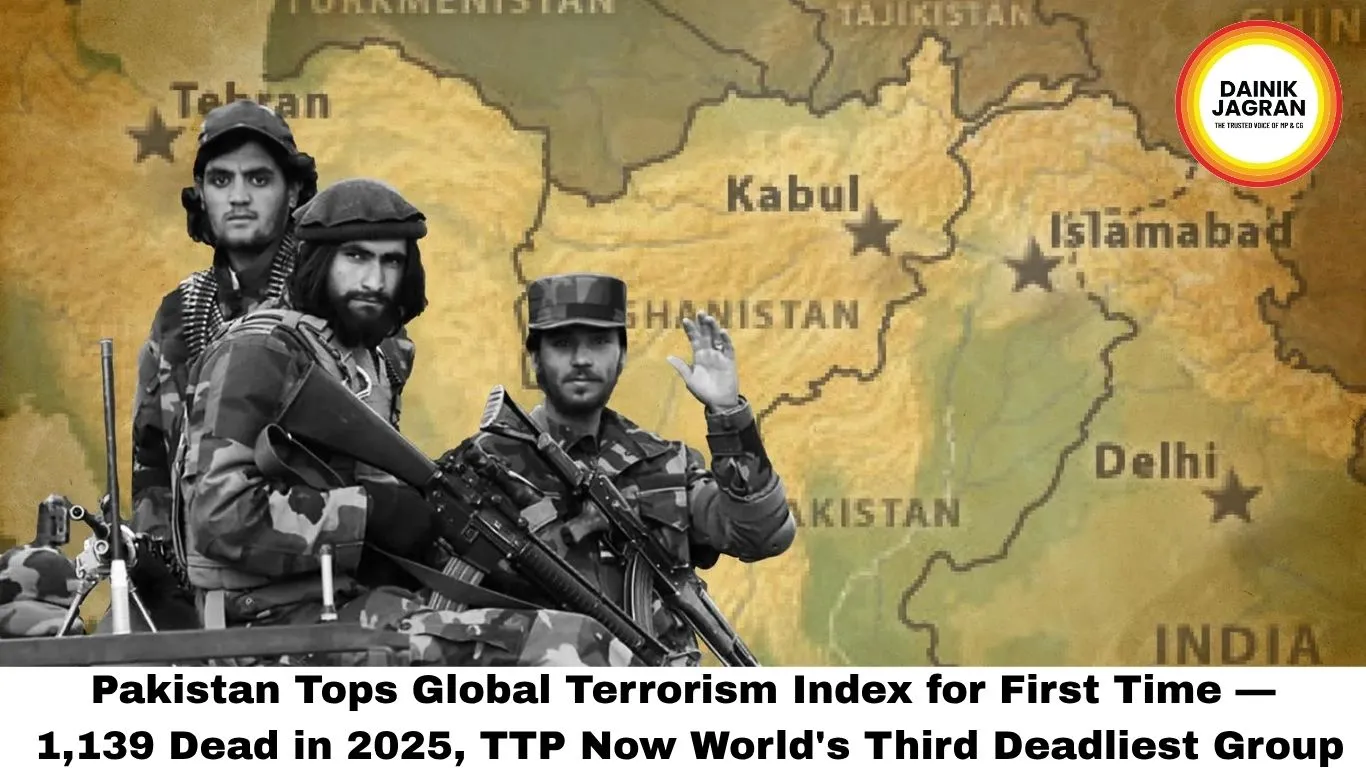
Pakistan Tops Global Terrorism Index 2026 for First Time Ever
Digital Desk
Pakistan ranks first on the Global Terrorism Index 2026 with 1,139 deaths in 2025 — its highest since 2013. TTP attacks surge 24%, Jaffar Express hostage crisis drives record kidnappings.
The Ranking Pakistan Never Wanted
For the first time in the history of the Global Terrorism Index — a comprehensive annual assessment covering 163 countries — Pakistan has claimed the top spot. Not for economic growth, not for diplomatic influence, not for development. For terrorism. The Global Terrorism Index 2026, published by the Institute for Economics and Peace, places Pakistan above every other nation in the world on the scale of terrorism impact — a grim distinction that underlines a security deterioration that has been building for six consecutive years and has now reached its most acute point since 2013.
The Numbers: 1,139 Dead, 1,045 Incidents
In 2025, Pakistan recorded 1,139 terrorism-related deaths across 1,045 separate incidents. That represents a 6 percent increase in fatalities over the previous year — and the highest death toll from terrorism the country has seen in over a decade. The figure places Pakistan in a category shared only by Burkina Faso, Nigeria, Niger, and the Democratic Republic of Congo — five nations that together account for nearly 70 percent of all global terrorism deaths recorded in 2025. For Pakistan — a nuclear-armed state with a population of 240 million, a functioning civilian government, and a powerful military establishment — the company it is keeping on this list is a measure of how severely its internal security architecture has degraded.
TTP: Deadlier Than Ever Before
At the centre of Pakistan's terrorism crisis is the Tehreek-i-Taliban Pakistan — the TTP. In 2025, the TTP launched 595 attacks — a 24 percent increase over the previous year. It is responsible for over 67 percent of all terrorist attacks in Pakistan since 2009. It has carried out five times as many attacks as the second most active group in the country, the Balochistan Liberation Army. Globally, the TTP has consolidated its position as the third deadliest terrorist organisation in the world — and critically, it was the only one among the world's four deadliest groups to actually increase its operational activity in 2025, at a time when other major terror organisations were either holding steady or declining.
The TTP's most lethal operations in 2025 were concentrated in Khyber Pakhtunkhwa, near the Afghan border — a region that has functionally become a perpetual combat zone. KPK alone recorded 637 deaths from TTP attacks — the highest figure from that province since 2011. The group's single most significant operation of the year was a coordinated armed attack on military forces that killed 21 soldiers in a single incident.
The Afghan Taliban Factor
The index is explicit about the root cause driving TTP's resurgence: the return of the Afghan Taliban to power in Kabul in August 2021. The report states that this geopolitical shift provided the TTP with the means and motivation to significantly expand its geographic reach and operational efficiency — resulting in a considerable rise in violent extremism across the broader region.
The logic is straightforward and well-documented. When the Taliban took Kabul, thousands of TTP fighters who had been sheltering in Afghan territory gained de facto sanctuary, logistical support, and ideological reinforcement. The Afghan Taliban has repeatedly refused Pakistani requests to act against the TTP — reflecting a fundamental tension between Islamabad's strategic expectation of a compliant Afghan government and the reality of a Taliban leadership that views the TTP as a fellow traveller rather than an enemy.
Pakistan's "strained" relations with Afghanistan — described in those terms directly in the report — have made the security situation along the Durand Line effectively unmanageable through conventional counterterrorism means.
Balochistan: The Second Front
While KPK bears the brunt of TTP violence, Balochistan continues to simmer under the pressure of the Balochistan Liberation Army — a separatist militant group seeking independence for Pakistan's largest province. Together, KPK and Balochistan accounted for over 74 percent of all terrorist attacks and 67 percent of all terrorism deaths in Pakistan in 2025. The two provinces — geographically vast, ethnically distinct, and historically underserved — represent Pakistan's most persistent and structurally entrenched security challenges.
The BLA's operational tempo remained high in 2025, with attacks on infrastructure, security forces, and civilian targets continuing to destabilise the province. The Gwadar-centred China-Pakistan Economic Corridor, which runs through Balochistan, remains a persistent target — raising strategic anxieties that extend well beyond Pakistan's borders.
The Jaffar Express Attack — Pakistan's Most Shocking Hostage Crisis
One data point in the index stands out for its sheer scale. Pakistan's hostage-taking incidents surged dramatically in 2025 — from 101 victims in 2024 to 655 in a single year. The overwhelming majority of this surge was driven by a single operation: the Jaffar Express attack, in which militants — believed to be the BLA — seized a passenger train and took 442 people hostage in a dramatic and prolonged standoff that gripped the country for days. The incident underlined the degree to which Pakistan's militant groups have evolved beyond hit-and-run strikes into sophisticated, high-visibility operations designed to maximise international attention and domestic psychological impact.
Six Consecutive Years of Rising Deaths
The 2026 ranking did not arrive without warning. The index notes that 2025 marked the sixth consecutive year of rising terrorism deaths in Pakistan — a trend that has continued despite multiple military operations, counterterrorism campaigns, national action plans, and diplomatic engagements. This sustained upward trajectory suggests that the structural conditions driving terrorism — ungoverned spaces, cross-border sanctuaries, economic marginalisation, and the failure to dismantle the ideological infrastructure of extremism — remain firmly in place.
Pakistan finished second on the Global Terrorism Index in 2025. It now sits at number one. The direction of travel has been consistent. Whether it continues depends on choices that Islamabad has, so far, been unable or unwilling to fully make.
What Comes Next
The Global Terrorism Index 2026 arrives at a moment when Pakistan is already under acute external pressure. The US Director of National Intelligence has designated Pakistan as one of four countries posing the most significant nuclear threats to the United States. The country is navigating the economic fallout of the Middle East war. A former Pakistani diplomat has made public threats to bomb Indian cities. And now, the world's most authoritative terrorism tracking index places Pakistan at the very top of its ranking for the first time in history.
For a country that has long described itself as a victim of terrorism rather than a state that enables it, the 2026 index is a document that will be very difficult to argue with.
Pakistan Tops Global Terrorism Index 2026 for First Time Ever
Digital Desk
The Ranking Pakistan Never Wanted
For the first time in the history of the Global Terrorism Index — a comprehensive annual assessment covering 163 countries — Pakistan has claimed the top spot. Not for economic growth, not for diplomatic influence, not for development. For terrorism. The Global Terrorism Index 2026, published by the Institute for Economics and Peace, places Pakistan above every other nation in the world on the scale of terrorism impact — a grim distinction that underlines a security deterioration that has been building for six consecutive years and has now reached its most acute point since 2013.
The Numbers: 1,139 Dead, 1,045 Incidents
In 2025, Pakistan recorded 1,139 terrorism-related deaths across 1,045 separate incidents. That represents a 6 percent increase in fatalities over the previous year — and the highest death toll from terrorism the country has seen in over a decade. The figure places Pakistan in a category shared only by Burkina Faso, Nigeria, Niger, and the Democratic Republic of Congo — five nations that together account for nearly 70 percent of all global terrorism deaths recorded in 2025. For Pakistan — a nuclear-armed state with a population of 240 million, a functioning civilian government, and a powerful military establishment — the company it is keeping on this list is a measure of how severely its internal security architecture has degraded.
TTP: Deadlier Than Ever Before
At the centre of Pakistan's terrorism crisis is the Tehreek-i-Taliban Pakistan — the TTP. In 2025, the TTP launched 595 attacks — a 24 percent increase over the previous year. It is responsible for over 67 percent of all terrorist attacks in Pakistan since 2009. It has carried out five times as many attacks as the second most active group in the country, the Balochistan Liberation Army. Globally, the TTP has consolidated its position as the third deadliest terrorist organisation in the world — and critically, it was the only one among the world's four deadliest groups to actually increase its operational activity in 2025, at a time when other major terror organisations were either holding steady or declining.
The TTP's most lethal operations in 2025 were concentrated in Khyber Pakhtunkhwa, near the Afghan border — a region that has functionally become a perpetual combat zone. KPK alone recorded 637 deaths from TTP attacks — the highest figure from that province since 2011. The group's single most significant operation of the year was a coordinated armed attack on military forces that killed 21 soldiers in a single incident.
The Afghan Taliban Factor
The index is explicit about the root cause driving TTP's resurgence: the return of the Afghan Taliban to power in Kabul in August 2021. The report states that this geopolitical shift provided the TTP with the means and motivation to significantly expand its geographic reach and operational efficiency — resulting in a considerable rise in violent extremism across the broader region.
The logic is straightforward and well-documented. When the Taliban took Kabul, thousands of TTP fighters who had been sheltering in Afghan territory gained de facto sanctuary, logistical support, and ideological reinforcement. The Afghan Taliban has repeatedly refused Pakistani requests to act against the TTP — reflecting a fundamental tension between Islamabad's strategic expectation of a compliant Afghan government and the reality of a Taliban leadership that views the TTP as a fellow traveller rather than an enemy.
Pakistan's "strained" relations with Afghanistan — described in those terms directly in the report — have made the security situation along the Durand Line effectively unmanageable through conventional counterterrorism means.
Balochistan: The Second Front
While KPK bears the brunt of TTP violence, Balochistan continues to simmer under the pressure of the Balochistan Liberation Army — a separatist militant group seeking independence for Pakistan's largest province. Together, KPK and Balochistan accounted for over 74 percent of all terrorist attacks and 67 percent of all terrorism deaths in Pakistan in 2025. The two provinces — geographically vast, ethnically distinct, and historically underserved — represent Pakistan's most persistent and structurally entrenched security challenges.
The BLA's operational tempo remained high in 2025, with attacks on infrastructure, security forces, and civilian targets continuing to destabilise the province. The Gwadar-centred China-Pakistan Economic Corridor, which runs through Balochistan, remains a persistent target — raising strategic anxieties that extend well beyond Pakistan's borders.
The Jaffar Express Attack — Pakistan's Most Shocking Hostage Crisis
One data point in the index stands out for its sheer scale. Pakistan's hostage-taking incidents surged dramatically in 2025 — from 101 victims in 2024 to 655 in a single year. The overwhelming majority of this surge was driven by a single operation: the Jaffar Express attack, in which militants — believed to be the BLA — seized a passenger train and took 442 people hostage in a dramatic and prolonged standoff that gripped the country for days. The incident underlined the degree to which Pakistan's militant groups have evolved beyond hit-and-run strikes into sophisticated, high-visibility operations designed to maximise international attention and domestic psychological impact.
Six Consecutive Years of Rising Deaths
The 2026 ranking did not arrive without warning. The index notes that 2025 marked the sixth consecutive year of rising terrorism deaths in Pakistan — a trend that has continued despite multiple military operations, counterterrorism campaigns, national action plans, and diplomatic engagements. This sustained upward trajectory suggests that the structural conditions driving terrorism — ungoverned spaces, cross-border sanctuaries, economic marginalisation, and the failure to dismantle the ideological infrastructure of extremism — remain firmly in place.
Pakistan finished second on the Global Terrorism Index in 2025. It now sits at number one. The direction of travel has been consistent. Whether it continues depends on choices that Islamabad has, so far, been unable or unwilling to fully make.
What Comes Next
The Global Terrorism Index 2026 arrives at a moment when Pakistan is already under acute external pressure. The US Director of National Intelligence has designated Pakistan as one of four countries posing the most significant nuclear threats to the United States. The country is navigating the economic fallout of the Middle East war. A former Pakistani diplomat has made public threats to bomb Indian cities. And now, the world's most authoritative terrorism tracking index places Pakistan at the very top of its ranking for the first time in history.
For a country that has long described itself as a victim of terrorism rather than a state that enables it, the 2026 index is a document that will be very difficult to argue with.


