

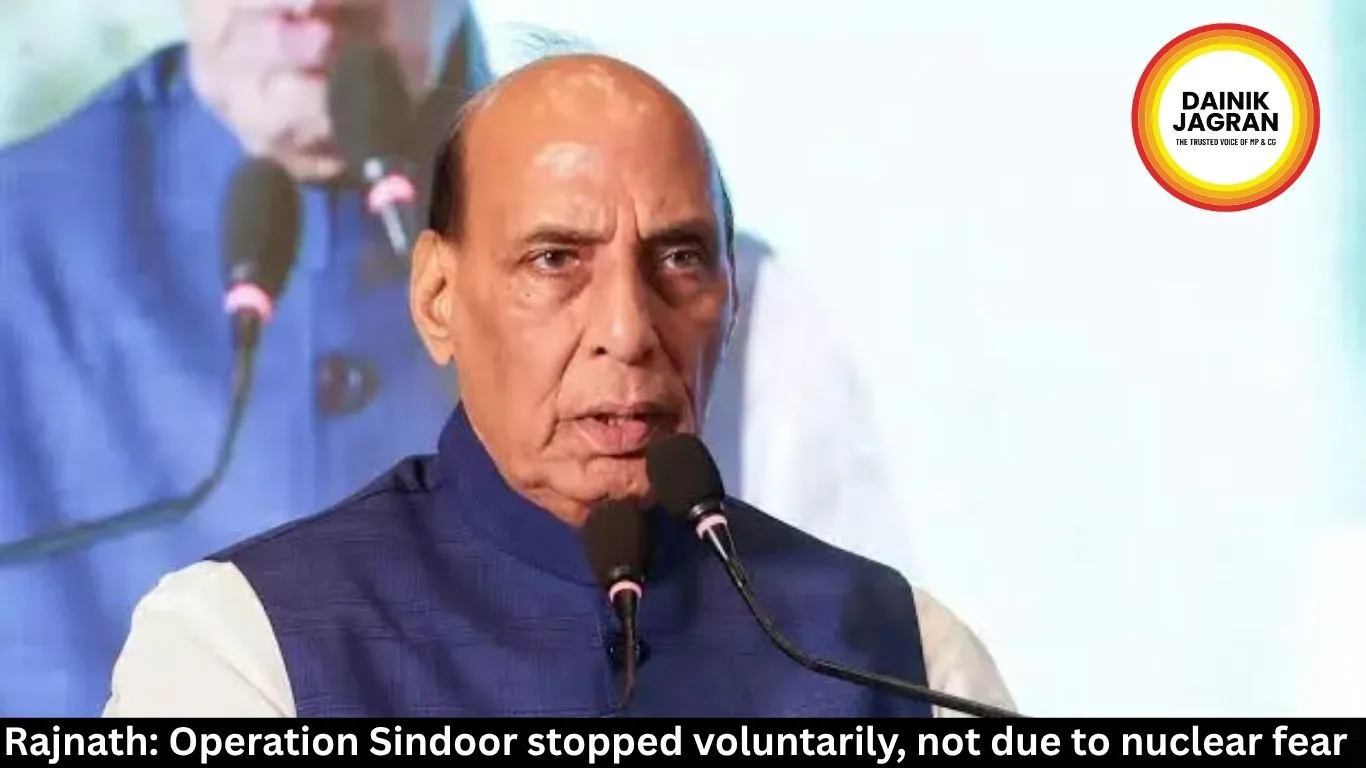
Rajnath: Operation Sindoor stopped voluntarily, not due to nuclear fear
Digital Desk
Defence Minister Rajnath Singh says India called off Operation Sindoor on its own terms, rejects nuclear threat fears, and asserts readiness for long conflict if needed.
‘Operation Sindoor was stopped voluntarily’: Rajnath rules out nuclear fear
Defence Minister says India called off Operation Sindoor on its own terms, asserts readiness for long conflict if needed.
Defence Minister Rajnath Singh on Thursday said India voluntarily halted Operation Sindoor and was not forced into the decision by Pakistan’s nuclear threats. Speaking at the ANI National Security Summit 2.0 in the capital, Singh described the operation as a deliberate, measured response — not a sign of hesitation.
No pressure from nuclear threats
Singh rejected suggestions that Islamabad’s nuclear brinkmanship influenced the government’s calculus. “Pakistan had threatened a nuclear attack, but India was not afraid of it,” he said. The Minister added that the Indian Army’s surge capacity — its ability to rapidly escalate troop and firepower strength — is now stronger than ever before.
Operation timeline and scale
India launched Operation Sindoor on May 7 last year, hours after a terrorist attack in Pahalgam killed several tourists. According to military assessments shared by officials, the operation struck nine major terrorist launchpads across Pakistan and Pakistan-occupied Jammu and Kashmir. Over 100 militants were reportedly killed in the cross-border strikes.
“This was a turning point,” Singh said. “It showed the world that India is no longer a country that only makes statements, but one that takes direct action.”
‘Long conflict’ readiness
Without naming specific scenarios, the Defence Minister said India is fully prepared for a protracted engagement against Pakistan if circumstances demand. “We stopped on our terms, voluntarily,” he reiterated. “If needed, we are ready for a long conflict.”
Sources familiar with the matter told reporters that the decision to end the operation was based on achieving tactical objectives — not external pressure.
Terrorism’s root cause
Singh drew a sharp contrast between the two neighbours. “India is known today for Information Technology. Pakistan is seen as the centre of ‘IT’ — International Terrorism,” he said.
The Defence Minister stressed that terrorism cannot be eliminated without uprooting its ideology and political patronage. “The root lies in its ideology and political support. Without removing this, terrorism cannot be fully wiped out,” he added.
Clear policy under PM
Singh said the government’s post-Uri and post-Pulwama doctrine remains unchanged: no terrorist attack will go unanswered. Under the Prime Minister’s leadership, he added, direct action will follow if needed — without seeking permission or signalling intent beforehand.
What next
While cross-border calm has largely held since the operation wound down early this summer, officials indicate surveillance along the Line of Control remains heightened. Intelligence inputs suggest Pakistan has not fully vacated forward launchpads, though no fresh mobilisation has been detected in recent weeks.
--------
šØ Beat the News Rush ā Join Now!
Get breaking alerts, hot exclusives, and game-changing stories instantly on your phone. No delays, no fluff ā just the edge you need. ā”
Tap to join:Ā
š¢ WhatsApp Channel: Dainik Jagran MP CG
Crave more?
š Facebook: Dainik Jagran MP CG English
š § Twitter (X): Dainik Jagran MP CG
š Instagram: Dainik Jagran MP CG
Share the fire ā keep your crew ahead! šļøš„
Rajnath: Operation Sindoor stopped voluntarily, not due to nuclear fear
Digital Desk
‘Operation Sindoor was stopped voluntarily’: Rajnath rules out nuclear fear
Defence Minister says India called off Operation Sindoor on its own terms, asserts readiness for long conflict if needed.
Defence Minister Rajnath Singh on Thursday said India voluntarily halted Operation Sindoor and was not forced into the decision by Pakistan’s nuclear threats. Speaking at the ANI National Security Summit 2.0 in the capital, Singh described the operation as a deliberate, measured response — not a sign of hesitation.
No pressure from nuclear threats
Singh rejected suggestions that Islamabad’s nuclear brinkmanship influenced the government’s calculus. “Pakistan had threatened a nuclear attack, but India was not afraid of it,” he said. The Minister added that the Indian Army’s surge capacity — its ability to rapidly escalate troop and firepower strength — is now stronger than ever before.
Operation timeline and scale
India launched Operation Sindoor on May 7 last year, hours after a terrorist attack in Pahalgam killed several tourists. According to military assessments shared by officials, the operation struck nine major terrorist launchpads across Pakistan and Pakistan-occupied Jammu and Kashmir. Over 100 militants were reportedly killed in the cross-border strikes.
“This was a turning point,” Singh said. “It showed the world that India is no longer a country that only makes statements, but one that takes direct action.”
‘Long conflict’ readiness
Without naming specific scenarios, the Defence Minister said India is fully prepared for a protracted engagement against Pakistan if circumstances demand. “We stopped on our terms, voluntarily,” he reiterated. “If needed, we are ready for a long conflict.”
Sources familiar with the matter told reporters that the decision to end the operation was based on achieving tactical objectives — not external pressure.
Terrorism’s root cause
Singh drew a sharp contrast between the two neighbours. “India is known today for Information Technology. Pakistan is seen as the centre of ‘IT’ — International Terrorism,” he said.
The Defence Minister stressed that terrorism cannot be eliminated without uprooting its ideology and political patronage. “The root lies in its ideology and political support. Without removing this, terrorism cannot be fully wiped out,” he added.
Clear policy under PM
Singh said the government’s post-Uri and post-Pulwama doctrine remains unchanged: no terrorist attack will go unanswered. Under the Prime Minister’s leadership, he added, direct action will follow if needed — without seeking permission or signalling intent beforehand.
What next
While cross-border calm has largely held since the operation wound down early this summer, officials indicate surveillance along the Line of Control remains heightened. Intelligence inputs suggest Pakistan has not fully vacated forward launchpads, though no fresh mobilisation has been detected in recent weeks.


