Soldier's Body to Return Home After 30 Years: DNA Confirms ‘Green Boots’ Was Ladakh’s Dorje Morup, Family Awaits Final Homecoming

Digital Desk

Soldier's Body to Return Home After 30 Years: DNA Confirms ‘Green Boots’ Was Ladakh’s Dorje Morup, Family Awaits Final Homecoming

After three decades on Mount Everest's infamous Death Zone, DNA testing has identified the legendary 'Green Boots' as Lance Naik Dorje Morup. His family in Ladakh is expected to receive his mortal remains by October, bringing closure to one of India's most poignant mountaineering stories.

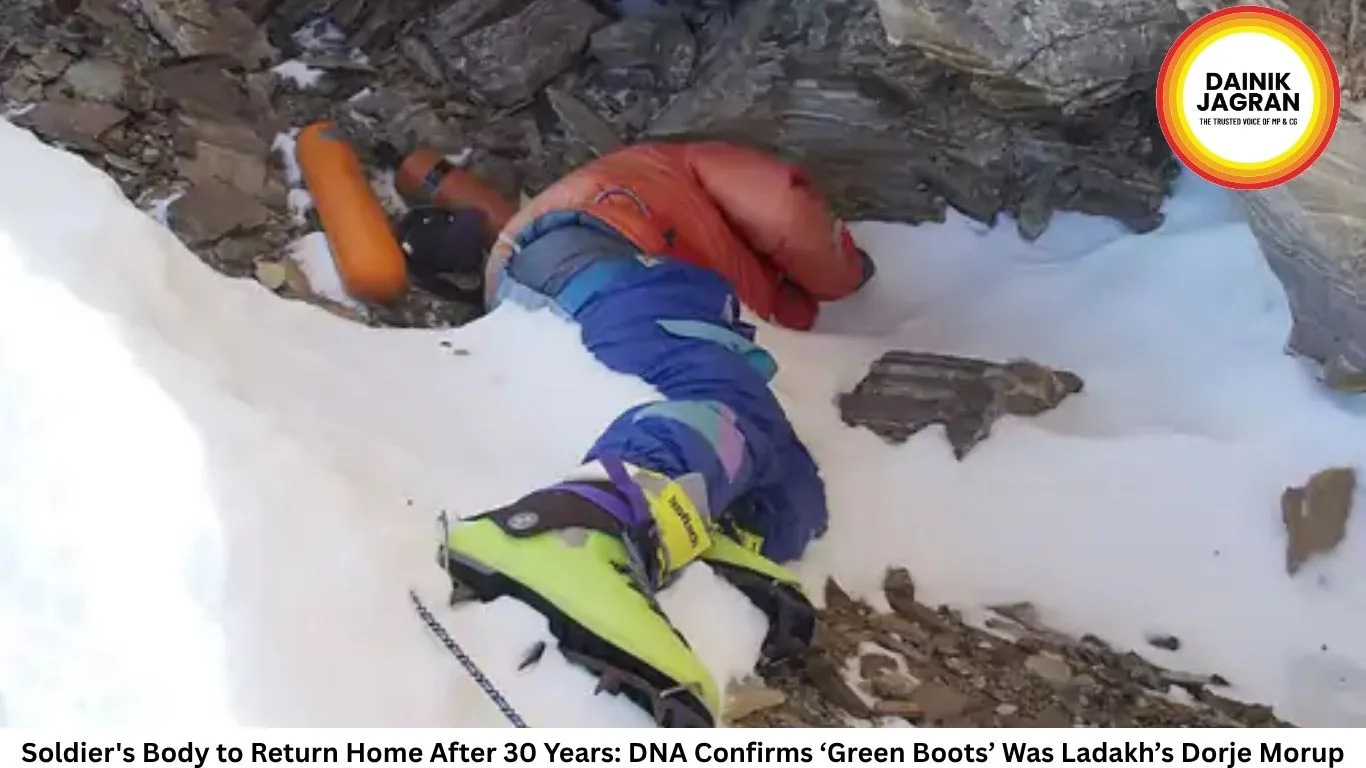
For nearly 30 years, the frozen body of a mountaineer resting on the icy slopes of Mount Everest served as a grim landmark for climbers attempting to conquer the world's highest peak. Known globally as "Green Boots" because of the distinctive green boots visible on the body, the identity of the climber remained the subject of debate for decades. Now, DNA testing has confirmed that the remains belong to Lance Naik Dorje Morup of Ladakh, ending years of speculation and paving the way for his final journey home.

Dorje Morup's family is expected to receive his body by October 2026, offering long-awaited closure after one of the most tragic chapters in Indian mountaineering history.

DNA Test Ends Three-Decade Mystery

For years, many believed the body was that of Indo-Tibetan Border Police (ITBP) Head Constable Tsewang Paljor. However, recent forensic analysis has established that the remains are actually those of Lance Naik Dorje Morup, who disappeared during the disastrous 1996 Everest expedition.

Morup, along with Head Constable Tsewang Paljor and Subedar Tsewang Smanla, formed India's three-member team attempting to summit Mount Everest through the northern Tibetan route.

On 10 May 1996, the climbers were caught in a violent snowstorm near the summit during what later became one of Everest's deadliest climbing seasons. The 1996 Everest disaster claimed the lives of 12 mountaineers, shocking the global climbing community.

A Wife's Wait Nears Its End

In Ladakh, the news has brought hope and emotion to Dorje Morup's family.

His 75-year-old wife, Konchok Yangskyt, has spent three decades waiting for her husband's return. Unable to hear and surviving on her husband's pension, she reportedly expressed her final wish in writing: "I will take my last breath only after seeing him."

Their son, Phuntsog Dorje, who serves in the Indian Army, said the family has not yet received complete details of the recovery mission but remains hopeful that his father's remains will finally return home after decades of uncertainty.

How 'Green Boots' Became an Everest Landmark

British mountaineer and filmmaker Matt Dickinson first filmed the body in 1996 during his Everest expedition. The footage later appeared in the documentary Summit Fever, introducing the world to what would become one of Everest's most recognizable landmarks.

The body rested inside a small rocky cave on the mountain's northern route, later known among climbers as "Green Boots Cave." Nearly every expedition ascending through this route passed the location, making it an unforgettable reference point on the climb toward the summit.

Why Recovery Took 30 Years

Recovering bodies from Everest's Death Zone, located above 8,000 metres (26,247 feet), is among the most dangerous rescue operations in the world.

At this altitude, oxygen levels are roughly one-third of those at sea level, making prolonged human activity extremely hazardous. Helicopters cannot safely operate at such heights, forcing recovery teams to rely on complex, high-risk climbing operations.

These challenges explain why the bodies of many climbers remain on the mountain for decades. Experts estimate that more than 340 mountaineers have died on Mount Everest over the years, with many still resting on its slopes.

An Emotional Homecoming

Dorje Morup's identification marks the end of one of mountaineering's longest-standing mysteries. Beyond solving the identity of "Green Boots," the development offers emotional closure to a family that waited three decades for answers.

As Ladakh prepares to welcome back one of its brave sons, the story stands as a powerful reminder of both the extraordinary courage and immense risks associated with climbing the world's highest mountain.


--------

🚨 Beat the News Rush – Join Now!

Get breaking alerts, hot exclusives, and game-changing stories instantly on your phone. No delays, no fluff – just the edge you need. ⚡

Tap to join: 

🟢 WhatsApp Channel: Dainik Jagran MP CG

Crave more?

🅕 Facebook: Dainik Jagran MP CG English

🅧 Twitter (X): Dainik Jagran MP CG

🅘 Instagram: Dainik Jagran MP CG

Share the fire – keep your crew ahead! 🗞️🔥

english.dainikjagranmpcg.com
19 Jul 2026 By Rishita

Soldier's Body to Return Home After 30 Years: DNA Confirms ‘Green Boots’ Was Ladakh’s Dorje Morup, Family Awaits Final Homecoming

Digital Desk

For nearly 30 years, the frozen body of a mountaineer resting on the icy slopes of Mount Everest served as a grim landmark for climbers attempting to conquer the world's highest peak. Known globally as "Green Boots" because of the distinctive green boots visible on the body, the identity of the climber remained the subject of debate for decades. Now, DNA testing has confirmed that the remains belong to Lance Naik Dorje Morup of Ladakh, ending years of speculation and paving the way for his final journey home.

Dorje Morup's family is expected to receive his body by October 2026, offering long-awaited closure after one of the most tragic chapters in Indian mountaineering history.

DNA Test Ends Three-Decade Mystery

For years, many believed the body was that of Indo-Tibetan Border Police (ITBP) Head Constable Tsewang Paljor. However, recent forensic analysis has established that the remains are actually those of Lance Naik Dorje Morup, who disappeared during the disastrous 1996 Everest expedition.

Morup, along with Head Constable Tsewang Paljor and Subedar Tsewang Smanla, formed India's three-member team attempting to summit Mount Everest through the northern Tibetan route.

On 10 May 1996, the climbers were caught in a violent snowstorm near the summit during what later became one of Everest's deadliest climbing seasons. The 1996 Everest disaster claimed the lives of 12 mountaineers, shocking the global climbing community.

A Wife's Wait Nears Its End

In Ladakh, the news has brought hope and emotion to Dorje Morup's family.

His 75-year-old wife, Konchok Yangskyt, has spent three decades waiting for her husband's return. Unable to hear and surviving on her husband's pension, she reportedly expressed her final wish in writing: "I will take my last breath only after seeing him."

Their son, Phuntsog Dorje, who serves in the Indian Army, said the family has not yet received complete details of the recovery mission but remains hopeful that his father's remains will finally return home after decades of uncertainty.

How 'Green Boots' Became an Everest Landmark

British mountaineer and filmmaker Matt Dickinson first filmed the body in 1996 during his Everest expedition. The footage later appeared in the documentary Summit Fever, introducing the world to what would become one of Everest's most recognizable landmarks.

The body rested inside a small rocky cave on the mountain's northern route, later known among climbers as "Green Boots Cave." Nearly every expedition ascending through this route passed the location, making it an unforgettable reference point on the climb toward the summit.

Why Recovery Took 30 Years

Recovering bodies from Everest's Death Zone, located above 8,000 metres (26,247 feet), is among the most dangerous rescue operations in the world.

At this altitude, oxygen levels are roughly one-third of those at sea level, making prolonged human activity extremely hazardous. Helicopters cannot safely operate at such heights, forcing recovery teams to rely on complex, high-risk climbing operations.

These challenges explain why the bodies of many climbers remain on the mountain for decades. Experts estimate that more than 340 mountaineers have died on Mount Everest over the years, with many still resting on its slopes.

An Emotional Homecoming

Dorje Morup's identification marks the end of one of mountaineering's longest-standing mysteries. Beyond solving the identity of "Green Boots," the development offers emotional closure to a family that waited three decades for answers.

As Ladakh prepares to welcome back one of its brave sons, the story stands as a powerful reminder of both the extraordinary courage and immense risks associated with climbing the world's highest mountain.

https://english.dainikjagranmpcg.com/national/soldiers-body-to-return-home-after-30-years-dna-confirms/article-22794

Trending News