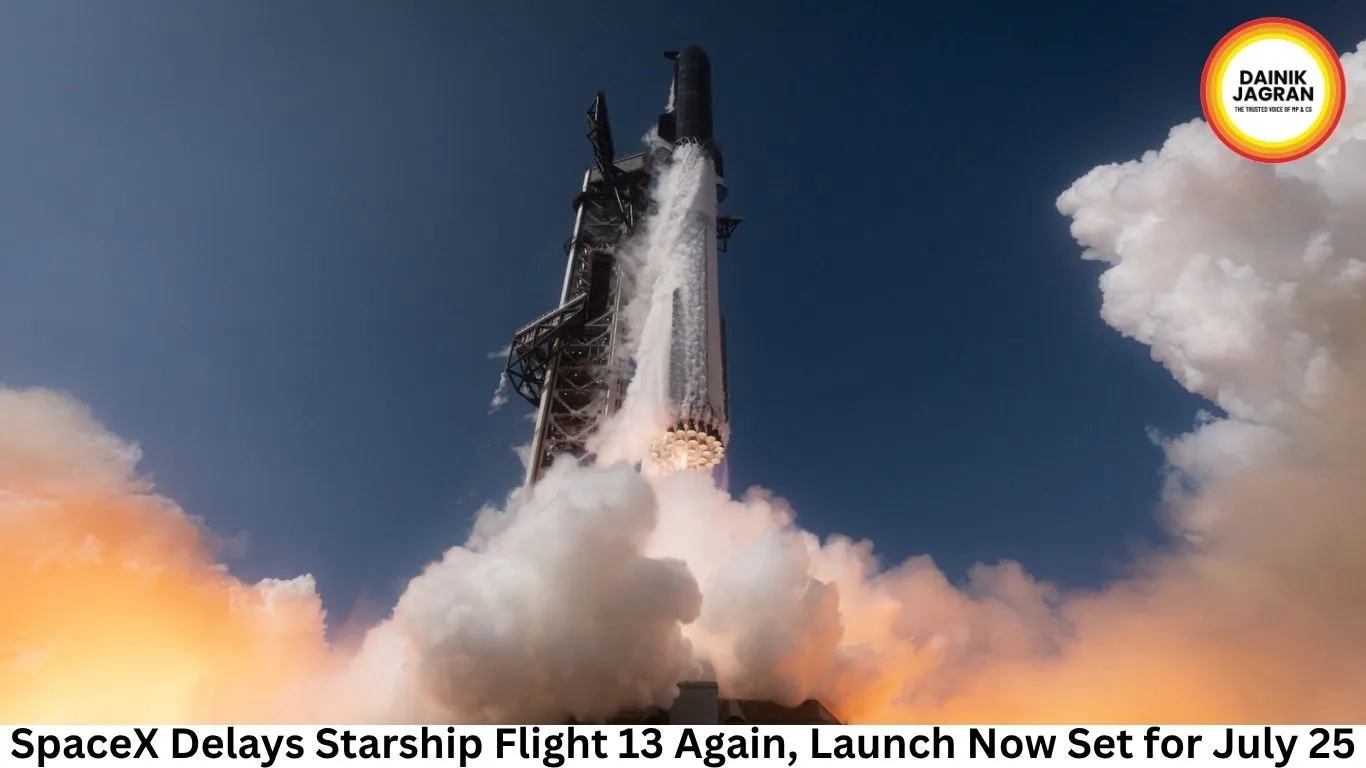
SpaceX Delays Starship Flight 13 Again, Launch Now Set for July 25
Digital Desk
SpaceX Starship Flight 13 has been postponed due to unfavourable weather at Starbase, Texas. The company now plans the next launch attempt on July 25, subject to suitable conditions.
SpaceX has postponed the launch of Starship Flight 13 for a second time, pushing back another major test of the world's largest and most powerful rocket. The company cited unfavourable weather conditions at Starbase, Texas, as the reason for the delay and announced that the next launch attempt is now targeted for July 25. The mission remains a key milestone in SpaceX's efforts to develop a fully reusable heavy-lift launch system for future Moon, Mars and deep-space missions.
Launch Delayed Again
The latest postponement comes after an earlier launch attempt scheduled for July 16 was aborted during the final countdown.
SpaceX had subsequently rescheduled the mission for July 24, but adverse weather conditions once again prevented liftoff. The company confirmed on social media that the next opportunity will be on July 25, provided weather conditions improve and all technical checks are successfully completed.
Weather Behind Delay
According to SpaceX, favourable weather is essential not only for a safe launch but also for meeting one of the mission's primary engineering objectives.
The company said engineers require clear atmospheric conditions to capture high-quality imagery of Starship's upgraded heat shield during flight. The visual data will help assess the spacecraft's thermal protection system and guide future improvements.
Mission Objectives
Starship Flight 13 is designed to evaluate several upgrades made to the fully reusable launch vehicle since earlier test missions.
Engineers will closely monitor the performance of the spacecraft and the Super Heavy booster throughout the flight. The mission is expected to provide valuable data on vehicle performance, heat shield durability and overall system reliability.
Focus On Reusability
Starship is central to SpaceX's long-term space exploration programme, which aims to reduce the cost of launching cargo and astronauts into space through rapid reusability.
The launch system is expected to play a significant role in future lunar missions under NASA's Artemis programme, commercial satellite deployments and eventually human missions to Mars.
Engineering First Approach
SpaceX has consistently maintained that gathering engineering data is more important than adhering to launch schedules.
The company has frequently delayed or scrubbed launches whenever weather conditions or technical factors could affect mission safety or compromise the quality of flight data. This testing strategy has become a defining feature of the Starship development programme.
Launch Timing
The company has scheduled the next launch attempt for Friday, July 25, at 6:45 p.m. EDT, which corresponds to approximately 4:15 a.m. IST on Saturday, July 26 from Starbase, Texas.
The schedule remains subject to weather conditions and final readiness assessments before liftoff.

--------
๐จ Beat the News Rush โ Join Now!
Get breaking alerts, hot exclusives, and game-changing stories instantly on your phone. No delays, no fluff โ just the edge you need. โก
Tap to join:ย
๐ข WhatsApp Channel: Dainik Jagran MP CG
Crave more?
๐ Facebook: Dainik Jagran MP CG English
๐ ง Twitter (X): Dainik Jagran MP CG
๐ Instagram: Dainik Jagran MP CG
Share the fire โ keep your crew ahead! ๐๏ธ๐ฅ
SpaceX Delays Starship Flight 13 Again, Launch Now Set for July 25
Digital Desk
SpaceX has postponed the launch of Starship Flight 13 for a second time, pushing back another major test of the world's largest and most powerful rocket. The company cited unfavourable weather conditions at Starbase, Texas, as the reason for the delay and announced that the next launch attempt is now targeted for July 25. The mission remains a key milestone in SpaceX's efforts to develop a fully reusable heavy-lift launch system for future Moon, Mars and deep-space missions.
Launch Delayed Again
The latest postponement comes after an earlier launch attempt scheduled for July 16 was aborted during the final countdown.
SpaceX had subsequently rescheduled the mission for July 24, but adverse weather conditions once again prevented liftoff. The company confirmed on social media that the next opportunity will be on July 25, provided weather conditions improve and all technical checks are successfully completed.
Weather Behind Delay
According to SpaceX, favourable weather is essential not only for a safe launch but also for meeting one of the mission's primary engineering objectives.
The company said engineers require clear atmospheric conditions to capture high-quality imagery of Starship's upgraded heat shield during flight. The visual data will help assess the spacecraft's thermal protection system and guide future improvements.
Mission Objectives
Starship Flight 13 is designed to evaluate several upgrades made to the fully reusable launch vehicle since earlier test missions.
Engineers will closely monitor the performance of the spacecraft and the Super Heavy booster throughout the flight. The mission is expected to provide valuable data on vehicle performance, heat shield durability and overall system reliability.
Focus On Reusability
Starship is central to SpaceX's long-term space exploration programme, which aims to reduce the cost of launching cargo and astronauts into space through rapid reusability.
The launch system is expected to play a significant role in future lunar missions under NASA's Artemis programme, commercial satellite deployments and eventually human missions to Mars.
Engineering First Approach
SpaceX has consistently maintained that gathering engineering data is more important than adhering to launch schedules.
The company has frequently delayed or scrubbed launches whenever weather conditions or technical factors could affect mission safety or compromise the quality of flight data. This testing strategy has become a defining feature of the Starship development programme.
Launch Timing
The company has scheduled the next launch attempt for Friday, July 25, at 6:45 p.m. EDT, which corresponds to approximately 4:15 a.m. IST on Saturday, July 26 from Starbase, Texas.
The schedule remains subject to weather conditions and final readiness assessments before liftoff.