


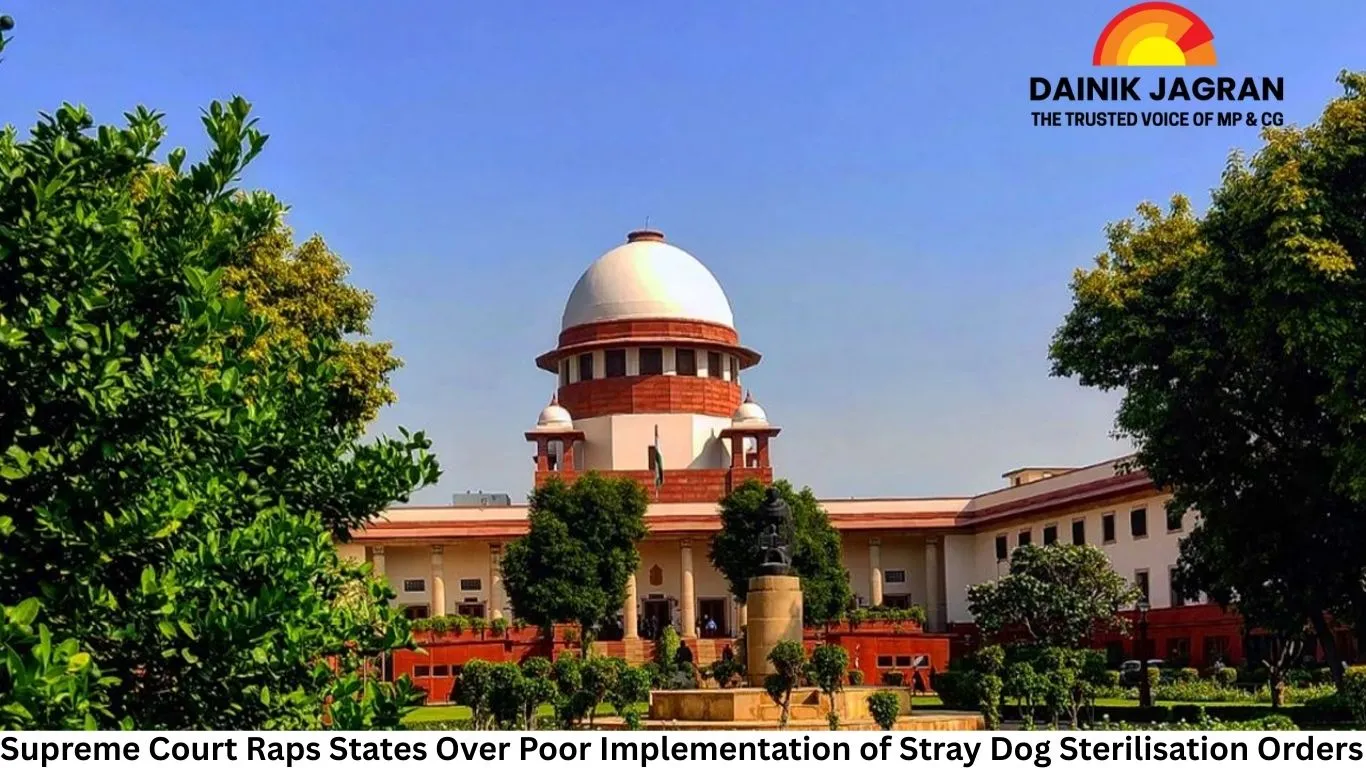
Supreme Court Raps States Over Poor Implementation of Stray Dog Sterilisation Orders
Digital Desk
A Bench comprising Justice Vikram Nath, Justice Sandeep Mehta and Justice N.V. Anjaria expressed serious displeasure over the lack of concrete action to increase sterilisation of stray dogs, despite repeated judicial orders. The court said that several states have submitted reports only on paper, with little evidence of effective implementation at the field level.
The observations came during hearings on compliance with directions related to Animal Birth Control (ABC) programmes, dog bite prevention, and public safety measures. Senior advocate Gaurav Agrawal, appointed as amicus curiae, presented a consolidated assessment of steps taken by various states and highlighted major gaps in execution.
The court outlined a series of actions that states must urgently undertake, including scaling up sterilisation drives, expanding ABC centres, constructing adequate dog shelters, fencing sensitive locations such as schools and hospitals, and removing stray animals from streets and highways. It stressed that public buildings must be secured to protect children, patients and government property.
Raising concerns over Bihar, the Bench noted that while the state claimed to have 34 ABC centres and reported sterilisation of around 20,000 dogs, the figure was negligible in comparison to an estimated stray dog population of over six lakh. The court also pointed out that Bihar failed to clearly disclose daily sterilisation rates or the extent of fencing in public areas.
The lack of reliable data on dog bite incidents drew particular concern. Except for Assam, no state submitted figures on injuries caused by dog attacks. Assam’s data alarmed the court: 1.66 lakh dog bite cases were reported in 2024, with 20,900 cases recorded in January 2025 alone. The Bench described the situation as “deeply disturbing”.
Justice Nath warned that the court would no longer accept vague or incomplete responses, adding that states failing to provide precise data could face strong judicial remarks. Arguments were heard from Goa, Karnataka, Madhya Pradesh, Jharkhand and Gujarat, while reports from Punjab, Rajasthan, Tamil Nadu, Uttar Pradesh and Telangana are scheduled for consideration on Thursday.
The court also indicated that states may be compelled to pay heavy compensation in dog bite cases. It observed that individuals feeding stray dogs could also be held accountable, and directed that captured dogs should not be released back into the same localities. All states were instructed to remove stray animals and livestock from national and state highways to prevent accidents.
.jpg)




