


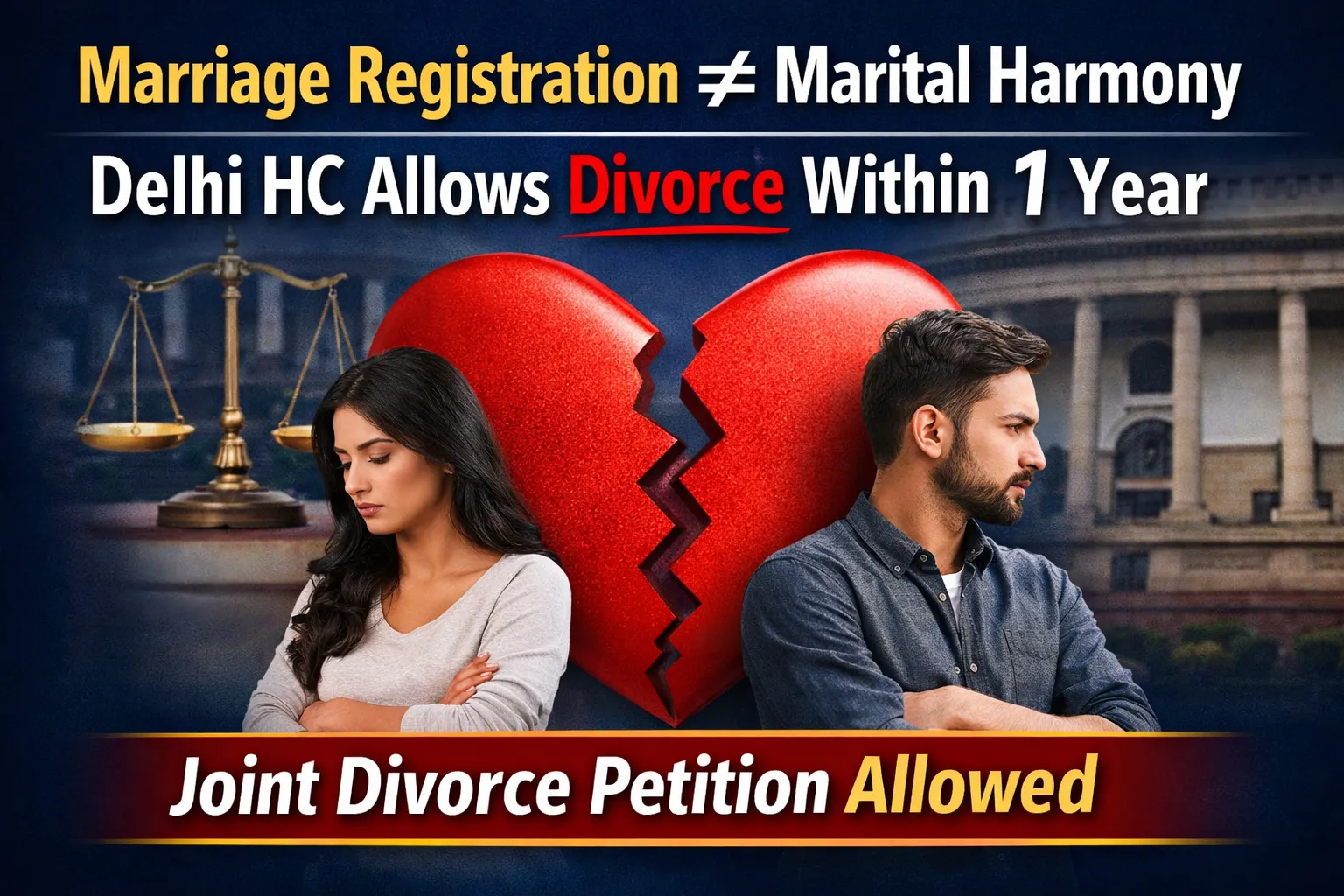
Marriage Registration Not Proof of Marital Harmony: Delhi High Court Allows Joint Divorce Petition Within One Year
Digital Desk
The decision was delivered on Wednesday by a division bench of Justice Vivek Chaudhary and Justice Renu Bhatnagar while hearing a petition filed by a woman challenging an order of a Family Court. The Family Court had refused to grant permission to file a joint divorce petition under Section 13B of the Hindu Marriage Act (HMA) within one year of marriage, citing the bar under Section 14 of the Act.
The petitioner contended that the marriage was never consummated and that the couple had not lived together even for a single day after the wedding. According to the plea, both parties returned to their respective parental homes immediately after the marriage and mutually decided that the relationship could not continue. Despite this, the Family Court rejected the plea, holding that the couple had failed to demonstrate “exceptional hardship,” a requirement under Section 14 for seeking divorce within one year.
The Family Court also noted that the marriage had been registered soon after the ceremony, which, in its view, contradicted the claim of exceptional hardship and suggested that sufficient efforts had not been made to save the marriage.
Setting aside the Family Court’s order, the High Court took a different view. It observed that since the parties had never cohabited and the marriage was never consummated, the very foundation of the marital relationship was absent. The bench held that a registered marriage, by itself, cannot be used to deny parties the right to seek divorce when the relationship has never taken shape in reality.
“Compelling parties to continue a marriage that exists only in records would cause unnecessary hardship and serve no meaningful purpose,” the court observed. It further held that the case squarely fell within the exception provided under Section 14 of the HMA, which allows courts to waive the one-year waiting period in cases of exceptional hardship or depravity.
Allowing the petition, the High Court granted permission to the couple to file a joint divorce petition by mutual consent before the appropriate court. Legal experts say the ruling reinforces a pragmatic approach to matrimonial disputes and underscores that the law must account for the factual realities of a relationship, not merely its formal existence.



.jpg)




