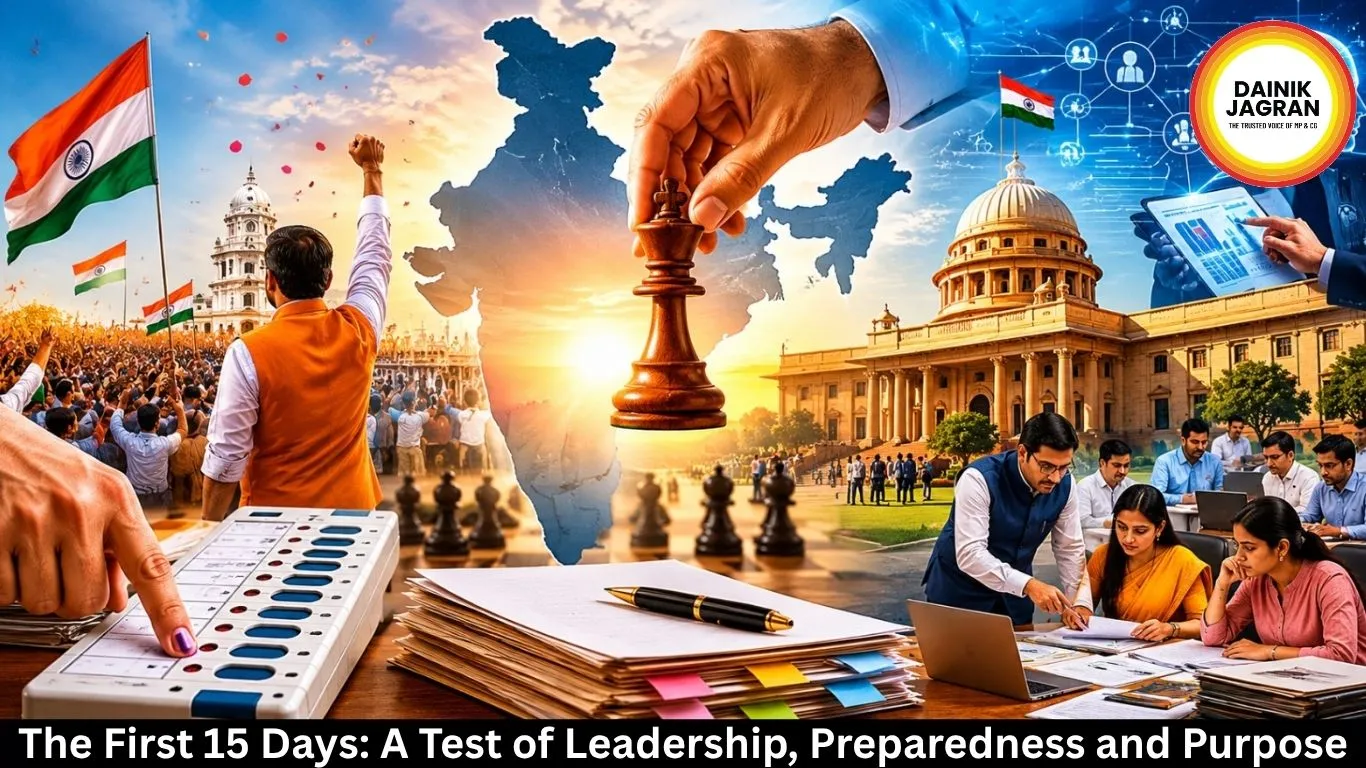
The First 15 Days: A Test of Leadership, Preparedness and Purpose

New Delhi

The First 15 Days: A Test of Leadership, Preparedness and Purpose

The most revealing phase of an election often begins after the votes have been counted. Campaigns may determine who wins power, but the opening days of a new government frequently reveal something deeper: whether a party entered office with a governing agenda already prepared or whether it is still working out how power should be exercised.

The recent electoral verdicts across Assam, West Bengal, Puducherry, Keralam and Tamil Nadu offered an unusually clear illustration of this distinction. The contrast was not simply between different parties or ideologies. It was between governments that appeared ready to govern from day one and governments that spent their formative weeks resolving questions that ordinarily precede governance.

The advantage of AdministrationPreparedness

One of the recurring features of modern politics is that election campaigns increasingly serve as rehearsals for government. Parties that enter elections with settled leadership, defined priorities and implementation plans are often able to convert a mandate into action almost immediately.

Assam exemplified that model. Returned to office with 102 seats, including 82 for the BJP, the Himanta Biswa Sarma government quickly moved from victory to execution. A roadmap for two lakh government jobs, approval of all 31 commitments contained in the BJP's SankalpaPatra 2026 and the creation of an implementation mechanism under the Chief Secretary signalled an administration treating its manifesto as a governing document rather than an electoral one. The same approach extended into governance reforms through a six-month austerity programme, the Assam State Data Policy 2026 and the establishment of a Centre for Data Management focused on technology-led administration.

Most significantly, the government moved towards introducing a Uniform Civil Code framework, becoming only the third state to take concrete steps in that direction. Regardless of one's position on the proposal, its timing was noteworthy. Governments generally defer politically sensitive reforms until later in their tenure. Assam chose to place one of its most consequential commitments at the centre of its opening agenda.

If Assam demonstrated preparedness through policy execution, West Bengal sought to project it through a broader administrative and political reset. Following the BJP's historic victory with 207 seats and the formation of the state's first BJP government under Chief Minister Suvendu Adhikari, the administration moved quickly on multiple fronts. Pending central schemes such as Ayushman Bharat, PM-KISAN and Ujjwala were activated, BSF border fencing projects received land allocation, government job eligibility was expanded and the long-pending census process was initiated.

Equally important was the effort to signal a change in governing culture. Action against syndicates, illegal mining, cattle smuggling and recruitment scams was accompanied by approval for CBI prosecution in corruption cases and implementation of the BharatiyaNyayaSanhita and BharatiyaSakshyaAdhiniyam. Welfare measures such as the Annapurna scheme, free bus travel for women, enhanced pensions, BharatNet expansion and approval of the Seventh State Pay Commission were paired with greater recruitment transparency and institutional restructuring.

The government also sought to define a distinct governing identity through reviews of caste certificates and OBC classifications, the discontinuation of religion-based assistance schemes, reforms in agricultural produce movement and civic measures such as compulsory Vande Mataram in educational institutions and restrictions on public-road namaz. Taken together, the decisions reflected an administration attempting to shape both governance and political messaging from the outset.

Puducherry offered a smaller but equally relevant example. Continuity under Chief Minister N. Rangasamy allowed the government to focus immediately on delivery. The revival of the Karaikal–Peralam railway connection through Thirunallar after nearly four decades, additional rooftop solar subsidies benefiting around 13,000 families and housing relief measures supporting approximately 8,600 families all pointed towards an administration concentrating on implementation rather than transition.

When Politics Delays Governance

Not every newly elected government entered office with the same degree of administrative clarity. In Keralam, the UDF's victory ended a decade of LDF rule, yet much of the early political conversation revolved around who would govern rather than how governance would unfold. The nearly ten-day leadership contest between camps backing V.D. Satheesan and K.C. Venugopal was followed by disagreements over portfolio allocation between Congress and the IUML, ensuring that political management dominated the government's formative period.

The pattern continued thereafter. Controversies surrounding the swearing-in ceremony, criticism over senior appointments and the resurfacing of the Munambam Waqf dispute affecting more than 600 families kept attention focused on disputes rather than direction. Even where assurances were offered, the broader challenge remained the same: the government was still defining its internal equilibrium at a moment when voters were looking for early signals of governance.

Tamil Nadu witnessed a different version of the same challenge. Although TVK emerged as the largest party, government formation depended heavily on coalition management involving Congress and multiple alliance partners. As a result, the early political conversation was shaped as much by negotiations and government formation as by governance itself.

That sense of transition persisted after the swearing-in. Modifications to key campaign promises, delays in portfolio allocation and controversy surrounding the appointment of Vijay's astrologer as Officer on Special Duty created avoidable distractions during the government's opening days. Simultaneously, power cuts and law-and-order concerns ensured that public attention remained focused on immediate challenges before a coherent governing narrative could fully emerge.

A Mandate Is Only the Beginning

The experiences of these five states underline a simple reality: electoral victory and governing readiness are not always the same thing. Some governments spent their opening weeks implementing priorities and signalling direction. Others spent them settling leadership questions, managing alliances and responding to controversies.

The distinction matters because elections do not end with the declaration of results. They merely move into a different phase. Winning power is the first test of politics. Using it effectively is the first test of governance. The weeks that follow often reveal who arrived prepared to govern and who arrived prepared only to win.




--------

🚨 Beat the News Rush – Join Now!

Get breaking alerts, hot exclusives, and game-changing stories instantly on your phone. No delays, no fluff – just the edge you need. ⚡

Tap to join: 

🟢 WhatsApp Channel: Dainik Jagran MP CG

Crave more?

🅕 Facebook: Dainik Jagran MP CG English

🅧 Twitter (X): Dainik Jagran MP CG

🅘 Instagram: Dainik Jagran MP CG

Share the fire – keep your crew ahead! 🗞️🔥

english.dainikjagranmpcg.com
29 May 2026 By Danik Jagran English

The First 15 Days: A Test of Leadership, Preparedness and Purpose

New Delhi

The recent electoral verdicts across Assam, West Bengal, Puducherry, Keralam and Tamil Nadu offered an unusually clear illustration of this distinction. The contrast was not simply between different parties or ideologies. It was between governments that appeared ready to govern from day one and governments that spent their formative weeks resolving questions that ordinarily precede governance.

The advantage of AdministrationPreparedness

One of the recurring features of modern politics is that election campaigns increasingly serve as rehearsals for government. Parties that enter elections with settled leadership, defined priorities and implementation plans are often able to convert a mandate into action almost immediately.

Assam exemplified that model. Returned to office with 102 seats, including 82 for the BJP, the Himanta Biswa Sarma government quickly moved from victory to execution. A roadmap for two lakh government jobs, approval of all 31 commitments contained in the BJP's SankalpaPatra 2026 and the creation of an implementation mechanism under the Chief Secretary signalled an administration treating its manifesto as a governing document rather than an electoral one. The same approach extended into governance reforms through a six-month austerity programme, the Assam State Data Policy 2026 and the establishment of a Centre for Data Management focused on technology-led administration.

Most significantly, the government moved towards introducing a Uniform Civil Code framework, becoming only the third state to take concrete steps in that direction. Regardless of one's position on the proposal, its timing was noteworthy. Governments generally defer politically sensitive reforms until later in their tenure. Assam chose to place one of its most consequential commitments at the centre of its opening agenda.

If Assam demonstrated preparedness through policy execution, West Bengal sought to project it through a broader administrative and political reset. Following the BJP's historic victory with 207 seats and the formation of the state's first BJP government under Chief Minister Suvendu Adhikari, the administration moved quickly on multiple fronts. Pending central schemes such as Ayushman Bharat, PM-KISAN and Ujjwala were activated, BSF border fencing projects received land allocation, government job eligibility was expanded and the long-pending census process was initiated.

Equally important was the effort to signal a change in governing culture. Action against syndicates, illegal mining, cattle smuggling and recruitment scams was accompanied by approval for CBI prosecution in corruption cases and implementation of the BharatiyaNyayaSanhita and BharatiyaSakshyaAdhiniyam. Welfare measures such as the Annapurna scheme, free bus travel for women, enhanced pensions, BharatNet expansion and approval of the Seventh State Pay Commission were paired with greater recruitment transparency and institutional restructuring.

The government also sought to define a distinct governing identity through reviews of caste certificates and OBC classifications, the discontinuation of religion-based assistance schemes, reforms in agricultural produce movement and civic measures such as compulsory Vande Mataram in educational institutions and restrictions on public-road namaz. Taken together, the decisions reflected an administration attempting to shape both governance and political messaging from the outset.

Puducherry offered a smaller but equally relevant example. Continuity under Chief Minister N. Rangasamy allowed the government to focus immediately on delivery. The revival of the Karaikal–Peralam railway connection through Thirunallar after nearly four decades, additional rooftop solar subsidies benefiting around 13,000 families and housing relief measures supporting approximately 8,600 families all pointed towards an administration concentrating on implementation rather than transition.

When Politics Delays Governance

Not every newly elected government entered office with the same degree of administrative clarity. In Keralam, the UDF's victory ended a decade of LDF rule, yet much of the early political conversation revolved around who would govern rather than how governance would unfold. The nearly ten-day leadership contest between camps backing V.D. Satheesan and K.C. Venugopal was followed by disagreements over portfolio allocation between Congress and the IUML, ensuring that political management dominated the government's formative period.

The pattern continued thereafter. Controversies surrounding the swearing-in ceremony, criticism over senior appointments and the resurfacing of the Munambam Waqf dispute affecting more than 600 families kept attention focused on disputes rather than direction. Even where assurances were offered, the broader challenge remained the same: the government was still defining its internal equilibrium at a moment when voters were looking for early signals of governance.

Tamil Nadu witnessed a different version of the same challenge. Although TVK emerged as the largest party, government formation depended heavily on coalition management involving Congress and multiple alliance partners. As a result, the early political conversation was shaped as much by negotiations and government formation as by governance itself.

That sense of transition persisted after the swearing-in. Modifications to key campaign promises, delays in portfolio allocation and controversy surrounding the appointment of Vijay's astrologer as Officer on Special Duty created avoidable distractions during the government's opening days. Simultaneously, power cuts and law-and-order concerns ensured that public attention remained focused on immediate challenges before a coherent governing narrative could fully emerge.

A Mandate Is Only the Beginning

The experiences of these five states underline a simple reality: electoral victory and governing readiness are not always the same thing. Some governments spent their opening weeks implementing priorities and signalling direction. Others spent them settling leadership questions, managing alliances and responding to controversies.

The distinction matters because elections do not end with the declaration of results. They merely move into a different phase. Winning power is the first test of politics. Using it effectively is the first test of governance. The weeks that follow often reveal who arrived prepared to govern and who arrived prepared only to win.


https://english.dainikjagranmpcg.com/national/the-first-15-days-a-test-of-leadership-preparedness-and/article-19436
Tags:

Latest News