


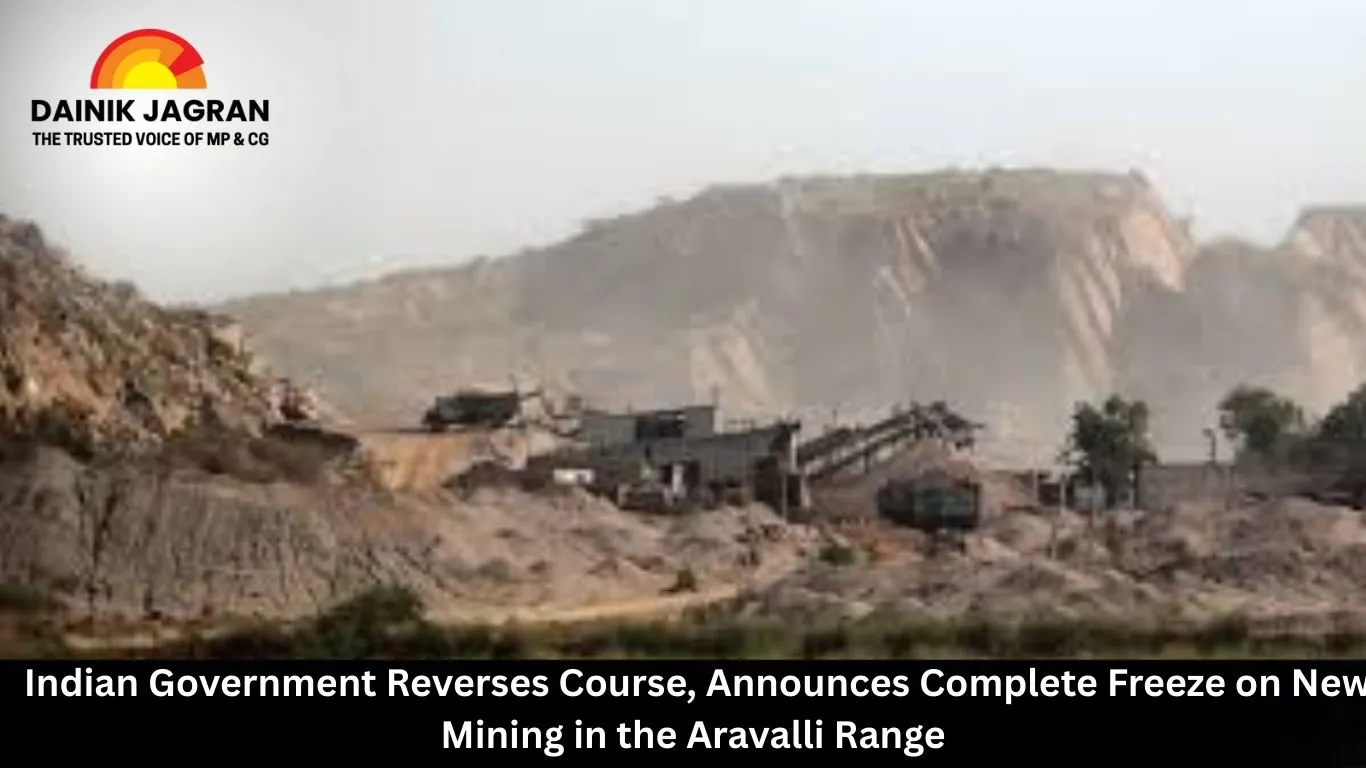
Indian Government Reverses Course, Announces Complete Freeze on New Mining in the Aravalli Range
Digital Desk
In a significant policy reversal, the Indian government has ordered a comprehensive freeze on issuing any new mining leases across the entire Aravalli mountain range, prioritizing long-term ecological security over narrow definitions.
The Ministry of Environment, Forest and Climate Change has directed all concerned state governments to halt the approval of new mining licenses in the Aravalli region. This directive applies irrespective of terrain elevation, marking a decisive shift from a controversial earlier proposal that would have protected only hills above 100 meters. The move is being seen as a direct response to widespread public and political backlash from environmentalists, scientists, and local communities.
The government has stated this freeze will remain until a complete scientific assessment and mapping of the entire ecosystem is completed by the Indian Council of Forestry Research and Education (ICFRE). This new ecosystem-based approach aims to identify and protect all ecologically sensitive zones, moving beyond a simple height-based criterion.
What the New Mining Ban Means on the Ground
The central government's order introduces several key provisions for the protection of the Aravallis:
A Complete Freeze: No fresh mining leases are to be granted anywhere within the Aravalli range system. The government has termed this a "preventive freeze," not a temporary pause.
Scrutiny of Existing Operations: Mining projects with valid existing clearances may continue, but only if they adhere to strict environmental norms and Supreme Court guidelines. State governments are mandated to actively monitor and review these ongoing leases for any violations.
Expansion of Protected Zones: The government has committed to protecting not just the Aravalli hills but also their surrounding areas. The ICFRE-led study will recommend "no-go zones" where all construction and industrial activity could be prohibited.
From Controversial Definition to Public Backlash
The policy reversal follows a contentious period that began in October. Initially, the central government proposed to the Supreme Court that only landforms with an elevation of 100 meters or more should qualify as "Aravalli hills" for protection.
This narrow definition triggered immediate alarm. Environmental experts argued that vast stretches of the ancient, eroded Aravalli range, which perform critical ecological functions like preventing desertification and recharging groundwater, would be left vulnerable. They warned that 80-90% of the range could be excluded, opening it up to exploitation.
The opposition, along with activists and civil society groups, labeled the initial definition a dilution of environmental protection. The significant public pressure is widely considered the catalyst for the government's current "big U-turn".
A Critical Shield for North India
The Aravalli range, one of the world's oldest mountain systems, serves as a vital natural ecological barrier. It hinders the eastward expansion of the Thar Desert, aids in groundwater recharge for states like Rajasthan, Haryana, and Delhi, and helps filter dust storms.
| Policy Aspect | Initial Government Stance (Oct-Nov 2025) | Revised Government Order (Dec 2025) |
| Definition for Protection | Hills with 100m+ elevation only | Entire Aravalli ecosystem, irrespective of height |
| New Mining Leases | Implied possibility in areas below 100m | Complete freeze across the entire range |
| Basis for Protection | Arbitrary height-based rule | Scientific, ecosystem-based mapping (by ICFRE) |
| Public & Expert Response | Widespread criticism and protests | Cautious welcome, calls for strict implementation |
The political reaction to the reversal has been mixed. While the government defends it as its "strongest protection tool," the opposition has called it a "damage control" measure. They caution that the old 100-meter definition technically remains until the new mapping is notified, and past violations have often gone unpunished.
The responsibility now shifts to state governments for enforcement. The effectiveness of this ban in halting illegal mining and securing the future of this critical landscape will depend on vigilant monitoring and transparent implementation on the ground.




.jpg)




