
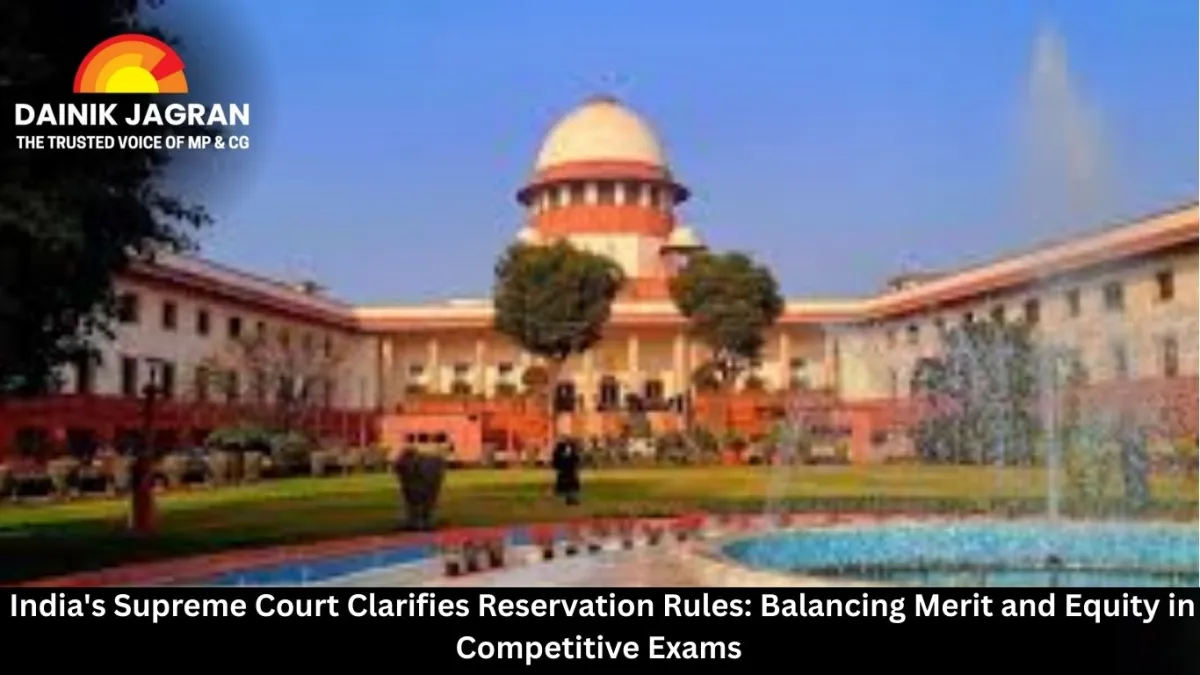

India's Supreme Court Clarifies Reservation Rules: Balancing Merit and Equity in Competitive Exams
Digital Desk
In a significant development for India's competitive examination landscape, the Supreme Court has recently issued clarifying judgments that address long-standing ambiguities surrounding reservation policies in public employment and educational admissions.
These rulings come as welcome guidance for both examination conducting bodies and millions of aspirants who navigate the complex interplay between merit-based selection and constitutional provisions for affirmative action.
The Court's decisions tackle two fundamental questions that have created confusion and litigation in recruitment processes: whether reserved category candidates can compete for general category seats, and whether candidates can claim reservation benefits at one stage of an examination while seeking general category status at another stage.
The Core Clarifications: Eligibility and Category Lock-In
The first judgment establishes that candidates from Scheduled Castes (SC), Scheduled Tribes (ST), Other Backward Classes (OBC), and Economically Weaker Sections (EWS) can compete for general category seats provided they do not avail themselves of any reservation benefits during the examination process. This includes age relaxation, lower cut-off marks, or any other concession tied to their reserved status.
This recognition that "general category is open to all" protects meritocracy while acknowledging caste identity alone cannot disqualify someone from competing on equal footing. The judgment effectively states that high-performing candidates from reserved backgrounds deserve full merit recognition when they compete without special concessions.
The second, more recent ruling addresses what has been termed "double benefit" scenarios. The Court has made it clear that once a candidate avails reservation benefits at any stage of a multi-stage examination process—be it preliminary, mains, or interview—they must remain within that reserved category throughout the entire selection process.
This "category lock-in" principle prevents candidates from strategically using reservation concessions to clear initial hurdles (like age relaxation to qualify for the exam) and then switching to general category pools for final selection if their scores are high enough. The Court explicitly rejected this practice as unfair and constitutionally impermissible, ensuring transparent and consistent application of reservation policies.
Constitutional Balancing Act
These rulings represent the Court's ongoing effort to balance competing constitutional principles: the guarantee of equality before law (Article 14) and equal opportunity in public employment (Article 16) with the special provisions for socially and educationally backward classes (Article 15) and reservation in appointments (Article 16).
The judiciary has consistently recognized that while affirmative action is essential to remedy historical injustices, it must not morph into an unfair advantage that undermines the constitutional framework. The recent decisions reinforce that reservation policies and merit-based selection are complementary rather than contradictory principles when properly implemented.
Practical Implications for Examination Systems
For examination conducting bodies like the Union Public Service Commission (UPSC), Staff Selection Commission (SSC), and state public service commissions, these rulings provide much-needed clarity. Recruitment agencies must now clearly identify candidates availing reservation benefits and maintain consistent category status throughout selection processes.
The transparency mandated by these judgments should reduce post-examination litigation and allegations of bias that have plagued recruitment drives. General category candidates now have greater assurance that reserved category candidates cannot claim their seats after utilizing reservation concessions, while reserved category candidates understand the consequences of their choice to use or forgo benefits.
Broader Context of Reservation in Judiciary
Interestingly, these rulings on reservation in public employment come alongside discussions about representation within the judiciary itself. Recent data shows that from 2018 onwards, approximately 78% of judges appointed to High Courts came from general category backgrounds, with only 22 from Scheduled Castes, 16 from Scheduled Tribes, 89 from OBC categories, and 37 from minority communities out of 715 appointments.
The Supreme Court itself recently implemented reservation policies for its administrative staff for the first time in its 75-year history, with 15% reservation for SC and 7.5% for ST categories effective from June 2025. This move toward greater institutional diversity at the administrative level highlights the ongoing evolution of affirmative action implementation even within judicial institutions.
The Road Ahead: Clarity with Continuing Debates
While these Supreme Court rulings provide clearer operational guidelines for reservation implementation in competitive examinations, fundamental debates about the nature, extent, and duration of affirmative action in India will undoubtedly continue. The tension between individual merit and group-based remedies, between formal equality and substantive justice, remains at the heart of India's social policy landscape.
What these judgments achieve is procedural clarity—establishing transparent rules for how reservation policies should be implemented in multi-stage selection processes. By preventing strategic manipulation of category status and recognizing genuine merit irrespective of background, the Court has strengthened both the integrity of competitive examinations and the legitimate aims of affirmative action.
As India continues to grapple with inequalities embedded in its social fabric, these rulings represent not an endpoint but a clarification of rules for the ongoing journey toward a society that balances equal opportunity with substantive justice.
.jpg)




