


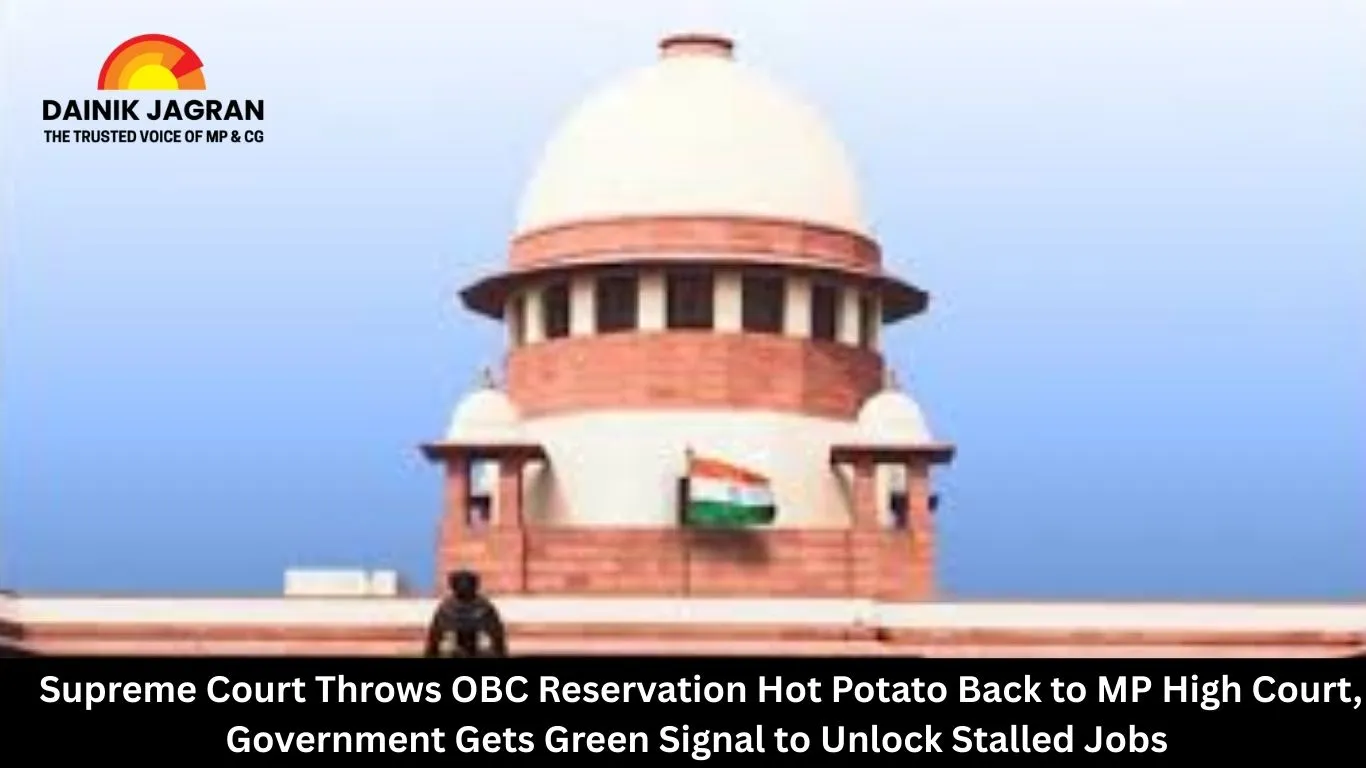
Supreme Court Throws OBC Reservation Hot Potato Back to MP High Court, Government Gets Green Signal to Unlock Stalled Jobs
Digital Desk
In a dramatic twist to a long-running legal saga, the Supreme Court of India has cleared the air but passed the buck. The apex court on Wednesday transferred all pending petitions related to the contentious 27% OBC reservation in Madhya Pradesh back to the Gwalior bench of the Madhya Pradesh High Court. While this might sound like a step backward, the fine print of the judgment offers a significant breather to the Mohan Yadav government in Bhopal and lakhs of OBC aspirants waiting for government jobs .
This legal shuffle, which has been ongoing since the Congress government first introduced the quota in 2019, finally has a clear directive: the High Court will now decide the constitutional validity of increasing OBC reservation from 14% to 27%. But here is the political and administrative kicker—the Supreme Court has made it clear that there is no stay on the implementation of this quota.
The 'Hold' is Finally Off
For years, the single biggest roadblock for recruiting agencies like the Madhya Pradesh Public Service Commission (MPPSC) and the Employee Selection Board (ESB) was the confusion over the "87:13 formula." Under this arrangement, while 87% of vacancies were being filled, 13% of posts were kept in a "hold" status due to the pending litigation.
The Supreme Court has now effectively dismantled this logjam. By clarifying that the absence of a stay means the law is operational, the ball is now firmly in the government's court. "The Supreme Court has clearly stated that the approximately 13% posts that were held back are now up to the state government's policy to unlock," legal experts confirmed following the hearing . This means if the Yadav government wants to push through with recruitments at the pre-2019 levels or the new enhanced level, the legal hurdle has been removed.
A Judicial Reprimand and a Reality Check
However, the order wasn't just a technical transfer; it came with a strong dose of judicial candor. Sources indicate that the bench was less than impressed with the state government's conduct during the hearings. There was a pointed observation regarding the "unnecessary delays" caused in the proceedings .
This stems from an incident just weeks ago when the court had pulled up the Madhya Pradesh government for its lawyers not being present during crucial hearings. On January 29, 2026, when the final arguments were scheduled, the government counsel was notably absent, leading to an adjournment and visible judicial irritation . The Supreme Court noted that transferring the case back to the High Court was not just about jurisdiction, but also about ensuring that the factual matrix regarding population and geographical conditions is best assessed by the High Court itself.
Why This Matters Now
So, why is this the biggest news for Madhya Pradesh today? Because this isn't just about a legal technicality; it is about political credit and electoral promises.
- The Congress Legacy: It was the Kamal Nath-led Congress government in 2019 that pushed the ordinance to raise the quota, betting big on the OBC vote bank. They argued that since OBCs constitute nearly 48% of the state's population, 27% reservation was their due .
- The BJP's Dilemma: When the BJP returned to power under Shivraj Singh Chouhan and now Mohan Yadav (himself an OBC face), they inherited this legal mess. While they support the reservation politically, the legal defense has been shaky.
With the case now back in Gwalior, the High Court will have to determine if breaching the 50% ceiling set by the Indra Sawhney verdict is permissible. Currently, with SC, ST, EWS, and existing OBC quota, the total reservation in MP already touches 60%. Adding 27% for OBC would push it to a staggering 73% .
The Road Ahead: Politics and Appointments
The Supreme Court’s decision to "remand" the matter also sends a subtle message: the High Court is the best forum to examine local data. This means we are likely to see the High Court scrutinize the caste and economic data to see if the "extraordinary circumstances" required to breach the 50% limit actually exist in Madhya Pradesh.
For now, the Mohan Yadav government has been handed a double-edged sword. On one hand, they can immediately start the process to fill those 13% held vacancies, bringing cheer to thousands of young voters. On the other hand, if the High Court eventually strikes down the 27% quota, the political fallout will be massive.
In the corridors of power, the chatter has already begun. The opposition Congress is accusing the BJP of "delaying tactics" and being "hostile" to OBCs, pointing to the absence of lawyers in the apex court. The BJP, meanwhile, is projecting this as a "victory," claiming they have unlocked the recruitment process.
The Bottom Line: For the common OBC youth in Indore, Bhopal, or Gwalior waiting for a government job, the message is clear—the legal blockade is gone. The government now has no excuse to hold back recruitment. Whether they will act on it before the High Court delivers its final verdict is the million-rupee question that will dominate the state's political narrative in the coming weeks.
.jpg)




