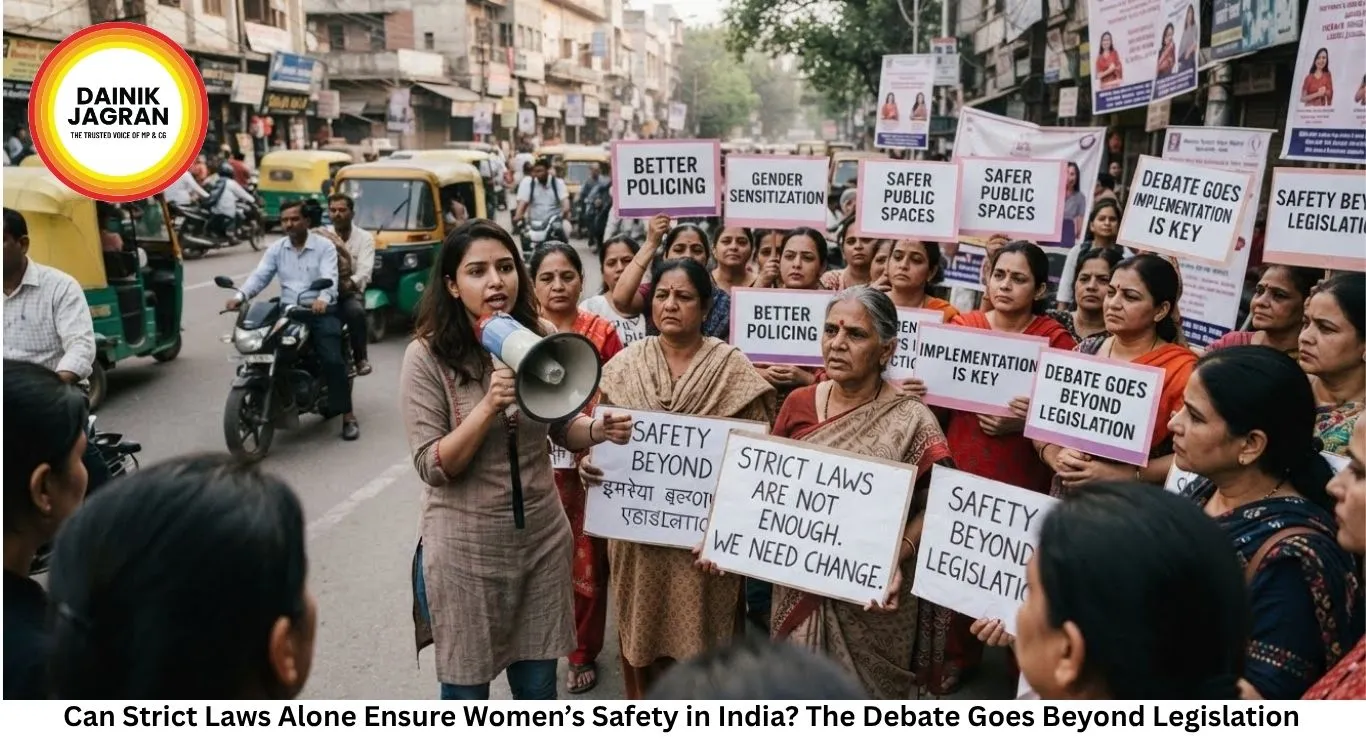
Can Strict Laws Alone Ensure Women’s Safety in India? The Debate Goes Beyond Legislation
Digital desk
Every time a major crime against a woman makes national headlines, a familiar demand resurfaces across India—stricter laws, harsher punishments and faster trials. Over the past decade, lawmakers have repeatedly responded with legal reforms, introducing stronger provisions against sexual assault, stalking, domestic violence and workplace harassment.
Yet, incidents involving violence against women continue to be reported from cities, towns and rural areas across the country. The recurring nature of these crimes has reignited a larger debate: can stricter laws alone ensure women's safety in India?
India already has an extensive legal framework aimed at protecting women. Various provisions under criminal law prescribe severe punishments for crimes such as rape, acid attacks, trafficking and domestic abuse. Fast-track courts have also been established in several states to accelerate the disposal of sensitive cases.
Supporters of tougher legislation argue that strong laws serve as a deterrent and send a clear message that crimes against women will not be tolerated. They point to legal amendments introduced after high-profile cases that led to broader definitions of sexual offences and stricter sentencing provisions.
However, legal experts and social observers often note that the challenge does not always lie in the absence of laws but in their implementation.
A significant number of cases face delays during investigation or trial. Victims frequently encounter social pressure, fear of stigma and difficulties while navigating legal procedures. In some instances, complaints are not reported immediately, while others fail to reach conviction despite legal provisions being available.
The issue becomes even more complex when examined beyond the criminal justice system.
Women's rights advocates have repeatedly argued that safety is influenced by social attitudes, education, economic independence and community support systems. According to them, legal action can punish offenders, but preventing crimes requires broader social change.
Questions surrounding gender sensitivity continue to dominate discussions in schools, workplaces and public institutions. Experts often stress that attitudes toward women are formed long before an individual encounters the legal system. This has led to increasing calls for gender awareness programmes, stronger community engagement and educational reforms aimed at challenging discriminatory behaviour.
Technology has introduced new dimensions to the conversation as well.
Online harassment, cyberstalking, image-based abuse and digital intimidation have become growing concerns. While laws addressing cybercrime exist, enforcement agencies continue adapting to the evolving nature of digital offences. As more aspects of life move online, protecting women in digital spaces has become an important part of the broader safety discussion.
Urban infrastructure also plays a role.
Poor street lighting, limited public transport options during late hours, inadequate surveillance systems and concerns over public safety frequently emerge in discussions involving women's mobility. Several city administrations have introduced measures ranging from CCTV expansion to women-focused transportation initiatives, but implementation remains uneven across regions.
Another factor often highlighted is economic empowerment.
Studies and policy discussions have frequently linked financial independence with greater personal agency and access to support systems. Women who have access to education, employment and institutional support may be better positioned to seek help when facing abuse or discrimination.
At the same time, many observers caution against viewing women's safety solely through the lens of law and order. They argue that sustainable change requires coordinated efforts involving governments, educational institutions, employers, families and civil society organisations.
Recent public conversations suggest that citizens increasingly expect a more comprehensive approach. Alongside stronger investigations and quicker justice, there is growing demand for preventive measures that address the root causes of gender-based violence.
The debate therefore continues to evolve. Few disagree on the importance of strong laws. The larger question is whether legislation, by itself, can transform the conditions that enable violence and discrimination.
As India continues to discuss women's safety in courts, legislatures and public forums, one reality remains clear: legal reform is only one part of a much larger challenge that extends into society, culture and everyday life.

--------
🚨 Beat the News Rush – Join Now!
Get breaking alerts, hot exclusives, and game-changing stories instantly on your phone. No delays, no fluff – just the edge you need. ⚡
Tap to join:
🟢 WhatsApp Channel: Dainik Jagran MP CG
Crave more?
🅕 Facebook: Dainik Jagran MP CG English
🅧 Twitter (X): Dainik Jagran MP CG
🅘 Instagram: Dainik Jagran MP CG
Share the fire – keep your crew ahead! 🗞️🔥
Can Strict Laws Alone Ensure Women’s Safety in India? The Debate Goes Beyond Legislation
Digital desk
Yet, incidents involving violence against women continue to be reported from cities, towns and rural areas across the country. The recurring nature of these crimes has reignited a larger debate: can stricter laws alone ensure women's safety in India?
India already has an extensive legal framework aimed at protecting women. Various provisions under criminal law prescribe severe punishments for crimes such as rape, acid attacks, trafficking and domestic abuse. Fast-track courts have also been established in several states to accelerate the disposal of sensitive cases.
Supporters of tougher legislation argue that strong laws serve as a deterrent and send a clear message that crimes against women will not be tolerated. They point to legal amendments introduced after high-profile cases that led to broader definitions of sexual offences and stricter sentencing provisions.
However, legal experts and social observers often note that the challenge does not always lie in the absence of laws but in their implementation.
A significant number of cases face delays during investigation or trial. Victims frequently encounter social pressure, fear of stigma and difficulties while navigating legal procedures. In some instances, complaints are not reported immediately, while others fail to reach conviction despite legal provisions being available.
The issue becomes even more complex when examined beyond the criminal justice system.
Women's rights advocates have repeatedly argued that safety is influenced by social attitudes, education, economic independence and community support systems. According to them, legal action can punish offenders, but preventing crimes requires broader social change.
Questions surrounding gender sensitivity continue to dominate discussions in schools, workplaces and public institutions. Experts often stress that attitudes toward women are formed long before an individual encounters the legal system. This has led to increasing calls for gender awareness programmes, stronger community engagement and educational reforms aimed at challenging discriminatory behaviour.
Technology has introduced new dimensions to the conversation as well.
Online harassment, cyberstalking, image-based abuse and digital intimidation have become growing concerns. While laws addressing cybercrime exist, enforcement agencies continue adapting to the evolving nature of digital offences. As more aspects of life move online, protecting women in digital spaces has become an important part of the broader safety discussion.
Urban infrastructure also plays a role.
Poor street lighting, limited public transport options during late hours, inadequate surveillance systems and concerns over public safety frequently emerge in discussions involving women's mobility. Several city administrations have introduced measures ranging from CCTV expansion to women-focused transportation initiatives, but implementation remains uneven across regions.
Another factor often highlighted is economic empowerment.
Studies and policy discussions have frequently linked financial independence with greater personal agency and access to support systems. Women who have access to education, employment and institutional support may be better positioned to seek help when facing abuse or discrimination.
At the same time, many observers caution against viewing women's safety solely through the lens of law and order. They argue that sustainable change requires coordinated efforts involving governments, educational institutions, employers, families and civil society organisations.
Recent public conversations suggest that citizens increasingly expect a more comprehensive approach. Alongside stronger investigations and quicker justice, there is growing demand for preventive measures that address the root causes of gender-based violence.
The debate therefore continues to evolve. Few disagree on the importance of strong laws. The larger question is whether legislation, by itself, can transform the conditions that enable violence and discrimination.
As India continues to discuss women's safety in courts, legislatures and public forums, one reality remains clear: legal reform is only one part of a much larger challenge that extends into society, culture and everyday life.