Education System vs AI: Is Artificial Intelligence Helping or Hurting College Learning?

Digital Desk

Education System vs AI: Is Artificial Intelligence Helping or Hurting College Learning?

An opinion on how Artificial Intelligence is transforming college education, its benefits, challenges and why critical thinking must remain at the heart of learning.

Education System vs Artificial Intelligence: Finding the Right Balance in Modern Classrooms

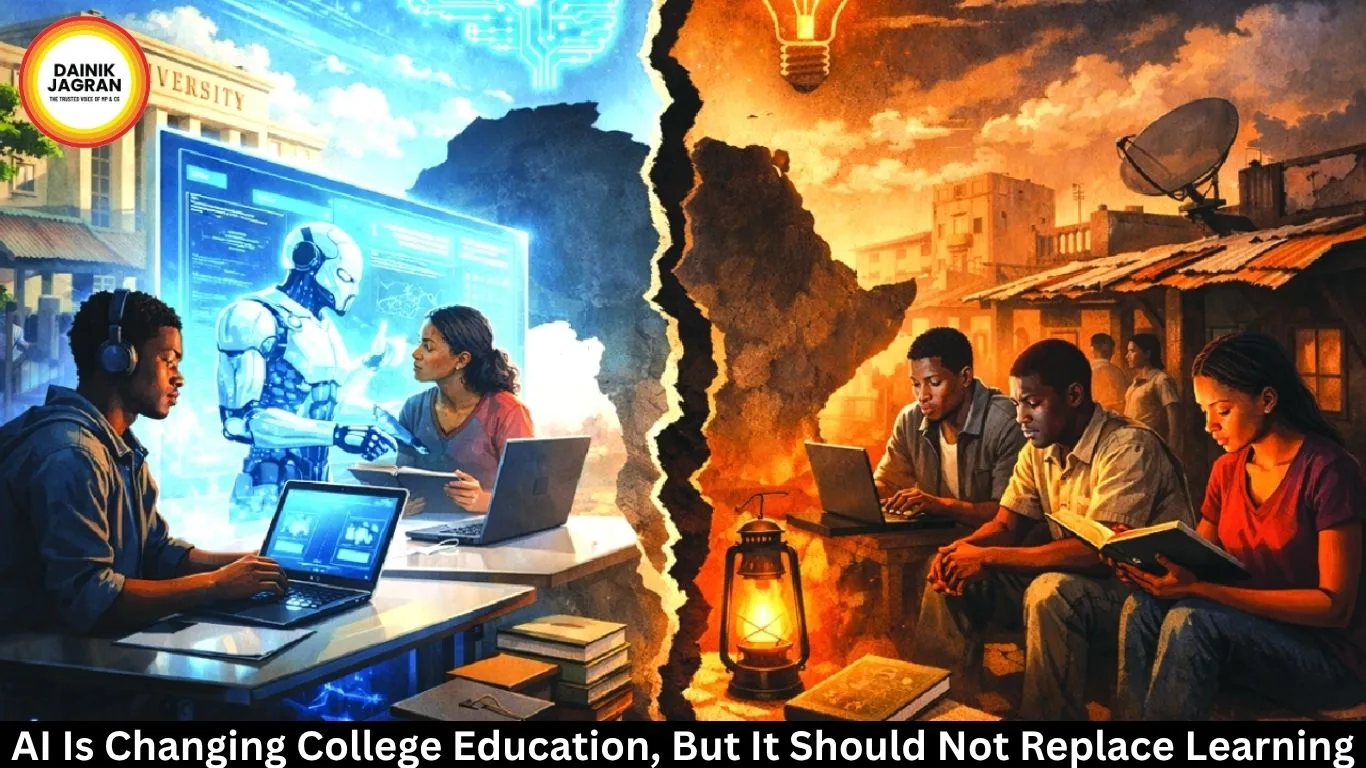
Artificial Intelligence (AI) is no longer a futuristic concept. It has become part of everyday college life. From writing assignments and solving coding problems to preparing presentations and conducting research, students are increasingly relying on AI-powered tools. While these technologies have made learning faster and more accessible, they have also raised a serious question: Is AI improving education, or is it slowly replacing the learning process itself?

Colleges around the world are witnessing a dramatic shift in how students approach academics. Instead of spending hours in libraries or discussing ideas with professors, many now turn to AI assistants for instant answers. Within seconds, AI can generate essays, explain complex theories, solve mathematical equations and even create project reports. This convenience has undoubtedly increased productivity, but it has also reduced the need for critical thinking in many cases.

The biggest concern is not that students are using AI—it is how they are using it. Technology has always been a part of education. Calculators changed mathematics, computers transformed research, and the internet revolutionized access to information. AI is simply the next step. However, unlike previous technologies, AI can think, write and create content that closely resembles human work. When students submit AI-generated assignments without understanding the subject, education shifts from learning to merely completing tasks.

This trend is creating a growing skills gap. Many graduates may possess impressive grades but lack problem-solving abilities, communication skills and creativity—qualities that employers continue to value the most. Companies are not just looking for candidates who can generate answers with AI; they need professionals who can ask the right questions, analyse situations and make informed decisions.

At the same time, blaming AI alone would be unfair. The current education system also needs to evolve. In many colleges, assessment methods still reward memorisation rather than innovation. If examinations continue to focus on information that AI can instantly generate, students will naturally depend on technology instead of developing independent thinking.

The solution is not to ban AI from classrooms. Such an approach would be unrealistic and ineffective. Instead, educational institutions should teach students how to use AI responsibly. AI should become a learning partner rather than a shortcut. Students should be encouraged to verify AI-generated information, question its accuracy and combine it with their own research and analysis.

Faculty members also need training to integrate AI into teaching. Rather than assigning repetitive written work, colleges can design assessments based on discussions, presentations, case studies, practical projects and real-world problem solving. These formats evaluate understanding instead of simple content generation.

Another critical aspect is ethics. Students must understand that academic honesty remains important even in the AI era. Transparency about AI usage and proper attribution should become part of institutional policies. Responsible use will help maintain trust while allowing learners to benefit from technological advancements.

Artificial Intelligence is not the enemy of education. In fact, it has the potential to personalise learning, assist students with disabilities, simplify research and make quality education accessible to millions. The real challenge lies in ensuring that technology complements human intelligence instead of replacing it.

The future belongs neither to AI alone nor to traditional education alone. It belongs to students who can combine technological efficiency with human creativity, emotional intelligence and ethical judgment. Colleges that embrace this balance will prepare graduates who are not only employable but also capable of leading innovation in an AI-driven world.


 

--------

๐Ÿšจ Beat the News Rush โ€“ Join Now!

Get breaking alerts, hot exclusives, and game-changing stories instantly on your phone. No delays, no fluff โ€“ just the edge you need. โšก

Tap to join:ย 

๐ŸŸข WhatsApp Channel: Dainik Jagran MP CG

Crave more?

๐Ÿ…• Facebook: Dainik Jagran MP CG English

๐Ÿ…ง Twitter (X): Dainik Jagran MP CG

๐Ÿ…˜ Instagram: Dainik Jagran MP CG

Share the fire โ€“ keep your crew ahead! ๐Ÿ—ž๏ธ๐Ÿ”ฅ

english.dainikjagranmpcg.com
14 Jul 2026 By Abhishek Joshi

Education System vs AI: Is Artificial Intelligence Helping or Hurting College Learning?

Digital Desk

Education System vs Artificial Intelligence: Finding the Right Balance in Modern Classrooms

Artificial Intelligence (AI) is no longer a futuristic concept. It has become part of everyday college life. From writing assignments and solving coding problems to preparing presentations and conducting research, students are increasingly relying on AI-powered tools. While these technologies have made learning faster and more accessible, they have also raised a serious question: Is AI improving education, or is it slowly replacing the learning process itself?

Colleges around the world are witnessing a dramatic shift in how students approach academics. Instead of spending hours in libraries or discussing ideas with professors, many now turn to AI assistants for instant answers. Within seconds, AI can generate essays, explain complex theories, solve mathematical equations and even create project reports. This convenience has undoubtedly increased productivity, but it has also reduced the need for critical thinking in many cases.

The biggest concern is not that students are using AI—it is how they are using it. Technology has always been a part of education. Calculators changed mathematics, computers transformed research, and the internet revolutionized access to information. AI is simply the next step. However, unlike previous technologies, AI can think, write and create content that closely resembles human work. When students submit AI-generated assignments without understanding the subject, education shifts from learning to merely completing tasks.

This trend is creating a growing skills gap. Many graduates may possess impressive grades but lack problem-solving abilities, communication skills and creativity—qualities that employers continue to value the most. Companies are not just looking for candidates who can generate answers with AI; they need professionals who can ask the right questions, analyse situations and make informed decisions.

At the same time, blaming AI alone would be unfair. The current education system also needs to evolve. In many colleges, assessment methods still reward memorisation rather than innovation. If examinations continue to focus on information that AI can instantly generate, students will naturally depend on technology instead of developing independent thinking.

The solution is not to ban AI from classrooms. Such an approach would be unrealistic and ineffective. Instead, educational institutions should teach students how to use AI responsibly. AI should become a learning partner rather than a shortcut. Students should be encouraged to verify AI-generated information, question its accuracy and combine it with their own research and analysis.

Faculty members also need training to integrate AI into teaching. Rather than assigning repetitive written work, colleges can design assessments based on discussions, presentations, case studies, practical projects and real-world problem solving. These formats evaluate understanding instead of simple content generation.

Another critical aspect is ethics. Students must understand that academic honesty remains important even in the AI era. Transparency about AI usage and proper attribution should become part of institutional policies. Responsible use will help maintain trust while allowing learners to benefit from technological advancements.

Artificial Intelligence is not the enemy of education. In fact, it has the potential to personalise learning, assist students with disabilities, simplify research and make quality education accessible to millions. The real challenge lies in ensuring that technology complements human intelligence instead of replacing it.

The future belongs neither to AI alone nor to traditional education alone. It belongs to students who can combine technological efficiency with human creativity, emotional intelligence and ethical judgment. Colleges that embrace this balance will prepare graduates who are not only employable but also capable of leading innovation in an AI-driven world.
 

https://english.dainikjagranmpcg.com/opinion/education-system-vs-ai-is-artificial-intelligence-helping-or-hurting/article-22103

Trending News