


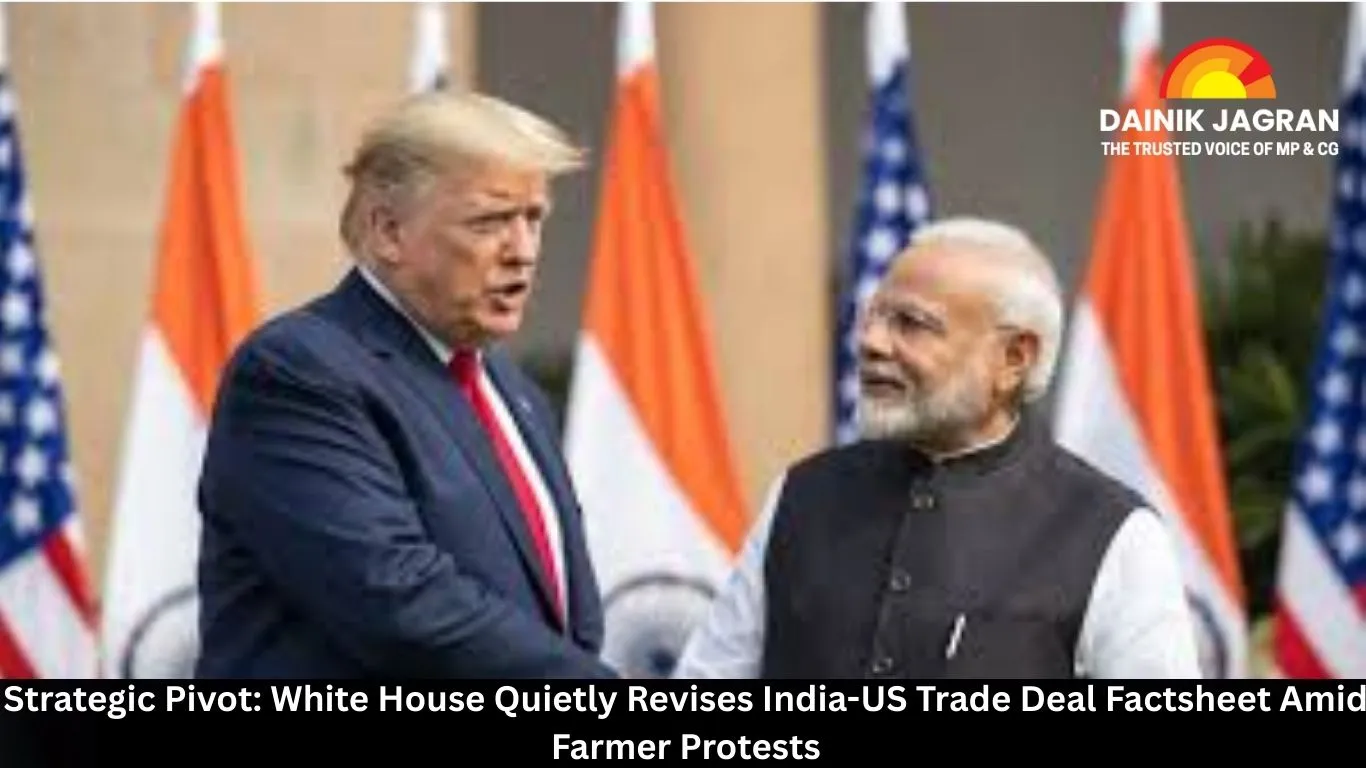
Strategic Pivot: White House Quietly Revises India-US Trade Deal Factsheet Amid Farmer Protests
Digital Desk
In a significant diplomatic recalibration, the White House has silently updated its official factsheet regarding the India-US trade deal. This move comes just days after the initial announcement sparked intense debate and protests within India’s agricultural sector. The revisions suggest a delicate balancing act by both Washington and New Delhi to preserve a historic partnership while navigating the sensitive waters of domestic politics and food security.
The "Pulses" Problem: Protecting India’s Agrarian Economy
The most striking change in the revised factsheet is the complete removal of references to pulses. In the original document, the U.S. claimed that India would reduce or eliminate tariffs on certain pulses—including chickpeas, lentils, and dry beans.
For India, this was a red-flag issue. India is the world’s largest producer and consumer of pulses, and any move to allow a flood of cheap American imports could have devastated the livelihoods of millions of local farmers. Following the initial announcement, groups like the Samyukta Kisan Morcha called for widespread protests, accusing the government of "surrendering" to U.S. interests. By removing pulses from the list of concessions, the White House has effectively de-escalated a major political flashpoint.
From "Committed" to "Intended": Rebranding the $500 Billion Target
Another critical adjustment involves the ambitious $500 billion trade target. Initially, the U.S. documentation framed India’s agreement to purchase American goods as a "commitment." This implied a legally binding obligation that left many experts skeptical, given that current bilateral trade sits around $120–$130 billion.
The updated factsheet now uses the phrase "India intends to purchase." Committed: Implies a binding contract with potential sanctions for non-compliance.
-
Intended: Functions as a non-binding "soft" goal, signaling a shared vision rather than a rigid mandate.
This shift allows India to maintain its strategic autonomy while still signaling a desire to deepen economic ties with the United States.
Mapping the Geopolitics
Beyond the trade figures, a subtle but vital change occurred on the digital front. The U.S. had briefly published a map showing the entire region of Jammu, Kashmir, and Aksai Chin as part of India—a move that was initially hailed in New Delhi as a major diplomatic win. However, that post has since been taken down, likely due to back-channel pressure from Islamabad.
Why This Matters Right Now
This revision proves that despite the "tough-talking" reputation of the Trump administration, the reality of international trade requires flexibility.
-
Farmer Interests: The Indian government remains highly protective of its agricultural base.
-
Productivity Gaps: U.S. farming operates on a massive industrial scale, whereas Indian farming is fragmented. Removing tariffs prematurely would have created an uneven playing field.
-
Digital Tax: The mention of removing digital services taxes was also scrapped, largely because India had already moved to abolish them, making the point redundant.
Conclusion: A Pragmatic Partnership
The revision of the India-US trade deal factsheet isn't a sign of a failing deal, but rather a sign of a maturing one. It reflects a mutual understanding that for a trade agreement to last, it must be politically sustainable in both nations. While the formal agreement is expected to be finalized around March, these "silent" edits ensure that the path to that signing remains clear of unnecessary hurdles.
.jpg)




