


‘Pakistan Is 12 Hours Older Than India’: Ajmer College Principal’s Remarks at Sociology Conference Trigger Debate
Digital Desk
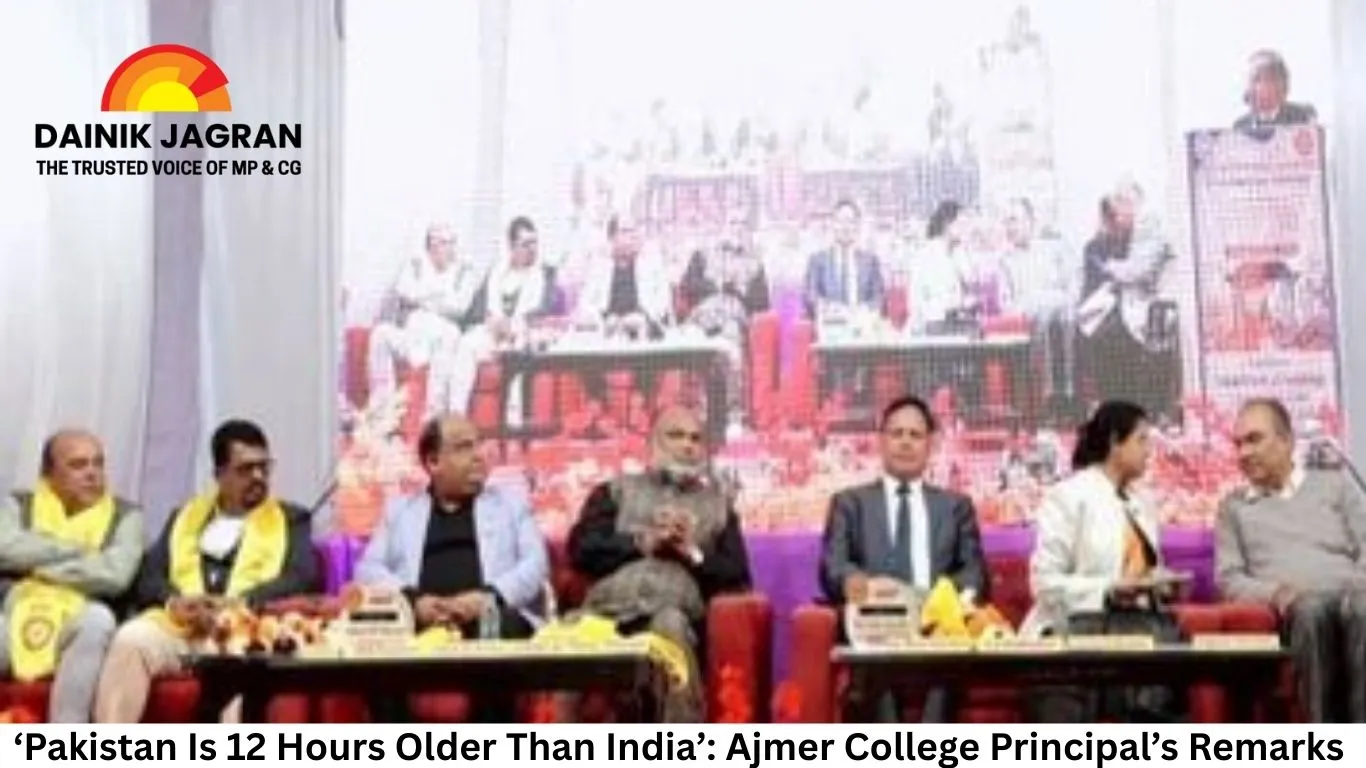
The remarks were made by Manoj Beharwal, principal of a government college in Ajmer, while speaking as the chief guest at the 31st International Conference of the Rajasthan Sociological Association.
Beharwal stated that Pakistan emerged on August 14, 1947, while India formally came into existence on August 15, 1947, suggesting that Pakistan was “12 hours older” and metaphorically referring to it as an “elder brother”. He also made observations on the political leadership at the time of Independence and India’s post-Partition financial assistance to Pakistan.
The comments were delivered on January 24 during the two-day conference held on January 23 and 24.
The seminar took place at Sanatan Dharma Government College in Beawar, Ajmer district, and was attended by scholars and delegates from across India and abroad.
Beharwal said his remarks were intended to contextualise historical events while emphasising the importance of understanding India’s civilisational and social traditions. His address focused on history’s role in shaping national consciousness and societal responsibility.
Addressing the gathering, Beharwal said that at the time of Independence, only three leaders — Mahatma Gandhi, Muhammad Ali Jinnah and B.R. Ambedkar — held mass influence, recounting an anecdote involving foreign journalists visiting the three leaders on the night of August 14–15, 1947. He quoted Ambedkar as saying he remained awake working on the Hindu Code Bill because “his society was still asleep”.
Beharwal also claimed that India provided Pakistan with ₹45 crore after Partition, alleging that the funds were later “wasted” as Pakistan pursued policies centred on terrorism. He further argued that politics had historically divided Indian society, but claimed a renewed connection between politics and Indian knowledge traditions after 2014.
The conference, themed around Indian knowledge systems, saw participation from representatives of seven Indian states, over 20 districts of Rajasthan, and delegates from three countries. Cultural programmes, including performances to Afghani music, were also part of the event.
While the remarks were made in an academic setting, they are likely to spark discussion on the interpretation of historical timelines and the responsibilities of public academics when addressing sensitive political and historical subjects.
.jpg)




