

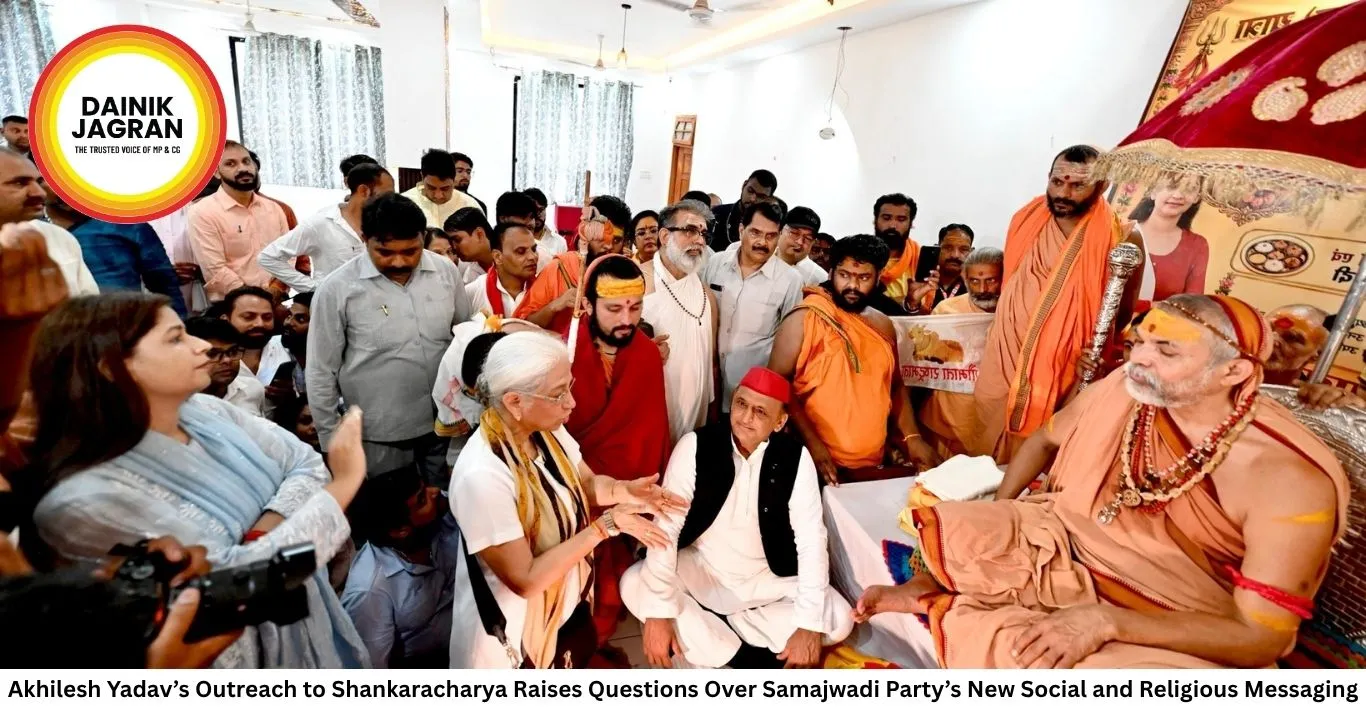
Akhilesh Yadav’s Outreach to Shankaracharya Raises Questions Over Samajwadi Party’s New Social and Religious Messaging

Digital desk

Akhilesh Yadav’s Outreach to Shankaracharya Raises Questions Over Samajwadi Party’s New Social and Religious Messaging

A recent meeting between Samajwadi Party chief Akhilesh Yadav and Shankaracharya Swami Avimukteshwaranand has sparked political discussion in Uttar Pradesh, with many observers viewing it as more than a routine courtesy call.

The interaction comes at a time when political parties across the spectrum are attempting to recalibrate their social coalitions and broaden their appeal ahead of future electoral contests. For the Samajwadi Party (SP), the meeting has renewed debate over whether the party is trying to connect its traditional socialist politics with a more visible engagement with Sanatan and religious institutions.

Photographs and details of the meeting quickly gained attention on social media and in political circles. While neither side presented the interaction as a political alliance, the symbolism of the engagement drew interest because of the changing nature of political messaging in Uttar Pradesh.

For decades, the Samajwadi Party has largely been identified with social justice politics, backward caste mobilisation and secular political positioning. However, the political landscape in the state has evolved significantly over the past decade, with religious identity and cultural narratives becoming increasingly central to electoral discourse.

Political analysts say Akhilesh Yadav has, in recent years, attempted to strike a balance between the party’s traditional ideological roots and the growing importance of religious symbolism in public life. Visits to temples, participation in religious events and statements emphasising respect for faith have become more visible in the SP’s political outreach.

The latest meeting with Swami Avimukteshwaranand is being viewed in that broader context. The Shankaracharya has been vocal on a range of religious and social issues and often commands attention beyond conventional political boundaries. Any public engagement with such a figure naturally attracts scrutiny in a politically significant state like Uttar Pradesh.

Supporters of the Samajwadi Party argue that there is no contradiction between socialism and Sanatan traditions. They point out that many socialist leaders in India historically maintained close connections with religious and cultural institutions while advocating social equality and welfare-oriented politics.

Critics, however, contend that such engagements may be driven more by electoral considerations than ideological evolution. Opposition leaders have suggested that several political parties are increasingly trying to appeal to religious sentiments because of the changing voter landscape.

The meeting also comes amid continued efforts by opposition parties to expand their support base beyond traditional vote banks. In Uttar Pradesh, where caste equations, welfare politics and religious identity often intersect, parties are constantly looking for ways to connect with new sections of voters without alienating their existing supporters.

For Akhilesh Yadav, the challenge is particularly significant. While retaining the Samajwadi Party’s core social justice narrative, he must also address perceptions created by political rivals regarding the party’s relationship with issues of faith and religious identity.

So far, neither the Samajwadi Party nor the Shankaracharya has indicated that the meeting was part of any larger political initiative. Yet its political significance lies less in what was formally discussed and more in the message it sends to different sections of society.

As Uttar Pradesh politics continues to evolve, symbolic interactions between political leaders and influential religious figures are likely to attract increasing attention. Whether Akhilesh Yadav’s engagement with Swami Avimukteshwaranand helps bridge the space between socialist politics and a broader cultural appeal remains a question that only future political developments can answer.

--------

🚨 Beat the News Rush – Join Now!

Get breaking alerts, hot exclusives, and game-changing stories instantly on your phone. No delays, no fluff – just the edge you need. ⚡

Tap to join: 

🟢 WhatsApp Channel: Dainik Jagran MP CG

Crave more?

🅕 Facebook: Dainik Jagran MP CG English

🅧 Twitter (X): Dainik Jagran MP CG

🅘 Instagram: Dainik Jagran MP CG

Share the fire – keep your crew ahead! 🗞️🔥

english.dainikjagranmpcg.com
10 Jul 2026 By Priyanshu.Jha

Akhilesh Yadav’s Outreach to Shankaracharya Raises Questions Over Samajwadi Party’s New Social and Religious Messaging

Digital desk

The interaction comes at a time when political parties across the spectrum are attempting to recalibrate their social coalitions and broaden their appeal ahead of future electoral contests. For the Samajwadi Party (SP), the meeting has renewed debate over whether the party is trying to connect its traditional socialist politics with a more visible engagement with Sanatan and religious institutions.

Photographs and details of the meeting quickly gained attention on social media and in political circles. While neither side presented the interaction as a political alliance, the symbolism of the engagement drew interest because of the changing nature of political messaging in Uttar Pradesh.

For decades, the Samajwadi Party has largely been identified with social justice politics, backward caste mobilisation and secular political positioning. However, the political landscape in the state has evolved significantly over the past decade, with religious identity and cultural narratives becoming increasingly central to electoral discourse.

Political analysts say Akhilesh Yadav has, in recent years, attempted to strike a balance between the party’s traditional ideological roots and the growing importance of religious symbolism in public life. Visits to temples, participation in religious events and statements emphasising respect for faith have become more visible in the SP’s political outreach.

The latest meeting with Swami Avimukteshwaranand is being viewed in that broader context. The Shankaracharya has been vocal on a range of religious and social issues and often commands attention beyond conventional political boundaries. Any public engagement with such a figure naturally attracts scrutiny in a politically significant state like Uttar Pradesh.

Supporters of the Samajwadi Party argue that there is no contradiction between socialism and Sanatan traditions. They point out that many socialist leaders in India historically maintained close connections with religious and cultural institutions while advocating social equality and welfare-oriented politics.

Critics, however, contend that such engagements may be driven more by electoral considerations than ideological evolution. Opposition leaders have suggested that several political parties are increasingly trying to appeal to religious sentiments because of the changing voter landscape.

The meeting also comes amid continued efforts by opposition parties to expand their support base beyond traditional vote banks. In Uttar Pradesh, where caste equations, welfare politics and religious identity often intersect, parties are constantly looking for ways to connect with new sections of voters without alienating their existing supporters.

For Akhilesh Yadav, the challenge is particularly significant. While retaining the Samajwadi Party’s core social justice narrative, he must also address perceptions created by political rivals regarding the party’s relationship with issues of faith and religious identity.

So far, neither the Samajwadi Party nor the Shankaracharya has indicated that the meeting was part of any larger political initiative. Yet its political significance lies less in what was formally discussed and more in the message it sends to different sections of society.

As Uttar Pradesh politics continues to evolve, symbolic interactions between political leaders and influential religious figures are likely to attract increasing attention. Whether Akhilesh Yadav’s engagement with Swami Avimukteshwaranand helps bridge the space between socialist politics and a broader cultural appeal remains a question that only future political developments can answer.

https://english.dainikjagranmpcg.com/politics/6a50c756b6116/article-21667

Trending News


