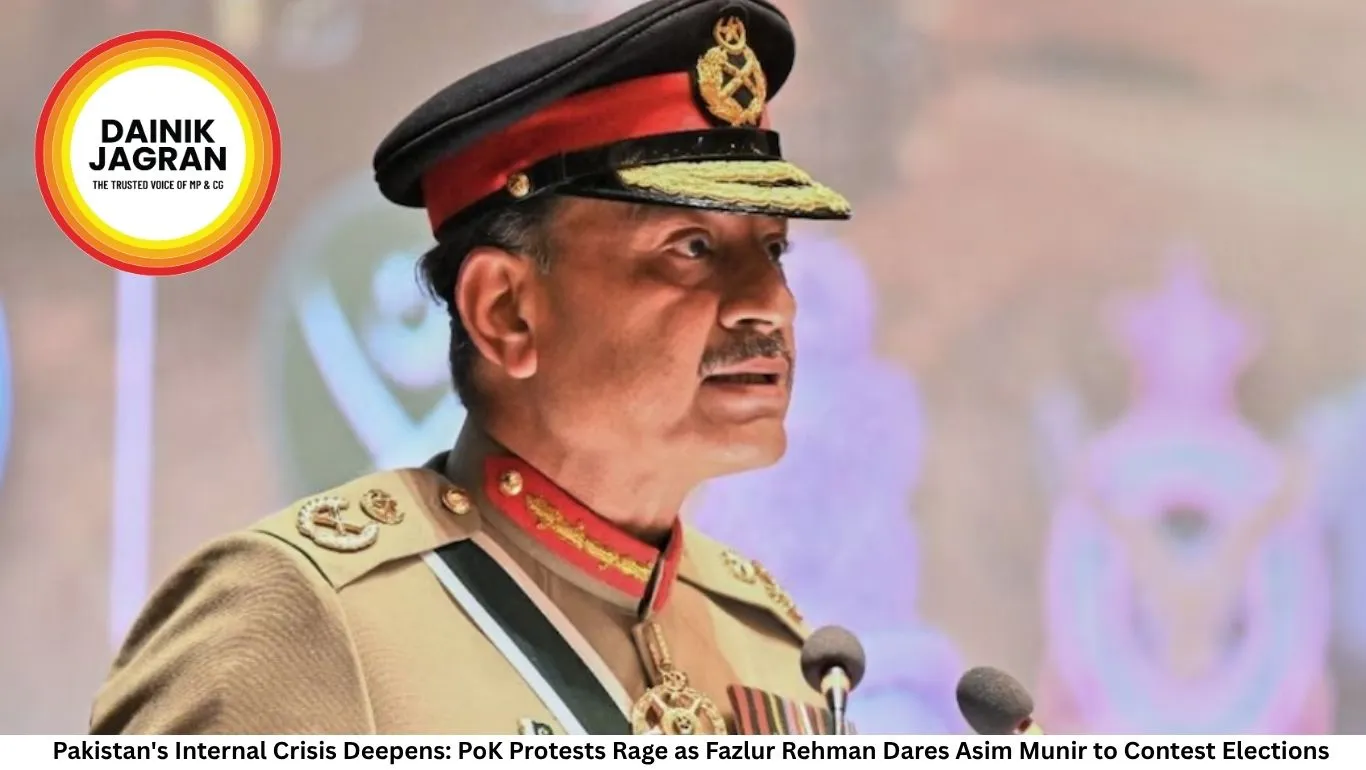
Pakistan's Internal Crisis Deepens: PoK Protests Rage as Fazlur Rehman Dares Asim Munir to Contest Elections
Digital desk
Pakistan is facing pressure on three fronts simultaneously — a monthslong uprising in Pakistan-occupied Kashmir, a bloody escalation in Balochistan and the Pashtun belt, and now a direct political challenge to Army Chief Field Marshal Asim Munir from one of the country's most senior religious-political leaders.
In Pakistan-occupied Jammu and Kashmir, anti-government protests entered their 34th consecutive day this week, having evolved from initial demands over inflation, electricity tariffs and wheat flour shortages into a broader rejection of Islamabad's control over the region altogether. At a gathering in Rawalakot, protest leader Javed Iqbal told the crowd that decades of Pakistani messaging about "liberating" Srinagar had lost all credibility with local Kashmiris. The gathering responded with a slogan declaring the region would never become a Pakistani province, and social media videos have shown large numbers of local women joining marches against what protesters describe as repression and arbitrary arrests. The unrest turned deadly this week when Pakistani security forces opened fire during clashes in Rawalakot, killing six civilians, according to multiple reports. The Joint Awami Action Committee has called for a long march toward Muzaffarabad on July 15, urging widespread participation.
India's Ministry of External Affairs addressed the situation directly at its weekly briefing, with spokesperson Randhir Jaiswal saying the protests are a consequence of what he called Pakistan's long-term denial of fundamental rights in the region, and accusing Pakistani authorities of responding with excessive force, supply blockades and communications blackouts. He said India hopes the international community will hold Pakistan accountable.
The unrest in PoK has coincided with a sharp escalation in violence in Balochistan and Khyber Pakhtunkhwa's Pashtun areas. JUI-F chief Maulana Fazlur Rehman said the region has recorded more than 50 deaths over just two to three days, arguing that Pakistani government authority no longer effectively extends into Balochistan at all. According to data from the South Asia Terrorism Portal, Pakistan has recorded roughly 650 killing incidents so far in 2026, including 487 civilian and 730 security force deaths, alongside close to 1,200 militants killed.
Rehman used the moment to take a direct swipe at Munir's growing political role, telling reporters that if the military wants to do politics, its personnel should retire their uniforms and contest elections instead — a way, he said, of testing how many votes people in uniform would actually receive from the public. He separately accused the military of pushing a new generation of Pakistanis toward violence through its handling of the crisis.
Pakistan Prime Minister Shehbaz Sharif has sought to shift blame for the violence outward, chairing a meeting with Munir and Balochistan Chief Minister Sarfraz Bugti last week where he accused militants of using Afghan territory to stage attacks inside both Balochistan and Khyber Pakhtunkhwa.
Taken together, the three fronts — PoK's sustained street movement, the mounting Balochistan-Pashtun death toll, and a senior political leader publicly challenging the Army's electoral legitimacy — paint a picture of a security and political establishment under simultaneous pressure from multiple directions, with no clear sign from Islamabad of how it intends to address any of them.
--------
🚨 Beat the News Rush – Join Now!
Get breaking alerts, hot exclusives, and game-changing stories instantly on your phone. No delays, no fluff – just the edge you need. ⚡
Tap to join:
🟢 WhatsApp Channel: Dainik Jagran MP CG
Crave more?
🅕 Facebook: Dainik Jagran MP CG English
🅧 Twitter (X): Dainik Jagran MP CG
🅘 Instagram: Dainik Jagran MP CG
Share the fire – keep your crew ahead! 🗞️🔥
Pakistan's Internal Crisis Deepens: PoK Protests Rage as Fazlur Rehman Dares Asim Munir to Contest Elections
Digital desk
In Pakistan-occupied Jammu and Kashmir, anti-government protests entered their 34th consecutive day this week, having evolved from initial demands over inflation, electricity tariffs and wheat flour shortages into a broader rejection of Islamabad's control over the region altogether. At a gathering in Rawalakot, protest leader Javed Iqbal told the crowd that decades of Pakistani messaging about "liberating" Srinagar had lost all credibility with local Kashmiris. The gathering responded with a slogan declaring the region would never become a Pakistani province, and social media videos have shown large numbers of local women joining marches against what protesters describe as repression and arbitrary arrests. The unrest turned deadly this week when Pakistani security forces opened fire during clashes in Rawalakot, killing six civilians, according to multiple reports. The Joint Awami Action Committee has called for a long march toward Muzaffarabad on July 15, urging widespread participation.
India's Ministry of External Affairs addressed the situation directly at its weekly briefing, with spokesperson Randhir Jaiswal saying the protests are a consequence of what he called Pakistan's long-term denial of fundamental rights in the region, and accusing Pakistani authorities of responding with excessive force, supply blockades and communications blackouts. He said India hopes the international community will hold Pakistan accountable.
The unrest in PoK has coincided with a sharp escalation in violence in Balochistan and Khyber Pakhtunkhwa's Pashtun areas. JUI-F chief Maulana Fazlur Rehman said the region has recorded more than 50 deaths over just two to three days, arguing that Pakistani government authority no longer effectively extends into Balochistan at all. According to data from the South Asia Terrorism Portal, Pakistan has recorded roughly 650 killing incidents so far in 2026, including 487 civilian and 730 security force deaths, alongside close to 1,200 militants killed.
Rehman used the moment to take a direct swipe at Munir's growing political role, telling reporters that if the military wants to do politics, its personnel should retire their uniforms and contest elections instead — a way, he said, of testing how many votes people in uniform would actually receive from the public. He separately accused the military of pushing a new generation of Pakistanis toward violence through its handling of the crisis.
Pakistan Prime Minister Shehbaz Sharif has sought to shift blame for the violence outward, chairing a meeting with Munir and Balochistan Chief Minister Sarfraz Bugti last week where he accused militants of using Afghan territory to stage attacks inside both Balochistan and Khyber Pakhtunkhwa.
Taken together, the three fronts — PoK's sustained street movement, the mounting Balochistan-Pashtun death toll, and a senior political leader publicly challenging the Army's electoral legitimacy — paint a picture of a security and political establishment under simultaneous pressure from multiple directions, with no clear sign from Islamabad of how it intends to address any of them.