


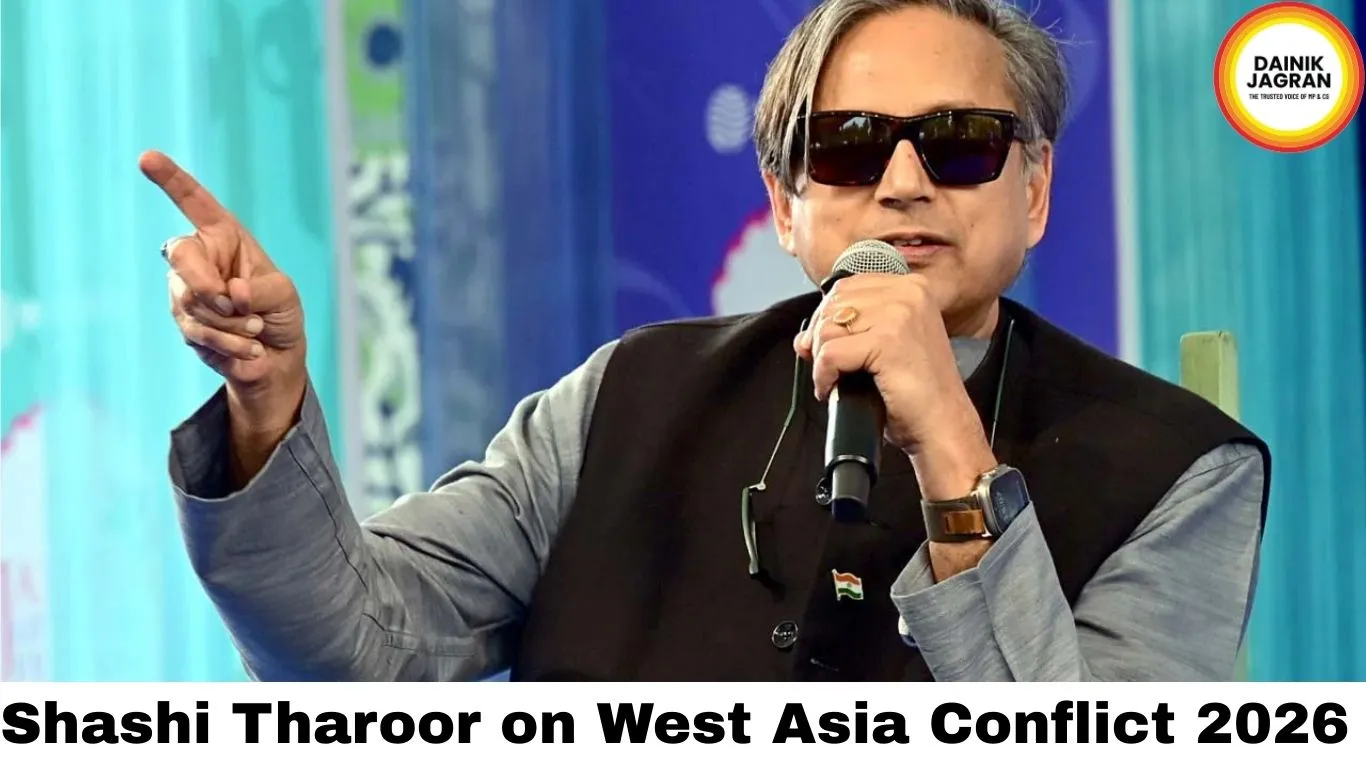
Shashi Tharoor on West Asia Conflict 2026: "The World Is Suffering" — Why India Must Now Step Up as the Loudest Voice for Peace in the Hormuz Crisis
Digital Desk
One Voice. One Urgent Question. When Does India Finally Say Enough?
For the past three weeks, as the West Asia conflict has escalated from the assassination of Iran's Supreme Leader Ayatollah Ali Khamenei on February 28 into a full-scale military exchange between the United States and Israel on one side and Iran on the other, Congress MP and Thiruvananthapuram Lok Sabha member Shashi Tharoor has been making the same argument — louder each time — in parliament corridors, on television channels, and to reporters across the country.
India, he insists, cannot afford to stay diplomatically quiet while the Strait of Hormuz burns. And increasingly, as LPG cylinders disappear from Indian kitchens, as dhabas shut across five states preparing for elections, and as oil prices push inflationary pressure into every household's monthly budget, the argument Tharoor is making is no longer just a foreign policy position. It is a domestic emergency disguised as a geopolitical observation.
What Tharoor Is Actually Arguing — In His Own Words
The Congress leader's position, developed and refined across multiple media interactions over the past two weeks, rests on a clear and internally consistent logic — one worth understanding on its own terms before evaluating it politically.
His central claim is that both sides in the West Asia conflict have, by now, achieved the core objectives that justified their entry into the war. The United States and Israel set out to degrade Iran's military infrastructure — its missile systems, industrial capacity, energy installations, and military command structure. That mission, Tharoor argues, has been substantially accomplished. Iran, on the other side, entered the conflict determined to avoid regime change and demonstrate the survival of its government under assault. That too, he maintains, has been achieved.
If both sides can acknowledge their respective victories — however painful those acknowledgements may be — the logical next step is de-escalation. What is needed, in Tharoor's framing, is a credible external voice that gives both Trump and Iran's leadership the diplomatic cover to step back without appearing to have lost.
That external voice, he argues, should be India.
The Hormuz Logic: Why This War Lives in India's Kitchen
Tharoor has been unusually specific and technically grounded in explaining exactly why the Hormuz Strait blockade hits India with a force that few other countries outside the Gulf region experience directly.
Qatar supplies approximately 40 percent of the LPG that India imports from West Asia. Nearly 90 percent of India's LPG imports travel through the Strait of Hormuz — the narrow 21-mile-wide waterway between Iran and the Omani coast of the Arabian Peninsula that Iran has effectively placed under restrictive control since the conflict began. With only three or four ships getting through in the days following the conflict's escalation — compared to the dozens that transit daily in normal conditions — physical gas simply cannot leave the region in the volumes India requires.
The consequences are not abstract. They are the missing cylinder in the Bhopal household. They are the Raipur hotel operating at half capacity. They are the 50,000 dhabas across Madhya Pradesh that went dark. They are the wedding caterers in Chhattisgarh burning firewood. They are the 1,013 cylinders seized from hoarders in a single state in a single week, and the ₹4,500 black market price that has replaced the subsidised rate.
Iran's leverage, as Tharoor correctly identifies, is not in its military strength at this point — it is suffering far greater damage than it is inflicting. Its leverage is in its ability to make global energy expensive and unpredictable for every country that did not ask for this conflict and cannot control its outcome. The Hormuz chokehold is Iran's last meaningful card — and it will not surrender that card unless someone persuasive enough asks it to.
What India Has Done — and What Tharoor Says Is Still Missing
To be fair to the government, India has not been entirely passive. Prime Minister Narendra Modi held a conversation with Iranian President Masoud Pezeshkian in the days following the conflict's outbreak, calling for de-escalation and offering India's role as a constructive bridge. External Affairs Minister S. Jaishankar has maintained active diplomatic channels with all sides. The UN Security Council passed Resolution 2817 (2026) with 13 votes in favour — including India's — condemning the widening of the conflict, with only China and Russia abstaining.
Tharoor welcomed these steps. When the PM-Iran call was announced, he publicly praised the initiative, calling it the right move and urging a collective push to end the conflict. But his position since then has been that these are necessary but insufficient. Individual diplomatic calls and UNSC votes are not the same thing as leading an international coalition — a coordinated, visible, multi-nation diplomatic effort with India at its centre actively demanding that both sides call it off.
The distinction matters. India's traditional foreign policy posture has favoured strategic ambiguity and behind-the-scenes engagement over loud public advocacy. That approach has preserved relationships on all sides across decades of Indian diplomacy. But Tharoor's argument is that this moment demands a different register — not just private conversations but a public, unambiguous Indian demand for an end to the conflict, backed by the moral authority of the world's largest democracy, the land of Gandhi and ahimsa.
The Domestic Stakes: Five Elections, Empty Dhabas, and a Closing Window
Tharoor has made one observation that cuts through every layer of diplomatic nuance with blunt, practical clarity. Five state assemblies are heading to elections in the coming weeks — and across all five states, roadside dhabas are shutting down because there is no gas to cook on.
As he put it directly to reporters: where will politicians stop and eat on the campaign trail if there are no dhabas open on the roadside? The observation is half-humorous and entirely serious. The LPG crisis is not a supply chain abstraction. It is arriving on the doorstep of every voter in India at the precise moment that India's political class needs those voters in the best possible mood.
For the ruling BJP, the gas shortage is a compound political liability — a global crisis that has landed domestically and that no amount of enforcement raids or helpline numbers can fully neutralise if cylinders remain absent from kitchens on polling day. For the Congress, Tharoor's dual-track approach — calling out the crisis clearly while simultaneously offering a constructive diplomatic solution rather than purely partisan criticism — is a more sophisticated political play than his party has managed on most issues in recent years.
India's Moment — And the Cost of Missing It
Shashi Tharoor is right about the diagnosis. The West Asia conflict is hurting India in ways that are deeply concrete and directly traceable to a geopolitical decision India had no part in making. The Hormuz Strait will not reopen at full capacity until the war ends or Iran chooses to stand down. The war will not end without someone offering both sides a face-saving off-ramp. India — with its historical relationships across the region, its credibility as the world's largest democracy, its non-aligned tradition, and its economic weight — is uniquely positioned to be that someone.
The question of whether India should make that bid loudly, publicly, and at the head of a coalition rather than through the quiet channels that have defined its West Asia diplomacy for decades is a legitimate strategic debate. The risks of visible diplomatic failure are real. The rewards of visible diplomatic success are transformational — for India's global standing, for its economic stability, and for the millions of Indian workers across the Gulf whose safety and livelihoods depend on regional stability.
What is not debatable is the cost of doing nothing. Every day that the Strait of Hormuz remains constrained, every cylinder that does not reach an Indian kitchen, every dhaba that stays dark is a reminder that India's energy security is hostage to a war it did not start and cannot ignore.
The world is suffering. India has both the standing and the self-interest to help end that suffering. Tharoor is right: this is India's moment. The only question is whether New Delhi will take it.
.jpg)




