


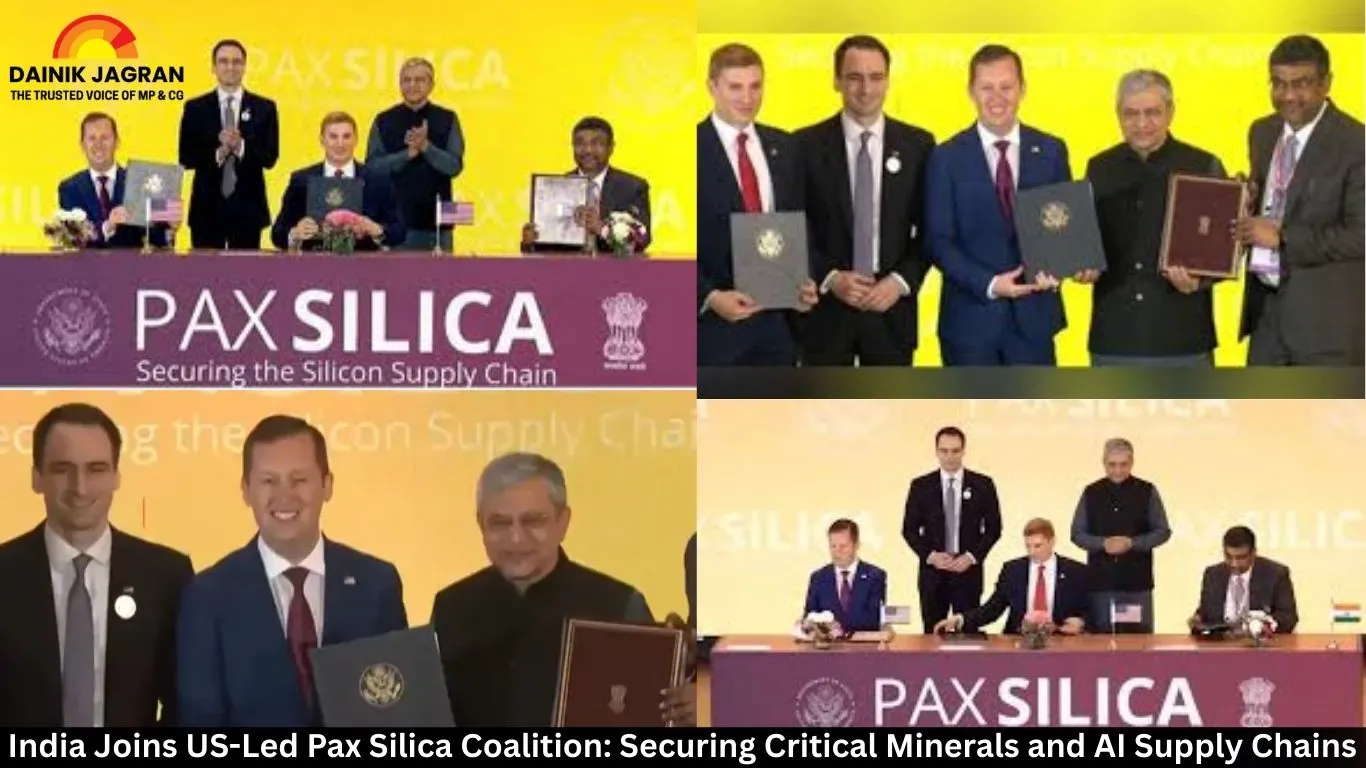
India Joins US-Led Pax Silica Coalition: Securing Critical Minerals and AI Supply Chains
Digital Desk
In a landmark move at the India AI Summit 2026, India has officially joined the US-led international coalition Pax Silica. Signed by Union IT Minister Ashwini Vaishnaw on February 20, 2026, at Bharat Mandapam in New Delhi, this partnership aims to safeguard global supply chains for semiconductors, artificial intelligence (AI), and critical minerals. As geopolitical tensions rise over tech dominance, India's entry into Pax Silica underscores a shift toward collaborative economic security, reducing reliance on single nations like China.
This development comes at a pivotal time when AI and semiconductors drive the 21st-century economy. With global demand for critical minerals surging—essential for everything from chips to batteries—Pax Silica offers a "positive-sum" framework for trusted allies. Experts view it as a response to supply chain disruptions seen in recent years, making it highly relevant to current trends in technology and international relations.
What is Pax Silica?
Launched in December 2025 by the US, Pax Silica—derived from "peace" and "silica" for silicon chips—is a coalition focused on securing raw material extraction, advanced manufacturing, and logistics. Founding members include the US, Japan, South Korea, Singapore, the Netherlands, the UK, Israel, the UAE, and Australia. India's addition strengthens this group, now encompassing major players in AI and tech innovation.
The US Department of State describes it as a new economic consensus: "If the 20th century ran on oil and steel, the 21st century runs on compute and the minerals that feed it." Objectives include preventing economic vulnerabilities and fostering secure AI development. By pooling resources, members aim to build resilient supply chains, ensuring trusted access to critical minerals like lithium, cobalt, and rare earths.
Benefits for India in Joining Pax Silica
India's participation in Pax Silica is poised to deliver significant advantages across multiple fronts:
- Securing Critical Supply Chains: With India's growing semiconductor ambitions, access to shared resources will mitigate risks from global shortages. This aligns with initiatives like the Semiconductor Mission, potentially attracting investments in mining and processing.
- Boosting Semiconductor and AI Infrastructure: Collaboration could accelerate India's AI ecosystem, including data centers and chip fabrication. Experts like Dr. Rajiv Kumar, a tech policy analyst, note: "This coalition provides India with technology transfers and joint R&D, essential for scaling up from design to full manufacturing."
- Strategic and Economic Integration: Joining Pax Silica enhances India's geopolitical standing, fostering deeper ties with the US and allies. It supports economic growth by integrating into high-value chains, potentially creating jobs in tech sectors.
- Enhanced Security: In an era of cyber threats, the coalition emphasizes secure AI models and data flows, protecting against dependencies that could compromise national security.
Why This Matters Now
Amid escalating US-China tech rivalries and supply chain fragility exposed by events like the 2024 chip shortages, Pax Silica represents a proactive alliance. For India, it's a strategic pivot toward self-reliance while embracing global cooperation. As Vaishnaw stated, "This partnership ensures India's AI future is secure and innovative."
In conclusion, India's entry into Pax Silica marks a forward-thinking step in global tech governance. Readers interested in tech policy should monitor upcoming summits for implementation details. This coalition not only secures critical minerals but also paves the way for a balanced, AI-driven world order.
.jpg)




