


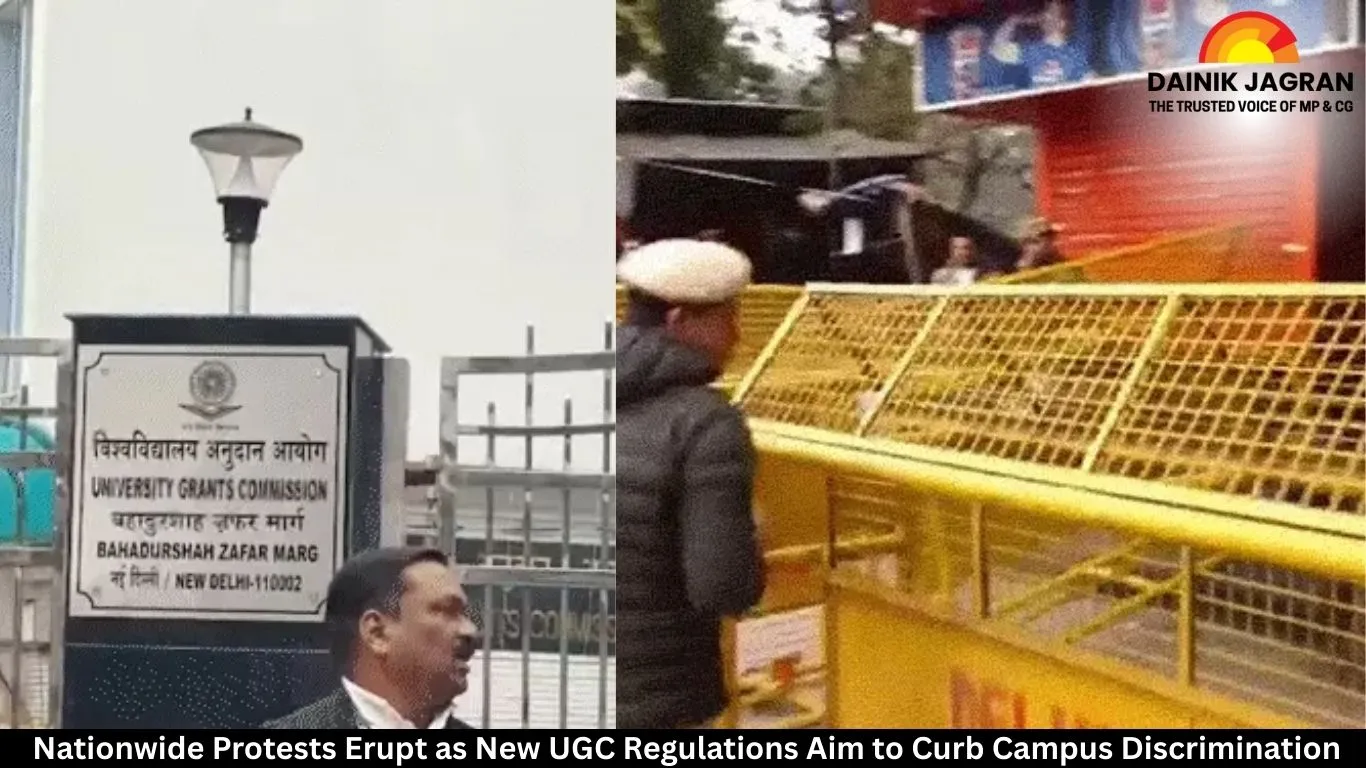
Nationwide Protests Erupt as New UGC Regulations Aim to Curb Campus Discrimination
Digital Desk
In a move that has ignited a fierce national debate, newly implemented regulations by the University Grants Commission (UGC) aimed at combating caste-based discrimination in higher education have been met with widespread protests and political resignations. As demonstrations spread across multiple states, Union Education Minister Dharmendra Pradhan has stepped in to assure the public that theUGC regulations 2026 will not be misused, while the government prepares an official clarification.
The controversy centers on theUGC (Promotion of Equity in Higher Education Institutions) Regulations, 2026, notified on January 13. These rules mandate all universities and colleges to establish rigorous mechanisms—includingEqual Opportunity Centres, Equity Committees, and 24/7 helplines—to address discrimination complaints, particularly from students belonging to Scheduled Castes (SC), Scheduled Tribes (ST), and Other Backward Classes (OBC). The regulations replace a 2012 framework and were developed following a Supreme Court order related to petitions filed by the families ofRohith Vemula and Payal Tadvi, students who died by suicide after alleged caste-based harassment.
What the New UGC Regulations Mandate
The 2026 regulations represent a significant shift from advisory guidelines to an enforceable legal framework with strict accountability. The core objective is to "eradicate discrimination" based on caste, religion, gender, disability, and other grounds, with a specific focus on protecting historically disadvantaged groups.
Table: Key Provisions of UGC Regulations 2026
|Provision |Key Requirement |Accountability Measure |
|Equal Opportunity Centre (EOC) | Must be established at every institution to implement equity policies and handle complaints. | Heads of institutions are directly accountable for compliance. |
|Equity Committee | A 10-member body, chaired by the institution head, must include representation from SC, ST, OBC, women, and persons with disabilities. | Must meet within24 hours of a complaint and submit a report in15 days. |
|Equity Squads & Helpline | Mobile squads to monitor campus "vulnerable spots" and a 24-hour helpline for reporting. | Institutions must submit bi-annual transparency reports to the UGC. |
|Non-Compliance Penalties | --- | Institutions face debarment from UGC schemes, suspension of degree programs, or loss of recognition. |
The Heart of the Controversy and Mounting Protests
Despite the stated aim of creating inclusive campuses, the regulations have triggered a vehement backlash, primarily from groups representinggeneral category students. Protests have erupted in New Delhi, Uttar Pradesh (Lucknow, Varanasi), Rajasthan, and Bihar.
The opposition is fueled by several key concerns:
Perceived Exclusion: Protesters argue the rules are "non-inclusionary" as the defined protected categories (SC, ST, OBC) do not explicitly include general category students, leaving them without a clear grievance path under this framework.
Fear of Misuse and Lack of Safeguards: A major point of contention is the removal of a "false complaints" clause from the draft version. Critics fear this could lead to harassment and that theaccused have few procedural safeguards.
Broad Definitions: Terms like "discrimination" and "indirect unfair treatment" are viewed as overly broad, granting significant discretionary power to Equity Committees.
The dissent has moved beyond student protests. ABareilly City Magistrate resigned, calling the rules a "black law". Several local BJP office-bearers in Uttar Pradesh have also resigned. The issue has reached the judiciary, with at least onePublic Interest Litigation (PIL) filed in the Supreme Court challenging the regulations as discriminatory and violative of constitutional principles of equality.
Government's Stance and the Path Forward
In response to the escalating crisis, the government has initiated damage control. Education MinisterDharmendra Pradhan publicly assured that "there will be no discrimination and no one can misuse the law". Ministry sources indicate a detailed clarification is being prepared to counter "misinformation" and affirm that misuse"will not be allowed under any circumstances".
The government defends the rules as a necessary response to hard data. The UGC has cited its own reports showing thatcomplaints of caste-based discrimination surged by 118% from 2019-20 to 2023-24, underscoring the need for a stronger systemic response.
The unfolding situation presents a complex challenge for India's higher education landscape. As institutions scramble to implement the new structures, the nation watches to see if this ambitious framework can achieve its goal of fostering truly equitable campuses or if the fears of increased polarization will materialize. The coming weeks, marked by promised government clarifications and potential judicial review, will be critical in determining the fate of these contentious regulations.


.jpg)




