


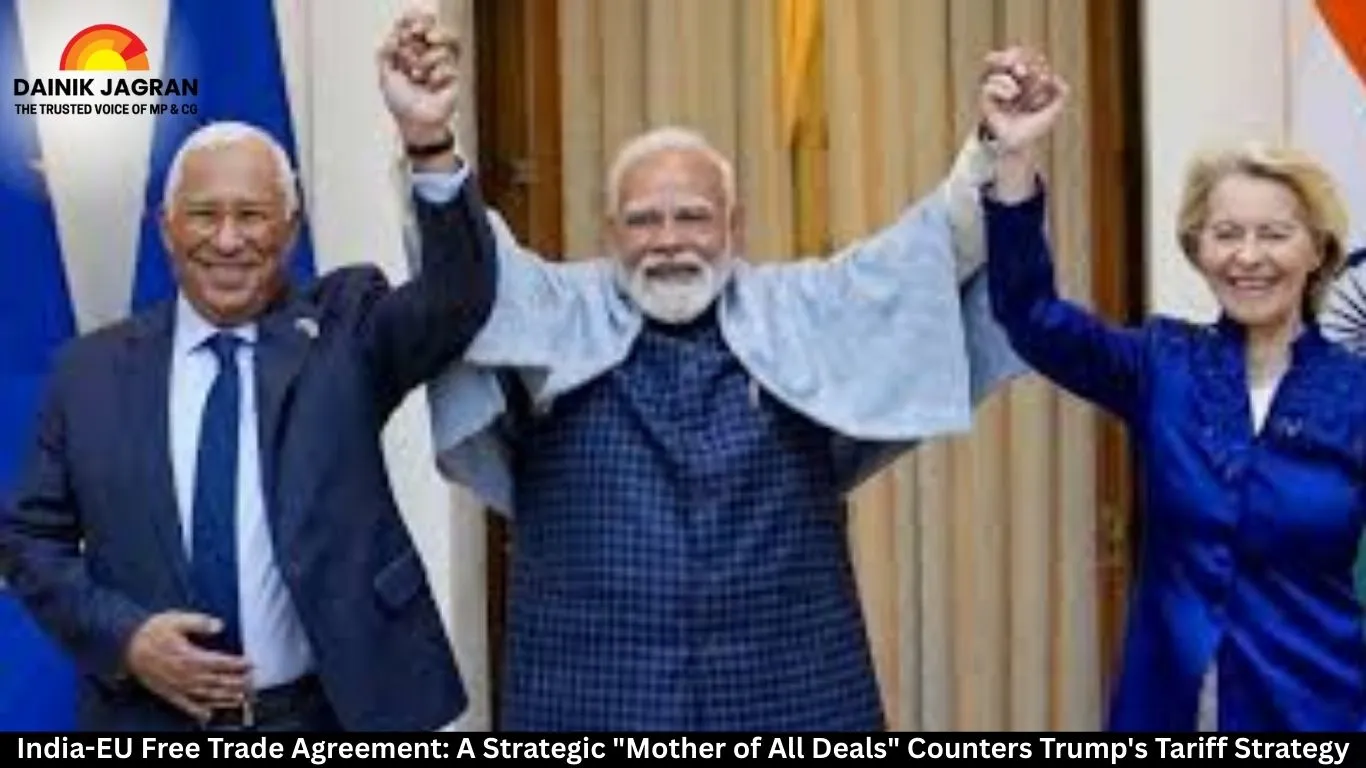
India-EU Free Trade Agreement: A Strategic "Mother of All Deals" Counters Trump's Tariff Strategy
Digital Desk
In a landmark move with profound geopolitical implications, India and the 27-member European Union have formally sealed a historic Free Trade Agreement (FTA), ending 19 years of negotiations. Announced on January 27, 2026, the deal has been dubbed the "Mother of All Deals" for its sheer scale, creating a combined market for nearly two billion people and representing about a quarter of the global economy.
This agreement arrives as a decisive strategic pivot for both powers, widely seen as a direct response to an increasingly aggressive and unilateral U.S. trade policy under President Donald Trump, who has levied significant tariffs on both partners.
What the "Mother of All Deds" Actually Means
The numbers behind the agreement are staggering. It aims to liberalize a massive volume of bilateral trade, which already stands at approximately $136.5 billion. The core of the deal is unprecedented market access:
For Indian Exports: The EU will grant duty-free access for over 99% of Indian export value (covering 97% of tariff lines). Key labor-intensive sectors like textiles, leather, marine products, and gems & jewelry will receive immediate zero-duty access, providing a massive boost to Indian manufacturers.
For EU Exports: India will eliminate or reduce tariffs on 92.1% of tariff lines, covering 97.5% of EU export value. This includes phased reductions on sensitive items like automobiles, wines, and spirits.
| Sector | EU's Tariff Concession to India | Key Impact |
| Textiles & Apparel | 100% duty-free access | Boosts India's competitiveness vs. Bangladesh, Vietnam. |
| Marine Products | 94.4% immediate duty-free | Major gain for Indian fisheries. |
| Automobiles | Phased reduction from 110% to lower rates | EU cars like BMW, Mercedes to become more affordable in India. |
Beyond goods, the partnership includes a Strategic Security Agenda for defense cooperation, intelligence sharing, and joint naval patrols in critical waterways like the Red Sea, signaling a move far beyond mere commerce.
The Long Road: From Stalled Talks to Strategic Realignment
The journey to this deal began in 2007 but stalled for years over irreconcilable differences on cars, wines, and dairy products. So, what changed to break the deadlock in 2026? Analysts point to a fundamental geopolitical realignment triggered by recent global shocks:
1. The China Factor: The COVID-19 pandemic and supply chain disruptions exposed over-dependence on China. Both the EU and India actively sought to diversify their economic partnerships to de-risk their economies.
2. The Trump Pressure: Aggressive U.S. tariff threats against both the EU and India created a shared sense of vulnerability. Trump's "America First" policy, including demands for higher NATO spending and threats of auto tariffs, pushed the EU to seek reliable partners. As one trade economist noted, the deal is a "strategic answer" to the U.S.'s unilateral trade aggression.
The Trump Factor: A Calculated Counter-Move?
The timing and strategic nature of the agreement send an unmistakable message to Washington. With the U.S. imposing a 25% tariff on Indian goods and threatening similar measures against the EU, the India-EU FTA is a powerful demonstration that both economies have credible alternatives.
Strategic Autonomy: The deal allows the EU to reduce dependency on the U.S. and China, while giving India access to the world's largest single market.
Leverage for Future Talks: Experts suggest the agreement strengthens India and the EU's hands in any future trade negotiations with the U.S., forcing the Trump administration to reconsider its hardline terms.
While U.S. Treasury Secretary Scott Bessent has already criticized the deal, the formation of this new economic axis marks a significant shift in global trade dynamics.
More Than a Trade Deal
The India-EU FTA is a cornerstone of the emerging multipolar world order. It transcends economics, representing a strategic partnership built on shared democratic values and a mutual need for stability. For consumers, it promises more choices and lower prices. For industries, it unlocks new markets. And for global geopolitics, it establishes a powerful new pole that can navigate the tensions between an assertive China and an unpredictable United States. This "Mother of All Deals" is, fundamentally, a pact for a new era of strategic independence.
.jpg)




