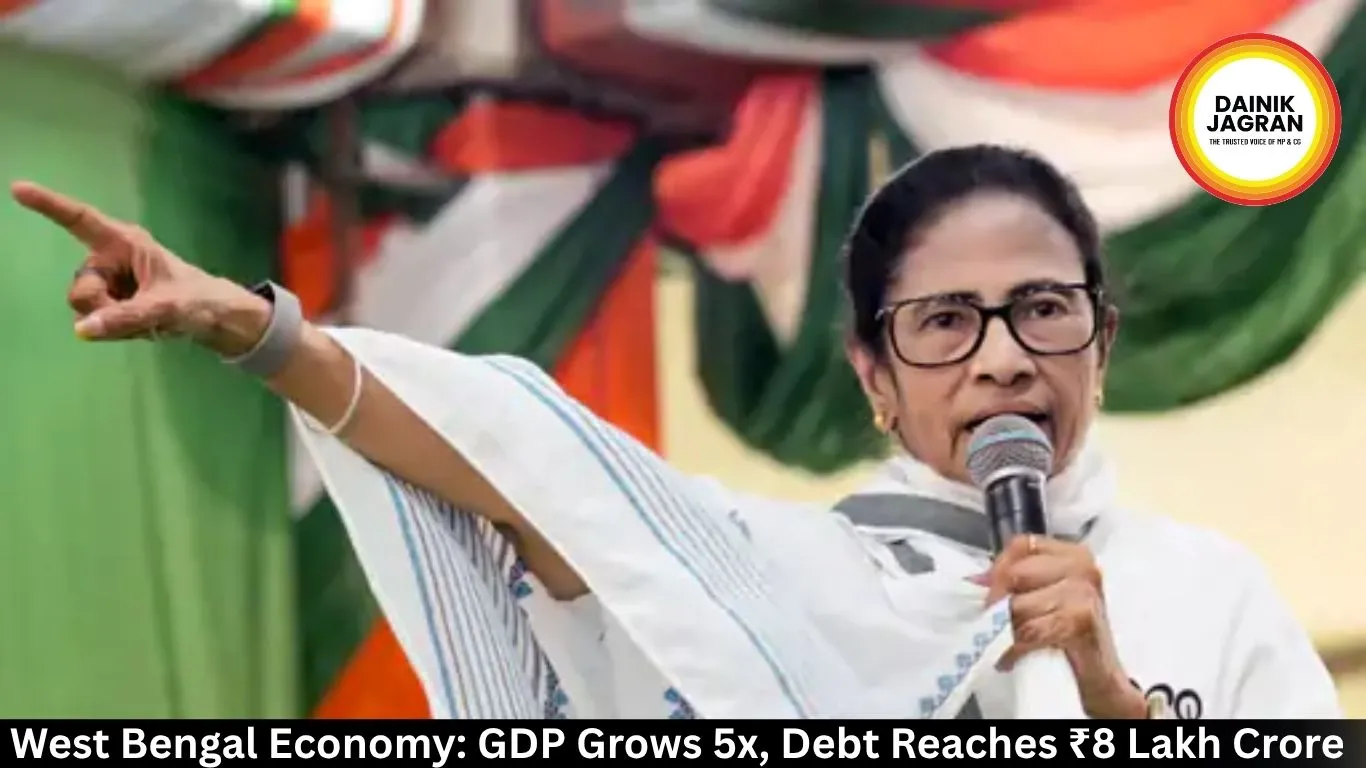
West Bengal Economy: GDP Grows 5x, Debt Reaches ₹8 Lakh Crore
Digital Desk
As West Bengal votes, we analyze Mamata Banerjee's 15-year economic legacy: A fivefold GSDP surge countered by a massive ₹8 lakh crore debt burden.
West Bengal Economy: GSDP Climbs Fivefold as Debt Hits ₹8 Lakh Crore Mark
As the state heads to the 2026 Assembly polls, Mamata Banerjee’s 15-year economic track record reveals a narrative of significant scale-up shadowed by a mounting fiscal burden.
As West Bengal commenced the first phase of its high-stakes Assembly elections on Thursday, the spotlight has sharpened on the state’s economic trajectory under Chief Minister Mamata Banerjee. After 15 years at the helm, the Trinamool Congress (TMC) government faces a complex balance sheet: a Gross State Domestic Product (GSDP) that has surged fivefold since 2011, contrasted against a debt mountain now touching ₹8 lakh crore.
The primary keyword for this economic assessment, the West Bengal Economy, has become the central pillar of the electoral discourse between the ruling TMC and the opposition BJP. While the state has seen a massive expansion in budget size and welfare spending, the sustainability of its borrowing remains a point of intense debate among policy experts and voters alike.
Budgetary expansion under TMC
In 2011, when Mamata Banerjee ended the 34-year Left Front rule, she inherited a state budget of approximately ₹77,510 crore. Fast forward to the FY2026-27 projections, and that figure has grown to a staggering ₹4.60 lakh crore.
This fivefold increase reflects the state’s aggressive push toward social sector schemes. Proponents of the government argue that this spending has successfully put liquidity directly into the hands of the rural and urban poor.
Massive surge in GSDP
The GSDP, which stood at a modest level during the transition from the Buddhadeb Bhattacharya era, is projected to hit ₹21.48 lakh crore in 2025-26. This growth indicates that the state’s total value of goods and services has scaled up significantly over three terms.
Officials suggest that despite the lack of large-scale industrial projects, the MSME sector and rural consumption have driven these numbers. However, the private investment climate continues to be a point of contention for the opposition.
The ₹8 lakh crore burden
The most critical challenge for the West Bengal Economy remains its ballooning debt. From an inherited debt of nearly ₹2 lakh crore in 2011, the state’s liabilities have quadrupled to nearly ₹8 lakh crore in the current fiscal year.
Economists warn that a significant portion of the state's revenue is now diverted toward interest payments. This fiscal pressure limits the government’s ability to fund capital-intensive infrastructure projects without further borrowing.
Per capita income trends
Bengal’s annual per capita income has seen a steady rise, moving from roughly ₹51,500 in 2011 to ₹1,71,184 in 2024-25. While the growth is evident, it remains a point of concern for many.
The state still lags behind the national average of ₹2,11,725. This gap provides ammunition to critics who claim that while Bengal is growing, it is not keeping pace with the faster-moving industrial states of the west and south.
The unemployment paradox
The Periodic Labour Force Survey (PLFS) pegged the state’s unemployment rate at 3.6% in 2025, down from 4.5% in 2011. On paper, this aligns with or beats the national average.
Despite these figures, labor migration remains a visible issue. Large numbers of workers continue to leave for states like Maharashtra and Kerala, leading to questions about the quality and wages of local employment opportunities.
Political stakes in 2026
With the 294-member Assembly up for grabs, Mamata Banerjee is seeking a fourth term, contesting once again from the high-profile Nandigram seat. The election, held in two phases on April 23 and 29, is essentially a referendum on her "Bengal Development Model."
The results, expected on May 4, will determine if the electorate prioritizes the social safety nets provided by the TMC or the industrialization promises made by the opposition.
Future fiscal outlook
As the West Bengal Economy moves toward the 2026-27 cycle, the next government will face the Herculean task of managing the debt-to-GSDP ratio. Balancing populism with fiscal prudence will be the defining challenge for the state's leadership in the coming decade, making this a vital Public Interest Story for the nation.
--------
🚨 Beat the News Rush – Join Now!
Get breaking alerts, hot exclusives, and game-changing stories instantly on your phone. No delays, no fluff – just the edge you need. ⚡
Tap to join:
🟢 WhatsApp Channel: Dainik Jagran MP CG
Crave more?
🅕 Facebook: Dainik Jagran MP CG English
🅧 Twitter (X): Dainik Jagran MP CG
🅘 Instagram: Dainik Jagran MP CG
Share the fire – keep your crew ahead! 🗞️🔥
West Bengal Economy: GDP Grows 5x, Debt Reaches ₹8 Lakh Crore
Digital Desk
West Bengal Economy: GSDP Climbs Fivefold as Debt Hits ₹8 Lakh Crore Mark
As the state heads to the 2026 Assembly polls, Mamata Banerjee’s 15-year economic track record reveals a narrative of significant scale-up shadowed by a mounting fiscal burden.
As West Bengal commenced the first phase of its high-stakes Assembly elections on Thursday, the spotlight has sharpened on the state’s economic trajectory under Chief Minister Mamata Banerjee. After 15 years at the helm, the Trinamool Congress (TMC) government faces a complex balance sheet: a Gross State Domestic Product (GSDP) that has surged fivefold since 2011, contrasted against a debt mountain now touching ₹8 lakh crore.
The primary keyword for this economic assessment, the West Bengal Economy, has become the central pillar of the electoral discourse between the ruling TMC and the opposition BJP. While the state has seen a massive expansion in budget size and welfare spending, the sustainability of its borrowing remains a point of intense debate among policy experts and voters alike.
Budgetary expansion under TMC
In 2011, when Mamata Banerjee ended the 34-year Left Front rule, she inherited a state budget of approximately ₹77,510 crore. Fast forward to the FY2026-27 projections, and that figure has grown to a staggering ₹4.60 lakh crore.
This fivefold increase reflects the state’s aggressive push toward social sector schemes. Proponents of the government argue that this spending has successfully put liquidity directly into the hands of the rural and urban poor.
Massive surge in GSDP
The GSDP, which stood at a modest level during the transition from the Buddhadeb Bhattacharya era, is projected to hit ₹21.48 lakh crore in 2025-26. This growth indicates that the state’s total value of goods and services has scaled up significantly over three terms.
Officials suggest that despite the lack of large-scale industrial projects, the MSME sector and rural consumption have driven these numbers. However, the private investment climate continues to be a point of contention for the opposition.
The ₹8 lakh crore burden
The most critical challenge for the West Bengal Economy remains its ballooning debt. From an inherited debt of nearly ₹2 lakh crore in 2011, the state’s liabilities have quadrupled to nearly ₹8 lakh crore in the current fiscal year.
Economists warn that a significant portion of the state's revenue is now diverted toward interest payments. This fiscal pressure limits the government’s ability to fund capital-intensive infrastructure projects without further borrowing.
Per capita income trends
Bengal’s annual per capita income has seen a steady rise, moving from roughly ₹51,500 in 2011 to ₹1,71,184 in 2024-25. While the growth is evident, it remains a point of concern for many.
The state still lags behind the national average of ₹2,11,725. This gap provides ammunition to critics who claim that while Bengal is growing, it is not keeping pace with the faster-moving industrial states of the west and south.
The unemployment paradox
The Periodic Labour Force Survey (PLFS) pegged the state’s unemployment rate at 3.6% in 2025, down from 4.5% in 2011. On paper, this aligns with or beats the national average.
Despite these figures, labor migration remains a visible issue. Large numbers of workers continue to leave for states like Maharashtra and Kerala, leading to questions about the quality and wages of local employment opportunities.
Political stakes in 2026
With the 294-member Assembly up for grabs, Mamata Banerjee is seeking a fourth term, contesting once again from the high-profile Nandigram seat. The election, held in two phases on April 23 and 29, is essentially a referendum on her "Bengal Development Model."
The results, expected on May 4, will determine if the electorate prioritizes the social safety nets provided by the TMC or the industrialization promises made by the opposition.
Future fiscal outlook
As the West Bengal Economy moves toward the 2026-27 cycle, the next government will face the Herculean task of managing the debt-to-GSDP ratio. Balancing populism with fiscal prudence will be the defining challenge for the state's leadership in the coming decade, making this a vital Public Interest Story for the nation.