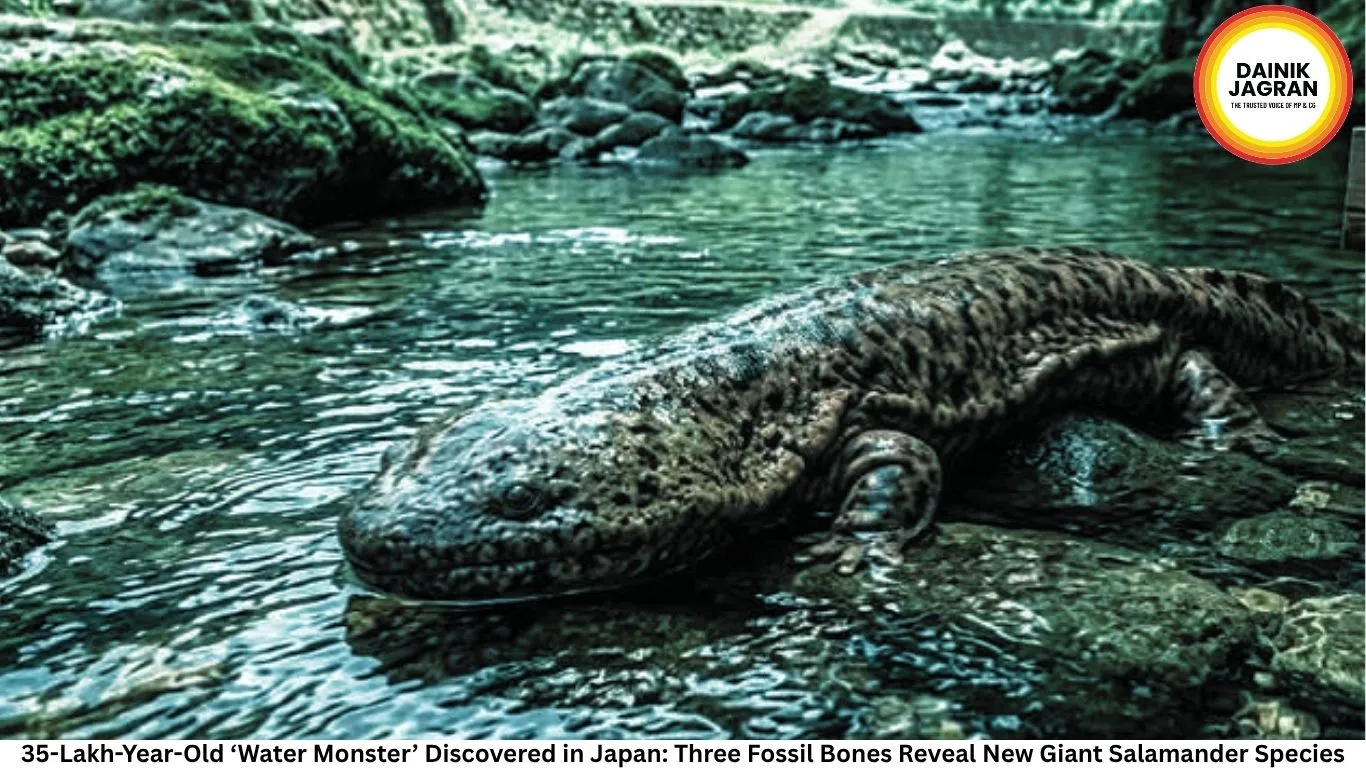
35-Lakh-Year-Old ‘Water Monster’ Discovered in Japan: Three Fossil Bones Reveal New Giant Salamander Species
Digital Desk
A remarkable fossil discovery in Japan has led scientists to identify a previously unknown species of giant salamander that lived around 3.5 million years ago. The breakthrough came after researchers re-examined three fossil bones unearthed nearly 30 years ago, revealing a massive amphibian that once inhabited ancient lakes and wetlands.
The newly identified species has been named Limnospondylus ajimuensis, marking a significant addition to the evolutionary history of giant salamanders and filling a major gap in Asia's fossil record.
The fossil bones were originally discovered between 1995 and 1997 during excavations in the Ajimu region of Japan. The remains were found in the Tsubusugawa Formation, a geological site known for preserving sediments from an ancient lake.
At the time, scientists could not determine the exact identity of the fossils and tentatively classified them under the Andrias genus, which includes the world's largest living salamanders.
However, advances in fossil analysis and imaging technology prompted researchers from Kyoto University to re-examine the specimens.
Unique Spine Revealed a New Species
Detailed analysis showed that the salamander's mid-trunk vertebra had a structure unlike that of any previously known giant salamander.
This distinctive anatomical feature convinced researchers that the fossils belonged to an entirely new genus and species, leading to the scientific name Limnospondylus ajimuensis.
The discovery offers fresh insights into the evolution and diversity of ancient amphibians in East Asia.
A Giant Amphibian That Lived in Ancient Lakes
Researchers estimate that the prehistoric salamander measured around 1.1 metres (3.6 feet) in length.
Unlike many modern giant salamanders that inhabit fast-flowing rivers, this ancient species is believed to have lived in calm lakes, marshes, and wetland environments.
Its habitat suggests that prehistoric Japan supported a rich freshwater ecosystem capable of sustaining large amphibian predators.
Why the Discovery Matters
Scientists say the finding helps bridge a 20-million-year gap in Asia's fossil record of giant salamanders.
The discovery also improves understanding of how these ancient amphibians evolved and adapted to changing environments over millions of years.
Researchers believe further studies of the Ajimu fossil site could uncover additional evidence about prehistoric ecosystems and the evolution of amphibian life in East Asia.
Key Highlights
- Scientists identified a new giant salamander species from 3.5-million-year-old fossils.
- The fossils were discovered in Japan's Ajimu region nearly 30 years ago.
- Researchers named the species Limnospondylus ajimuensis.
- The ancient amphibian measured approximately 1.1 metres (3.6 feet) in length.
- The discovery fills an important gap in Asia's prehistoric amphibian fossil record.

--------
🚨 Beat the News Rush – Join Now!
Get breaking alerts, hot exclusives, and game-changing stories instantly on your phone. No delays, no fluff – just the edge you need. ⚡
Tap to join:
🟢 WhatsApp Channel: Dainik Jagran MP CG
Crave more?
🅕 Facebook: Dainik Jagran MP CG English
🅧 Twitter (X): Dainik Jagran MP CG
🅘 Instagram: Dainik Jagran MP CG
Share the fire – keep your crew ahead! 🗞️🔥
35-Lakh-Year-Old ‘Water Monster’ Discovered in Japan: Three Fossil Bones Reveal New Giant Salamander Species
Digital Desk
The newly identified species has been named Limnospondylus ajimuensis, marking a significant addition to the evolutionary history of giant salamanders and filling a major gap in Asia's fossil record.
The fossil bones were originally discovered between 1995 and 1997 during excavations in the Ajimu region of Japan. The remains were found in the Tsubusugawa Formation, a geological site known for preserving sediments from an ancient lake.
At the time, scientists could not determine the exact identity of the fossils and tentatively classified them under the Andrias genus, which includes the world's largest living salamanders.
However, advances in fossil analysis and imaging technology prompted researchers from Kyoto University to re-examine the specimens.
Unique Spine Revealed a New Species
Detailed analysis showed that the salamander's mid-trunk vertebra had a structure unlike that of any previously known giant salamander.
This distinctive anatomical feature convinced researchers that the fossils belonged to an entirely new genus and species, leading to the scientific name Limnospondylus ajimuensis.
The discovery offers fresh insights into the evolution and diversity of ancient amphibians in East Asia.
A Giant Amphibian That Lived in Ancient Lakes
Researchers estimate that the prehistoric salamander measured around 1.1 metres (3.6 feet) in length.
Unlike many modern giant salamanders that inhabit fast-flowing rivers, this ancient species is believed to have lived in calm lakes, marshes, and wetland environments.
Its habitat suggests that prehistoric Japan supported a rich freshwater ecosystem capable of sustaining large amphibian predators.
Why the Discovery Matters
Scientists say the finding helps bridge a 20-million-year gap in Asia's fossil record of giant salamanders.
The discovery also improves understanding of how these ancient amphibians evolved and adapted to changing environments over millions of years.
Researchers believe further studies of the Ajimu fossil site could uncover additional evidence about prehistoric ecosystems and the evolution of amphibian life in East Asia.
Key Highlights
- Scientists identified a new giant salamander species from 3.5-million-year-old fossils.
- The fossils were discovered in Japan's Ajimu region nearly 30 years ago.
- Researchers named the species Limnospondylus ajimuensis.
- The ancient amphibian measured approximately 1.1 metres (3.6 feet) in length.
- The discovery fills an important gap in Asia's prehistoric amphibian fossil record.