


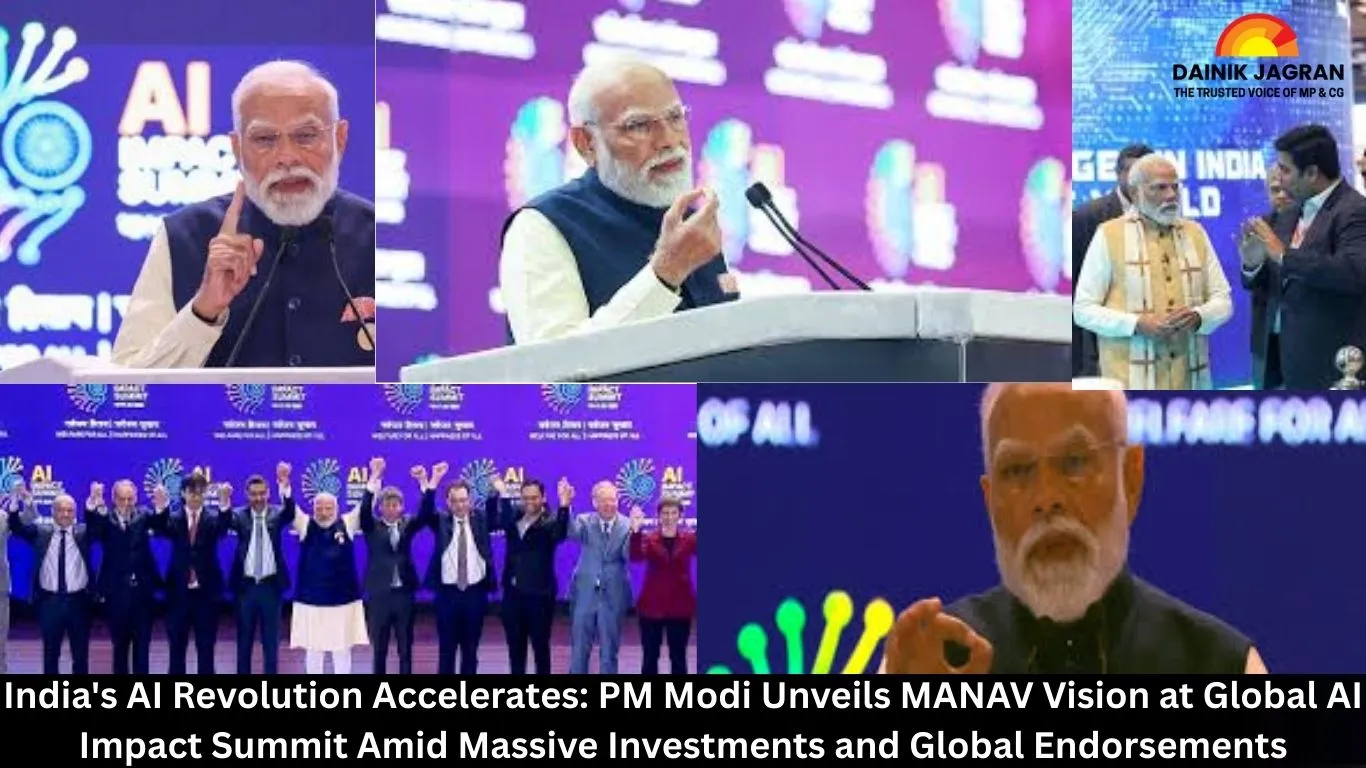
India's AI Revolution Accelerates: PM Modi Unveils MANAV Vision at Global AI Impact Summit Amid Massive Investments and Global Endorsements
Digital Desk
India took center stage in the global artificial intelligence race as Prime Minister Narendra Modi inaugurated the India AI Impact Summit 2026 at Bharat Mandapam, unveiling the MANAV vision — a human-centric framework to ensure AI serves humanity ethically and inclusively.
Speaking on the summit's high-profile day, PM Modi emphasized that India views AI not with fear but as destiny and future. "We see opportunity in AI, not threat," he said, stressing the need to place Global South aspirations at the core of AI governance. Without inclusive rules, he warned, developing nations risk becoming mere "data points" for a few dominant powers.
The MANAV vision — standing for Moral and Ethical Systems, Accountable Governance, National Sovereignty, Accessible and Inclusive, and Valid and Legitimate — outlines principles for transparent, sovereign, and equitable AI. Modi called it a "vital link for human welfare in the AI-driven 21st century," urging the world to treat AI as a global common good.
This vision resonates now as AI advances rapidly, raising concerns over ethics, job displacement, and inequality. Hosting the first such summit in the Global South, India positions itself as a bridge between innovation and responsibility.
Tech giants echoed the momentum with bold commitments. Reliance Industries Chairman Mukesh Ambani announced a massive ₹10 lakh crore investment over seven years in AI infrastructure, including gigawatt-scale data centers. He vowed to make AI as affordable as mobile data became through Jio, proving "AI won't kill jobs but create them" and building sovereign capabilities so India doesn't "rent intelligence."
OpenAI CEO Sam Altman hailed India as a future global AI leader, announcing the "OpenAI for India" initiative with new offices in Mumbai and Bengaluru, plus partnerships like with Tata Group. He predicted early superintelligence within years, urging urgent regulation.
Google CEO Sundar Pichai pledged $5 billion for an AI hub, while sharing DeepMind models with the government. Anthropic's Dario Amodei committed to joint safety testing, and Meta's Alexandr Wang praised India's world-class developers.
A viral group photo moment captured industry rivalries: Altman and Amodei raised hands separately, hinting at past tensions from Amodei's OpenAI exit.
French President Emmanuel Macron raised alarms over social media algorithms, warning they trap users in echo chambers and push extreme content, threatening democracies without transparency.
Microsoft's planned investments for the Global South reached $50 billion this decade, focusing on infrastructure and skilling.
However, not all went smoothly. Bill Gates canceled his keynote amid renewed scrutiny over Jeffrey Epstein links, with organizers citing focus on AI priorities.
Experts note India's edge in talent and digital public infrastructure like UPI, but challenges remain in rural connectivity, affordability, and literacy. As one analysis suggests, true success lies in balancing disruption with equity.
The summit signals India's ambition: not just adopting AI but shaping it responsibly. With trillions in pledges and a clear ethical roadmap via MANAV vision, the nation is racing toward becoming an AI superpower — proving the path, while long, is accelerating fast.




.jpg)




