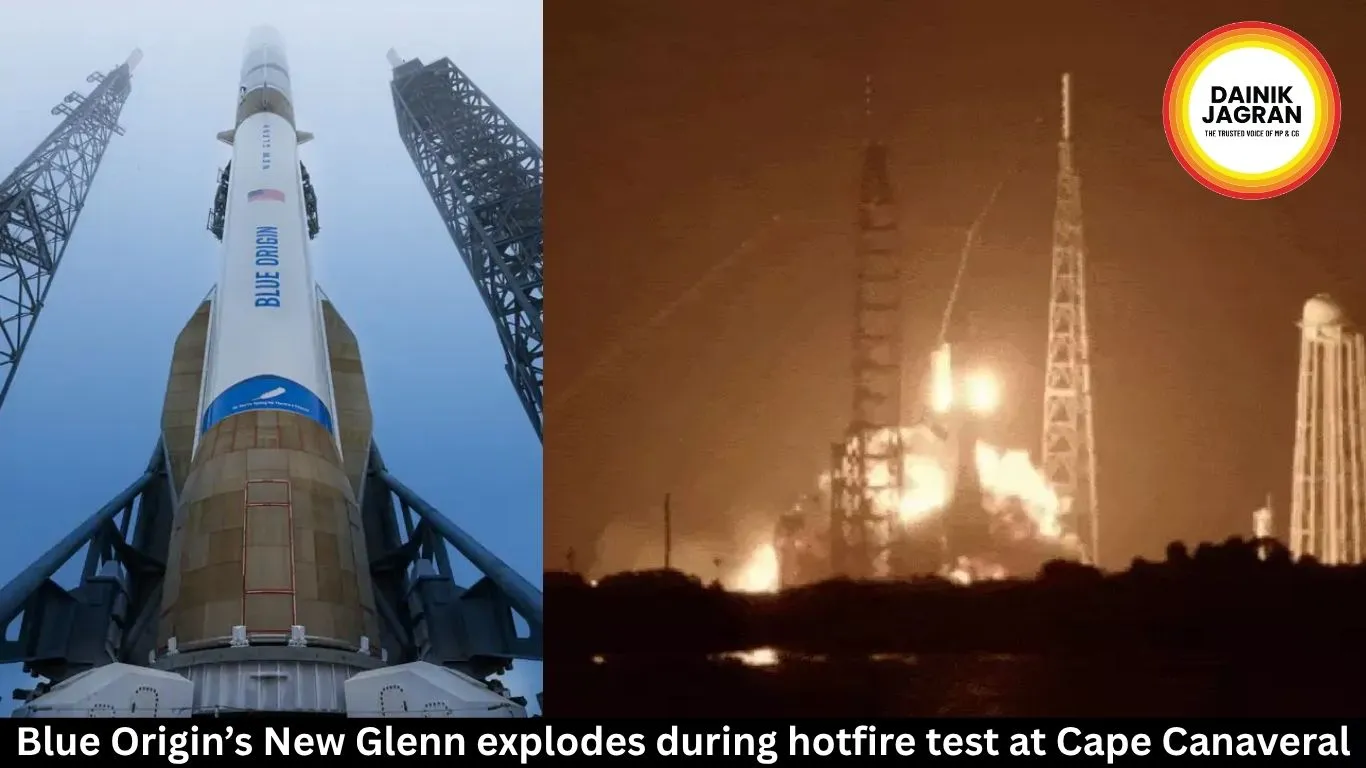
Blue Origin New Glenn explodes during hotfire test at Cape Canaveral

Digital Desk

Blue Origin New Glenn explodes during hotfire test at Cape Canaveral

Blue Origin’s New Glenn exploded during a hotfire test at Cape Canaveral; company says employees safe and an investigation is underway.


New Glenn rocket exploded during a hotfire test, footage shows large fireball forming

A Blue Origin New Glenn rocket exploded on the launch pad late Thursday during a preflight hotfire test at Cape Canaveral, Florida, sending a large fireball into the night sky but causing no reported injuries, company and local officials said.

What happened
Officials said the anomaly occurred during a hotfire test of New Glenn’s main engines at about 9:00 pm local time. Video shared on social media showed flames and a sudden bright fireball around the vehicle, followed by smoke. Blue Origin confirmed the test was underway and said initial reports indicate a “malfunction” led to the accident.

Company response
Blue Origin founder Jeff Bezos posted that all employees at the site are safe and that the company has begun an investigation. “Today was a very difficult day,” Bezos said in a brief statement. “We will determine the cause, rebuild what we must, and return to flight.”

Safety and investigations
Brevard County Emergency Management said there was no danger to the public from the incident and that local emergency responders were on scene. The U.S. Space Force — which supports civilian launch operations at Cape Canaveral — confirmed it has personnel working with Blue Origin to evaluate telemetry and other data to identify the cause of the anomaly.

NASA also weighed in, stressing the inherent difficulty of developing heavy-lift rockets. NASA Administrator Jared Isaacman said the agency will support a full investigation, assess impacts on upcoming missions, and work with partners to return to flight as soon as it is safe to do so.

Test details and timeline
A hotfire test clamps the rocket to the pad and runs its engines at full thrust to validate performance ahead of a launch. According to sources familiar with such tests, teams monitor engine health, structural loads, and ground systems while recording extensive telemetry. Blue Origin said the hotfire was part of final preparations for a planned launch in the coming days, though the company had not publicly announced a firm launch date.

Recent regulatory scrutiny
The accident follows a turbulent stretch for Blue Origin. Last month the Federal Aviation Administration opened an investigation into a failed satellite launch that had grounded New Glenn until regulators and the company could complete a review. The FAA’s probe and this latest anomaly add to scrutiny of Blue Origin’s rollout of its heavy-lift vehicle.

Programme background
New Glenn is a key element of Blue Origin’s long-term strategy to compete in the commercial heavy-lift market and to support satellite deployments, including a planned Amazon broadband constellation. The rocket — roughly equivalent in height to a 29‑storey building — features a reusable first stage designed to reduce launch costs. Blue Origin invested nearly a decade and billions of dollars into the programme; the company celebrated a milestone last November when a New Glenn flight achieved its first successful booster landing.

Commercial context
Industry analysts said the incident could delay Blue Origin’s near-term launch calendar and complicate plans to deploy Amazon’s low‑Earth-orbit broadband satellites, announced this week to compete with SpaceX’s Starlink. Blue Origin had said it was preparing to carry 48 Amazon LEO satellites but had not set a firm launch date.

Reactions on X and social media
Footage of the explosion circulated quickly online, and industry figures reacted. SpaceX CEO Elon Musk wrote on X that the accident was “extremely unfortunate” and reiterated that building and operating rockets is difficult. Analysts noted that setbacks are common in rocket development and that robust investigations usually follow to prevent recurrence.

What’s next
Blue Origin said it will work with regulators and partners to determine the sequence of events and the root cause. Investigators will comb through sensor data, video, and ground‑support diagnostics. Officials did not provide a timeline for the investigation or for a potential return-to-flight.

If findings require hardware or pad repairs, that work could take weeks to months depending on damage. For now, the focus for Blue Origin and federal agencies is a careful, data-driven inquiry before resuming flights.

 

--------

🚨 Beat the News Rush – Join Now!

Get breaking alerts, hot exclusives, and game-changing stories instantly on your phone. No delays, no fluff – just the edge you need. ⚡

Tap to join: 

🟢 WhatsApp Channel: Dainik Jagran MP CG

Crave more?

🅕 Facebook: Dainik Jagran MP CG English

🅧 Twitter (X): Dainik Jagran MP CG

🅘 Instagram: Dainik Jagran MP CG

Share the fire – keep your crew ahead! 🗞️🔥

english.dainikjagranmpcg.com
29 May 2026 By Abhishek Joshi

Blue Origin New Glenn explodes during hotfire test at Cape Canaveral

Digital Desk

New Glenn rocket exploded during a hotfire test, footage shows large fireball forming

A Blue Origin New Glenn rocket exploded on the launch pad late Thursday during a preflight hotfire test at Cape Canaveral, Florida, sending a large fireball into the night sky but causing no reported injuries, company and local officials said.

What happened
Officials said the anomaly occurred during a hotfire test of New Glenn’s main engines at about 9:00 pm local time. Video shared on social media showed flames and a sudden bright fireball around the vehicle, followed by smoke. Blue Origin confirmed the test was underway and said initial reports indicate a “malfunction” led to the accident.

Company response
Blue Origin founder Jeff Bezos posted that all employees at the site are safe and that the company has begun an investigation. “Today was a very difficult day,” Bezos said in a brief statement. “We will determine the cause, rebuild what we must, and return to flight.”

Safety and investigations
Brevard County Emergency Management said there was no danger to the public from the incident and that local emergency responders were on scene. The U.S. Space Force — which supports civilian launch operations at Cape Canaveral — confirmed it has personnel working with Blue Origin to evaluate telemetry and other data to identify the cause of the anomaly.

NASA also weighed in, stressing the inherent difficulty of developing heavy-lift rockets. NASA Administrator Jared Isaacman said the agency will support a full investigation, assess impacts on upcoming missions, and work with partners to return to flight as soon as it is safe to do so.

Test details and timeline
A hotfire test clamps the rocket to the pad and runs its engines at full thrust to validate performance ahead of a launch. According to sources familiar with such tests, teams monitor engine health, structural loads, and ground systems while recording extensive telemetry. Blue Origin said the hotfire was part of final preparations for a planned launch in the coming days, though the company had not publicly announced a firm launch date.

Recent regulatory scrutiny
The accident follows a turbulent stretch for Blue Origin. Last month the Federal Aviation Administration opened an investigation into a failed satellite launch that had grounded New Glenn until regulators and the company could complete a review. The FAA’s probe and this latest anomaly add to scrutiny of Blue Origin’s rollout of its heavy-lift vehicle.

Programme background
New Glenn is a key element of Blue Origin’s long-term strategy to compete in the commercial heavy-lift market and to support satellite deployments, including a planned Amazon broadband constellation. The rocket — roughly equivalent in height to a 29‑storey building — features a reusable first stage designed to reduce launch costs. Blue Origin invested nearly a decade and billions of dollars into the programme; the company celebrated a milestone last November when a New Glenn flight achieved its first successful booster landing.

Commercial context
Industry analysts said the incident could delay Blue Origin’s near-term launch calendar and complicate plans to deploy Amazon’s low‑Earth-orbit broadband satellites, announced this week to compete with SpaceX’s Starlink. Blue Origin had said it was preparing to carry 48 Amazon LEO satellites but had not set a firm launch date.

Reactions on X and social media
Footage of the explosion circulated quickly online, and industry figures reacted. SpaceX CEO Elon Musk wrote on X that the accident was “extremely unfortunate” and reiterated that building and operating rockets is difficult. Analysts noted that setbacks are common in rocket development and that robust investigations usually follow to prevent recurrence.

What’s next
Blue Origin said it will work with regulators and partners to determine the sequence of events and the root cause. Investigators will comb through sensor data, video, and ground‑support diagnostics. Officials did not provide a timeline for the investigation or for a potential return-to-flight.

If findings require hardware or pad repairs, that work could take weeks to months depending on damage. For now, the focus for Blue Origin and federal agencies is a careful, data-driven inquiry before resuming flights.

 

https://english.dainikjagranmpcg.com/special-news/blue-origin-new-glenn-explodes-during-hotfire-test-at-cape/article-19395

Related Posts

Latest News