Iran Warns US of Heavy Price Over Hormuz Strait Security
Digital Desk
Iran’s IRGC warns Washington of severe consequences if the Strait of Hormuz security is disrupted after missile attacks on US sites in Kuwait and Bahrain. Fresh clashes push oil prices higher amid ongoing Middle East tensions. Iran’s IRGC warns Washington of severe consequences if the Strait of Hormuz security is disrupted after missile attacks on US sites in Kuwait and Bahrain. Fresh clashes push oil prices higher amid ongoing Middle East tensions.
Tehran escalates rhetoric after fresh military exchanges in the Gulf
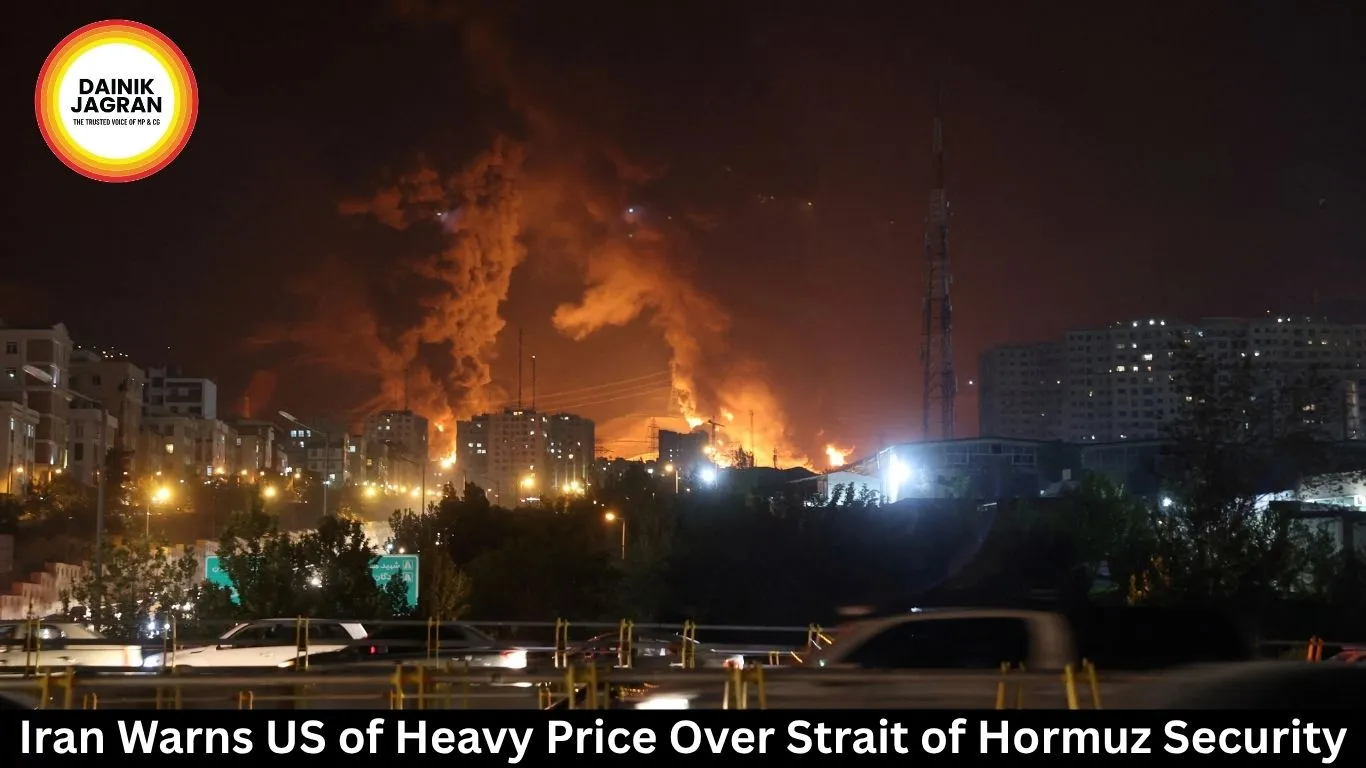
Iran’s Islamic Revolutionary Guard Corps (IRGC) has issued a stern warning to the United States, stating that any threat to security in the Strait of Hormuz will come at a “heavy price.” The statement follows a night of direct military exchanges, including Iranian missile and drone attacks targeting US-linked sites in Kuwait and Bahrain.
According to officials, the latest flare-up began after US forces conducted what they described as self-defence strikes on a communications tower on Iran’s Qeshm Island. In response, Iran launched multiple waves of missiles and drones toward American military installations in the region.
IRGC spokesperson’s firm message
Ibrahim al Fiqar, an IRGC spokesperson, posted on X that Iran had delivered on earlier warnings of a “different and more forceful response.” He described the recent actions as a lesson for potential aggressors. “We reiterate that any threat to the security of the Strait of Hormuz will cost the aggressor U.S. military a heavy price,” he added.
The Strait of Hormuz, a narrow chokepoint through which nearly a fifth of global oil passes, remains at the centre of rising tensions. Any prolonged disruption here could send energy prices spiralling further.
US forces intercept attacks
US Central Command (CENTCOM) confirmed that American and Bahraini air defence systems successfully intercepted most of the Iranian projectiles aimed at Kuwait and Bahrain. No American casualties or major damage were reported. CENTCOM described its own strike on Qeshm Island as a measured response to Iranian aggression.
Initial reports indicate that Iranian missiles also targeted areas near US naval assets, though claims of direct hits on the Fifth Fleet headquarters in Bahrain were rejected by Washington as false.
Oil prices surge amid uncertainty
Crude oil prices jumped more than one percent in early Asian trading on Wednesday. Brent crude rose to around $97 per barrel while WTI climbed near $95. Market analysts linked the spike directly to fears over potential closure or disruption of the Strait of Hormuz.
The fresh clashes come even as diplomatic efforts between Washington and Tehran appear to continue, despite public posturing. President Donald Trump earlier dismissed reports of a breakdown in communications, calling them “fake news.”
Wider regional fallout
The Hormuz tensions are part of a broader conflict involving Israel, Hezbollah in Lebanon, and spillover effects across the Gulf. Israeli strikes continued in southern Lebanon, including the port city of Tyre, even after claims of de-escalation. Meanwhile, Japan approved a $19 billion supplementary budget to cushion its economy from rising energy and commodity costs triggered by the Middle East crisis.
Local observers in Gulf capitals report heightened alert levels at military bases and increased naval patrols near key shipping lanes. Shipping companies have begun rerouting some vessels, adding to global supply chain concerns.
Questions over de-escalation prospects
US Secretary of State Marco Rubio emphasised that Iran must stop actions in the Strait and reopen it fully for normal traffic. He described Tehran’s behaviour as “unlawful and illegal,” noting that the international community stands united against it.
Iran, for its part, insists its actions are retaliatory and aimed at defending its territorial waters and sovereignty. The IRGC has also claimed responses to US strikes on Iranian oil tankers near the strait.
As of Wednesday morning, the situation remains fluid. Diplomatic channels are reportedly still active, though both sides continue military posturing. Any further escalation in the Strait of Hormuz could have severe consequences for global energy security and push oil prices well above the $100 mark.
Analysts say the coming days will be critical in determining whether the latest exchanges lead to a dangerous cycle or create space for renewed talks.
--------
🚨 Beat the News Rush – Join Now!
Get breaking alerts, hot exclusives, and game-changing stories instantly on your phone. No delays, no fluff – just the edge you need. ⚡
Tap to join:
🟢 WhatsApp Channel: Dainik Jagran MP CG
Crave more?
🅕 Facebook: Dainik Jagran MP CG English
🅧 Twitter (X): Dainik Jagran MP CG
🅘 Instagram: Dainik Jagran MP CG
Share the fire – keep your crew ahead! 🗞️🔥
Iran Warns US of Heavy Price Over Hormuz Strait Security
Digital Desk
Tehran escalates rhetoric after fresh military exchanges in the Gulf
Iran’s Islamic Revolutionary Guard Corps (IRGC) has issued a stern warning to the United States, stating that any threat to security in the Strait of Hormuz will come at a “heavy price.” The statement follows a night of direct military exchanges, including Iranian missile and drone attacks targeting US-linked sites in Kuwait and Bahrain.
According to officials, the latest flare-up began after US forces conducted what they described as self-defence strikes on a communications tower on Iran’s Qeshm Island. In response, Iran launched multiple waves of missiles and drones toward American military installations in the region.
IRGC spokesperson’s firm message
Ibrahim al Fiqar, an IRGC spokesperson, posted on X that Iran had delivered on earlier warnings of a “different and more forceful response.” He described the recent actions as a lesson for potential aggressors. “We reiterate that any threat to the security of the Strait of Hormuz will cost the aggressor U.S. military a heavy price,” he added.
The Strait of Hormuz, a narrow chokepoint through which nearly a fifth of global oil passes, remains at the centre of rising tensions. Any prolonged disruption here could send energy prices spiralling further.
US forces intercept attacks
US Central Command (CENTCOM) confirmed that American and Bahraini air defence systems successfully intercepted most of the Iranian projectiles aimed at Kuwait and Bahrain. No American casualties or major damage were reported. CENTCOM described its own strike on Qeshm Island as a measured response to Iranian aggression.
Initial reports indicate that Iranian missiles also targeted areas near US naval assets, though claims of direct hits on the Fifth Fleet headquarters in Bahrain were rejected by Washington as false.
Oil prices surge amid uncertainty
Crude oil prices jumped more than one percent in early Asian trading on Wednesday. Brent crude rose to around $97 per barrel while WTI climbed near $95. Market analysts linked the spike directly to fears over potential closure or disruption of the Strait of Hormuz.
The fresh clashes come even as diplomatic efforts between Washington and Tehran appear to continue, despite public posturing. President Donald Trump earlier dismissed reports of a breakdown in communications, calling them “fake news.”
Wider regional fallout
The Hormuz tensions are part of a broader conflict involving Israel, Hezbollah in Lebanon, and spillover effects across the Gulf. Israeli strikes continued in southern Lebanon, including the port city of Tyre, even after claims of de-escalation. Meanwhile, Japan approved a $19 billion supplementary budget to cushion its economy from rising energy and commodity costs triggered by the Middle East crisis.
Local observers in Gulf capitals report heightened alert levels at military bases and increased naval patrols near key shipping lanes. Shipping companies have begun rerouting some vessels, adding to global supply chain concerns.
Questions over de-escalation prospects
US Secretary of State Marco Rubio emphasised that Iran must stop actions in the Strait and reopen it fully for normal traffic. He described Tehran’s behaviour as “unlawful and illegal,” noting that the international community stands united against it.
Iran, for its part, insists its actions are retaliatory and aimed at defending its territorial waters and sovereignty. The IRGC has also claimed responses to US strikes on Iranian oil tankers near the strait.
As of Wednesday morning, the situation remains fluid. Diplomatic channels are reportedly still active, though both sides continue military posturing. Any further escalation in the Strait of Hormuz could have severe consequences for global energy security and push oil prices well above the $100 mark.
Analysts say the coming days will be critical in determining whether the latest exchanges lead to a dangerous cycle or create space for renewed talks.