


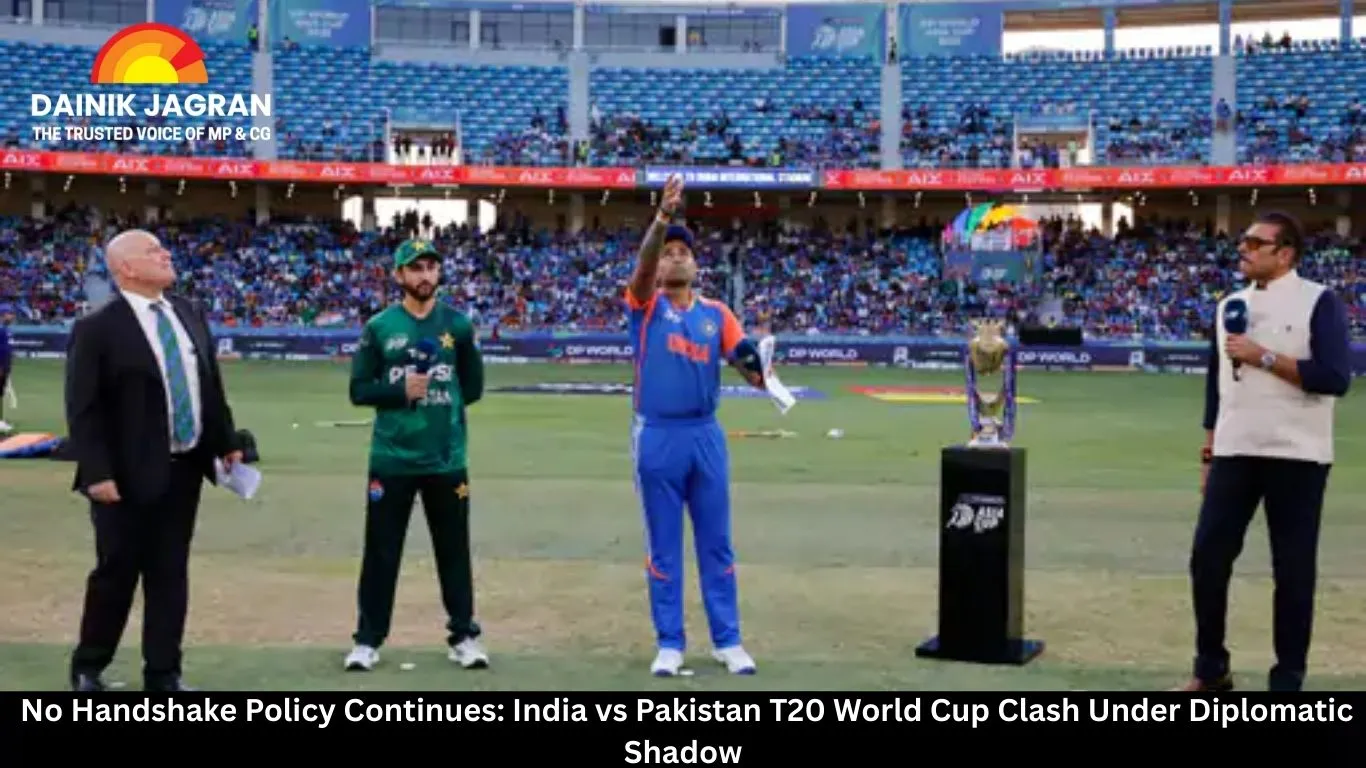
No Handshake Policy Continues: India vs Pakistan T20 World Cup Clash Under Diplomatic Shadow
Digital Desk
When India captain Suryakumar Yadav walks out for the toss against Pakistan skipper Salman Ali Agha at the R Premadasa Stadium in Colombo on Sunday, there will be no handshake. The continuation of India's no-handshake policy, in place since the September 2025 Asia Cup, has turned one of cricket's fiercest rivalries into a diplomatic flashpoint—and drawn sharp criticism from former cricketer Sanjay Manjrekar, who labeled the stance a "silly thing" unbecoming of a cricketing nation .
The high-voltage T20 World Cup 2026 Group A encounter, scheduled for February 15, carries enormous stakes beyond the points table. Both teams enter undefeated with two wins each, and the victor will seize control of the group. But the conversation ahead of Sunday's blockbuster has been dominated not by match-ups or strategies, but by whether players will engage in cricket's most basic gesture of sportsmanship.
'Wait for 24 Hours': Captains Play Coy
At the pre-match press conference on Saturday, Suryakumar Yadav kept the cricketing world guessing—sort of. When asked directly whether he would shake hands with his Pakistani counterpart, the Indian captain offered a cryptic response: "Wait for 24 hours. We are here to play cricket. Have good food and sleep" .
Pakistan captain Salman Ali Agha, meanwhile, struck a conciliatory tone while making it clear the decision rests entirely with India. "Cricket should be played in the right spirit. My personal opinion may not matter, but cricket should be played the way it has always been played. It's up to them to decide what to do," Agha told reporters .
But according to a report by The Indian Express, the suspense is merely theatrical—the Indian team will indeed continue its no-handshake stance, first adopted during the Asia Cup last year in the aftermath of the Pahalgam terror attack and subsequent military conflict .
Women's Rising Stars Match Sets the Tone
If any doubt remained about India's approach, it was erased hours before the men's clash when India A Women faced Pakistan A Women in the Rising Stars Asia Cup in Bangkok on Sunday. Captains Radha Yadav and Hafsa Khalid conspicuously skipped the customary handshake at the toss, continuing a pattern that has now become standard across all formats and age groups .
India A Women went on to register a dominant eight-wicket victory, with Vrinda Dinesh smashing an unbeaten 55 off just 29 balls. But the on-field result took a backseat to the pre-match optics. "The no-handshake tradition between Indian and Pakistani teams continued in yet another high-profile encounter," Zee News reported, noting that similar scenes played out at the 2025 Women's World Cup, the U-19 Asia Cup, and the U-19 World Cup .
The consistency across men's and women's teams, senior and age-group cricket, suggests a formalized policy rather than spontaneous decisions by individual players.
'Silly Thing': Sanjay Manjrekar's Blunt Assessment
Former Indian cricketer Sanjay Manjrekar, never one to mince words, has emerged as the most prominent voice criticizing the no-handshake stance. In a post on X (formerly Twitter), Manjrekar pulled no punches:
"This 'no shaking hands' is such a silly thing that India has started. It's unbecoming of a nation like ours. Either play properly within the spirit of the game or don't play at all" .
Manjrekar's comments have reignited debate about where to draw the line between political protest and sporting etiquette. The former batsman's position is clear: if the situation is so grave that players cannot exchange handshakes, perhaps the matches shouldn't happen at all.
The Political Backdrop: From Pahalgam to Operation Sindoor
The no-handshake policy cannot be understood without examining its origins. In April 2025, a terrorist attack in Pahalgam, Jammu & Kashmir, claimed the lives of 26 civilians, mostly Hindu tourists. The attack pushed India and Pakistan to the brink of all-out war, with India launching Operation Sindoor in response .
When India and Pakistan met at the Asia Cup in September 2025—their first encounter after the military conflict—Indian players refused to shake hands with their Pakistani counterparts. The gesture was described as a mark of respect for those killed in the attack and solidarity with the Indian armed forces .
Pakistan reacted sharply. The Pakistan Cricket Board (PCB) lodged a formal complaint with the International Cricket Council (ICC), accusing match referee Andy Pycroft of failing to uphold the spirit of the game. At one point, Pakistan threatened to boycott their remaining Asia Cup fixtures, though they eventually backed down after discussions with the ICC .
PCB chief Mohsin Naqvi, who also serves as Pakistan's interior minister, made his country's position clear in December 2025: "If they don't want to shake hands, then we have no particular desire to do so either. Whatever happens, it will happen on an equal footing with India" .
The Trophy That Never Was
The Asia Cup final in September produced perhaps the most dramatic manifestation of the tensions. After India defeated Pakistan to claim the title, the Indian players refused to accept the trophy from Mohsin Naqvi during the presentation ceremony, citing diplomatic sensitivities. Naqvi ultimately left the stadium with the trophy, and it remains unclear whether the Indian team has formally received it .
Naqvi later defended his actions, stating he was following ACC protocol, but the episode underscored how deeply politics has penetrated cricketing interactions.
ICC's Hands-Off Approach
Could cricket's governing body intervene? Multiple media reports suggest the ICC has adopted a hands-off stance. During a reported meeting in Lahore involving the ICC, PCB, and Bangladesh Cricket Board—where Pakistan's brief boycott threat was addressed—the world body reportedly made clear that handshakes fall outside its regulatory purview .
The Melbourne Cricket Club's Spirit of Cricket urges players to be courteous to opponents, but there is no enforceable rule mandating handshakes. Each team remains free to decide its own protocol .
Pakistan captain Salman Agha has previously claimed that Suryakumar Yadav shook hands with him in private during the Asia Cup—at a pre-tournament press conference and during a referee's meeting—suggesting the no-handshake policy applies specifically to public, televised moments .
What Happens at the Toss?
When Suryakumar Yadav and Salman Ali Agha meet at the center of the R Premadasa Stadium on Sunday, millions will watch to see whether hands are extended. All evidence points toward continuation of the policy.
- The Indian team has maintained the stance consistently since September 2025
- The women's Rising Stars match implemented it just hours before the men's game
- Suryakumar's coy "wait for 24 hours" response effectively confirmed nothing has changed
- The political context that triggered the policy remains unchanged
Pakistan, for their part, have signaled they will not force the issue. "The game should be played in the spirit it has always been played since its inception," Agha said, while acknowledging that "we don't have a good record against them in World Cups. But whenever you come to play a new match, it's a new day" .
The Broader Picture
India and Pakistan have not played a bilateral series in over a decade, meeting only in ICC tournaments and Asia Cups at neutral venues. India has not toured Pakistan since 2008, and Pakistan's 2023 tour of India for the 50-over World Cup remains their last visit across the border .
In T20 cricket, India holds a commanding 12-4 head-to-head record. In T20 World Cup meetings specifically, India has won seven of eight encounters, with Pakistan's solitary victory coming in 2021 .
Cricket's New Normal
As Sunday's blockbuster approaches, one thing is clear: the no-handshake policy has become cricket's new normal for India-Pakistan encounters. What began as an emotional response to tragedy has hardened into institutional protocol, applied uniformly across men's and women's teams, senior and age-group cricket.
Whether this strengthens or diminishes the "spirit of cricket" depends on one's perspective. For some, it's a necessary acknowledgment of real-world realities that cannot be wished away at the boundary rope. For others like Sanjay Manjrekar, it's a "silly" departure from the sporting values that make cricket meaningful.
What's undeniable is that when Suryakumar Yadav and Salman Ali Agha meet at the toss, their hands will remain by their sides—and that moment will speak volumes about where this rivalry stands in 2026.
.jpg)




