
.jpg)

.jpg)
Chhattisgarh Cabinet Approves 10 Big Bills: Anti-Conversion Law, Exam Cheating Act & Property Cess Abolished — Everything You Need to Know
Digital Desk
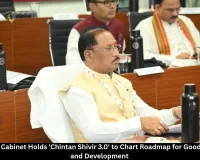
In one of the most consequential single-day cabinet sessions in recent Chhattisgarh history, Chief Minister Vishnu Deo Sai's government cleared a sweeping package of 10 major legislative proposals on March 10, 2026 — touching everything from religious freedom and exam integrity to property taxes and renewable energy subsidies.
The meeting, held at the Chhattisgarh Legislative Assembly premises in Nava Raipur Atal Nagar during the ongoing Budget Session, signals a government in legislative overdrive. But it is the Chhattisgarh Dharm Swatantrya Vidheyak, 2026 — the anti-conversion bill — that is already generating the most heat, debate, and national attention.
Here is a complete breakdown of every major decision and what it means for the people of Chhattisgarh.
1. The Anti-Conversion Bill — Chhattisgarh's Most Controversial Decision
The Chhattisgarh Cabinet approved the draft of the Chhattisgarh Dharm Swatantrya Vidheyak, 2026 — the Chhattisgarh Freedom of Religion Bill — which seeks to effectively curb conversion from one faith to another through force, allurement, undue influence or false representation. The bill is likely to be introduced in the ongoing budget session of the assembly. Amar Ujala
Deputy Chief Minister and Home Minister Vijay Sharma, Finance Minister O.P. Choudhary, and other senior ministers emphasised that the proposed legislation is not against any religion, but to ensure freedom and security of every religion. They stressed that while every religion is free to propagate itself, conversion through coercion, lure or any other unfair means will not be allowed. India TV News
Chhattisgarh is not entering new territory here. Anti-conversion laws already exist in 12 other states including Uttar Pradesh, Madhya Pradesh, Gujarat, Uttarakhand, Karnataka, Himachal Pradesh, Odisha, Haryana, Jharkhand, Arunachal Pradesh and Rajasthan. Business Today But the timing matters: this approval comes just days after Maharashtra's Cabinet cleared its own similar legislation, Maharashtra's Dharma Swatantrya Adhiniyam 2026, under which those convicted could face imprisonment of up to seven years and a fine of up to ₹5 lakh. Business Today
Critics, however, warn that the language of "allurement" and "undue influence" is dangerously broad. Civil society groups argue that vague terms such as "inducement", "allurement" and "pressure" could allow misuse by authorities and place consensual interfaith marriages under suspicion — creating an atmosphere of surveillance and moral policing. ANI News The Supreme Court is also already examining the constitutional validity of similar laws in multiple states — making Chhattisgarh's timing both bold and legally risky.
2. Exam Cheating Prevention Bill — Zero Tolerance for Paper Leaks
The Cabinet cleared the draft of the Chhattisgarh Public Recruitment and Professional Examinations (Prevention of Unfair Means) Bill, 2026, aimed at ensuring greater transparency, fairness, and credibility in public examination systems. Amar Ujala
This bill arrives at a moment of national urgency. The NEET paper leak scandal of 2024 and subsequent revelations of organised cheating networks across government recruitment exams have devastated the aspirations of millions of genuine candidates across India. The Anti-cheating Bill aims to prevent "unfair means" in order to "bring greater transparency, fairness and credibility to the public examinations system." IndiaMART
For Chhattisgarh's vast population of competitive exam aspirants — many of them first-generation graduates from tribal and rural communities — this law is not an abstract policy. It is a promise that hard work will not be cancelled by corruption. The bill is expected to introduce stringent penalties for paper leakers, impersonation, and digital cheating, with provisions for criminal prosecution of exam racket operators.
3. New Staff Selection Board — Ending Recruitment Chaos
The Cabinet approved the Chhattisgarh Employees Selection Board Bill, 2026, for constituting a board to conduct examinations and select candidates for technical and non-technical Class III and IV government posts. Asianet Newsable
The creation of a dedicated, statutory Staff Selection Board for Group C and D posts addresses a long-standing governance gap. Currently, recruitment processes for these posts are fragmented, inconsistent, and vulnerable to manipulation. A single, accountable, legally empowered board — modelled on the Staff Selection Commission at the national level — will bring uniformity, transparency, and a fixed examination calendar that candidates can plan around.
4. Property Registration Cess Abolished — Relief for Homebuyers
The Cabinet cleared the draft of the Chhattisgarh Cess (Amendment) Bill, 2026, to abolish the cess charged during property registration. The cess had been imposed in 2023 at 12 percent over stamp duty to fund the Rajiv Gandhi Mitra Club Scheme, which is presently not operational. Asianet Newsable
This is immediate, tangible relief for anyone buying or registering property in Chhattisgarh. A 12% cess over and above existing stamp duty — which itself ranges from 4% to 6% on property values — had made real estate transactions significantly more expensive. With the Rajiv Gandhi Mitan Club scheme defunct, the BJP government's decision to scrap the cess is both fiscally logical and politically smart — squarely targeting a Congress-era surcharge that affected every property buyer in the state.
5. Renewable Energy Push — Biogas Subsidies Approved
The Cabinet approved proposals relating to subsidies for projects based on non-conventional energy sources. For domestic biogas plants ranging from two to six cubic metres, a subsidy of ₹9,000 per unit has been proposed for 2024–25 and 2025–26, and the same amount for all capacities from 2026–27 onwards. Asianet Newsable
Against the backdrop of India's ongoing commercial LPG supply crisis — which is hitting states like Chhattisgarh hard — this subsidy for domestic biogas plants carries added significance. Biogas, produced from organic waste, offers rural households an alternative to LPG dependency. ₹9,000 per unit is a meaningful incentive in rural Chhattisgarh's agrarian economy, where cattle ownership makes biogas a practical, sustainable choice.
6. Political Case Withdrawals — Congress-Era FIRs Dropped
The Cabinet also approved the withdrawal of 13 cases from courts following recommendations made by a sub-committee constituted to examine cases related to purely political movements. Asianet Newsable
While the government has framed this as a humanitarian measure to relieve individuals prosecuted for political activity, opposition Congress has demanded full disclosure of exactly which cases are being withdrawn and against whom. Political case withdrawals by ruling parties are a recurring and contested practice in Indian state governance — one that demands transparency and legislative scrutiny.
7. Land Revenue, Housing Board, and Sports Infrastructure
Among other decisions, the Cabinet approved amendments to the Chhattisgarh Town and Village Investment Act and the Chhattisgarh Housing Board Act, 1972. It also approved amendments to Sections 40, 50, and 59 of the Chhattisgarh Land Revenue Code, 1959, and decided to allot five acres of Rajgami Estate land to the District Cricket Association in Rajnandgaon for establishing a modern sports ground and cricket academy. Asianet Newsable
The Rajnandgaon cricket academy is a welcome investment in sports infrastructure for a region that has produced talented players but lacked institutional support. Combined with land revenue modernisation and Housing Board reform, these decisions reflect a government attempting to simultaneously address urban governance, rural land administration, and grassroots sports development in a single cabinet session.
Opinion: An Ambitious Cabinet Session — But the Anti-Conversion Bill Will Define Its Legacy
The breadth of Tuesday's cabinet decisions is genuinely impressive. From relieving property buyers of a cess burden to protecting exam aspirants from paper leak mafias to subsidising clean energy — these are real, substantive governance moves that affect everyday Chhattisgarhi lives.
But it is the Dharm Swatantrya Vidheyak 2026 that will follow this cabinet session into history. Proponents argue it protects the vulnerable — particularly tribal communities who face organised conversion pressure. Critics counter that its broad language will be weaponised against minority communities and interfaith couples exercising personal choice.
Laws regulating religious conversions already exist in multiple states, but multiple civil society groups and rights organisations have documented how these statutes are frequently invoked not to address genuine cases of coercion but to police interfaith relationships and minority religious practices. ANI News
The Chhattisgarh government has a constitutional and moral responsibility to ensure that the final text of the bill, when tabled in the Assembly, is precise enough to prevent misuse — and that implementation protocols include independent oversight mechanisms.
Good governance builds trust across communities. It does not make one community feel protected while making another feel surveilled.
Key Takeaways — All 10 Cabinet Decisions at a Glance
- Chhattisgarh Dharm Swatantrya Vidheyak 2026 — Anti-conversion bill approved, to be tabled in Budget Session
- Prevention of Unfair Means Bill 2026 — Strict anti-cheating law for public recruitment exams
- Staff Selection Board Bill 2026 — New statutory body for Group C & D government recruitment
- Cess Amendment Bill 2026 — 12% property registration cess abolished, saving homebuyers money
- Biogas Subsidies — ₹9,000 per unit subsidy for domestic biogas plants approved
- 13 Political Cases Withdrawn — Based on sub-committee recommendations
- Town & Village Investment Act Amendment — Urban governance reform
- Housing Board Act 1972 Amendment — Housing sector reform
- Land Revenue Code Amendments — Sections 40, 50, 59 updated
- Rajnandgaon Cricket Academy — 5 acres of Rajgami Estate land allotted for sports infrastructure


.jpg)




