


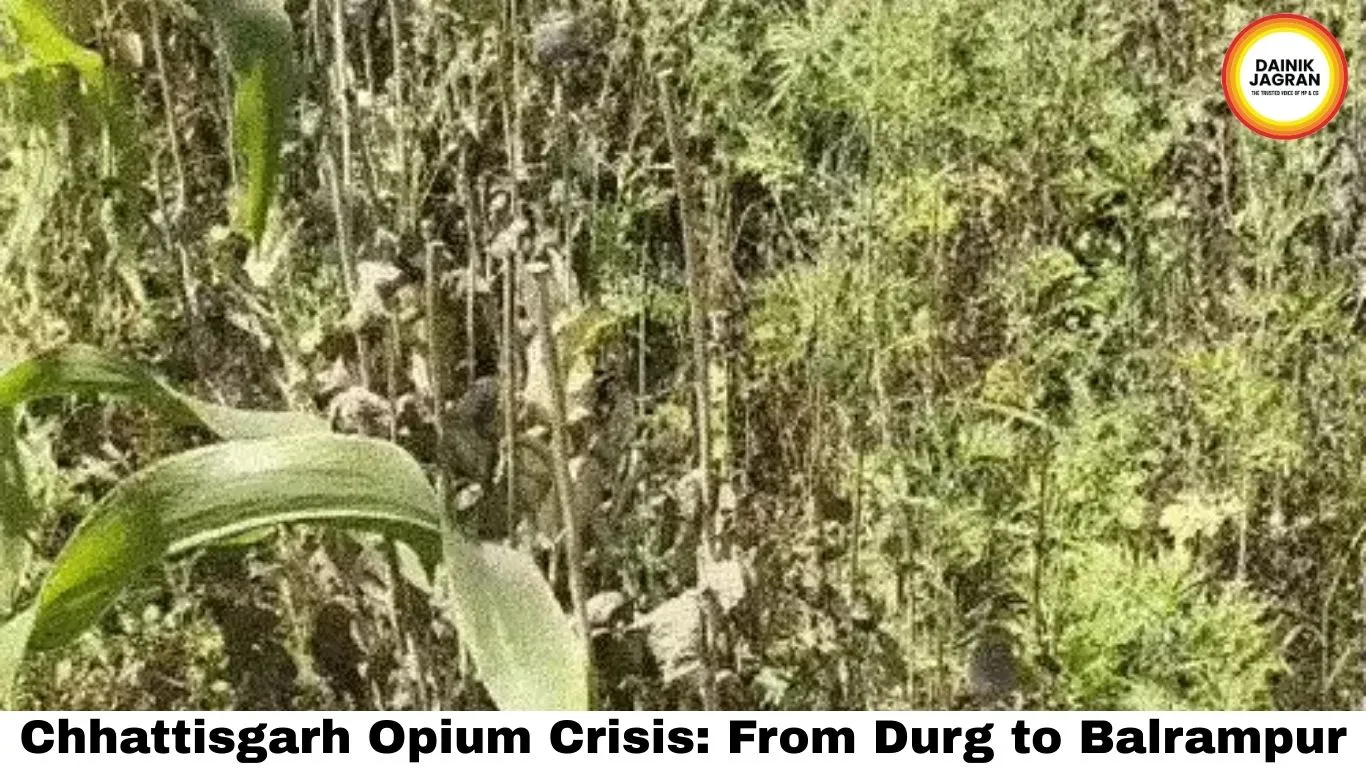
Chhattisgarh Opium Crisis: From Durg to Balrampur, Illegal Poppy Fields Spread — Bhupesh Baghel Demands Action, BJP Fires Back
Digital Desk
Chhattisgarh's "Dhaan Ka Katora" Is Growing Something Else: How Opium Farms Are Reshaping State Politics
Chhattisgarh built its identity as India's rice bowl — the dhaan ka katora. But in March 2026, it is finding itself in the middle of a crisis it did not see coming: illegal opium farming spreading from its western districts to its eastern tribal belts, touching a BJP leader's farmhouse in Durg, an obscure forest village in Balrampur, and — with explosive political consequences — the floor of the state assembly itself.
This is not a single isolated incident. It is a pattern. And the fight over who is responsible — and who protected it — has consumed Chhattisgarh's political class for the last ten days.
How It Started: A YouTube Video and a BJP Leader's Farm in Durg
Former Chief Minister Bhupesh Baghel visited the site on March 7 along with local Congress leaders to inspect the area and highlight the issue — and his social media posts, carrying photographs of poppy plants in a BJP leader's farm, spread across YouTube and WhatsApp with devastating speed. Within 48 hours of the raid, a BJP leader was suspended, a former Chief Minister had visited the site, and the Chhattisgarh Assembly was reverberating with Congress demands for the Home Minister's resignation. Wikipedia
The BJP leader at the centre of the Durg case is Vinayak Tamrakar, associated with the BJP Kisan Morcha. Baghel had posted on social media that Tamrakar was allegedly growing opium on a 10-acre field in village Samoda, Durg district, describing him as a man of considerable local influence. Al Jazeera Police subsequently arrested Tamrakar after the story went viral and could no longer be contained.
Balrampur: The Opium Trail Moves East
Just as the Durg scandal was simmering, a second case emerged — this time in Balrampur's Kusmi block, one of the most remote and forested corners of Chhattisgarh, bordering Jharkhand.
On March 10, 2026, acting on a tip-off, a joint team of police and district administration reached the Sarna Toli area under Tripuri Gram Panchayat in Kusmi block. Initial investigation confirmed that illegal opium was being cultivated on more than two acres of land. The area was immediately taken into custody and the relevant narcotics agencies were alerted. Zee News
A large quantity of dried poppy pods — some already incised for opium extraction — was recovered. Preliminary investigation revealed that the cultivation was being carried out by people from Jharkhand, who had rented the land from local farmers Rupdev Bhagat and Kaushal Bhagat. Villagers told police they knew opium was being grown but were unaware it was illegal — and came forward only after seeing the Durg case in the news. The Washington Post
A separate raid near Khajuri Panchayat's Turripani village in Balrampur revealed approximately two and a half to three acres of additional illegal opium cultivation, with a joint police and revenue department team seizing the crop and launching an investigation. Bloomberg
In total, multiple sites across Balrampur district are now under investigation — with the Jharkhand border geography making the case particularly complex, as cultivators can operate in the forest zone and retreat across the state line.
The Night Watch: Collector and SP Stand Guard Over the Fields
The administration's response in Balrampur was swift and visible. When the Balrampur Collector Rajendra Katara and Superintendent of Police reached the site and saw the thriving opium crop for themselves, they were visibly stunned. The fields were placed under overnight watch, with police conducting night-long surveillance, before the formal seizure and destruction of the crop was carried out on Wednesday morning with samples taken as evidence. NBC News
Collector Katara told media that as soon as the cultivation was confirmed, all departments were coordinated immediately and the crop was taken into custody before legal proceedings began. He stated clearly that illegal opium cultivation will not be tolerated anywhere in the state.
Bhupesh Baghel's Political Offensive
Former Chief Minister Bhupesh Baghel has made this issue his primary weapon against the Vishnu Deo Sai government — and he is using social media with surgical precision.
The sarpanch of the Balrampur village told police that he had informed them about the opium cultivation as far back as January — but no action was taken for nearly two months. Windward Baghel seized on this immediately, posting that the administration and government were trying to suppress the story entirely and demanding that the home department stop pressuring police officers and allow them to speak freely and share information with the media.
Baghel went further on March 10, alleging that the drug trade — including opium and dry narcotics — is being run in a planned manner under the protection of the Chief Minister and Home Minister. He said the Durg BJP leader who was caught growing opium had not even been designated the main accused by the Vishnu Deo Sai government. Wionews
Congress has also taken the attack into the assembly. The Chhattisgarh Assembly witnessed noisy scenes with the Opposition Congress demanding a discussion on opium cultivation in a BJP leader's land in Durg district. The Speaker rejected their adjournment motion, provoking Congress MLAs to march to the Well of the House in protest — leading to the automatic suspension of 29 Congress MLAs. Wikipedia
The BJP's Counter: Action Is Ongoing, Opposition Is Politicising
The ruling BJP has not taken the attacks lying down. State Minister Rajesh Agrawal responded directly to Baghel's allegations, stating that continuous action is being taken against those involved in the drug trade and that no one will be spared regardless of political affiliation.
The government points to the swift police action in both Durg and Balrampur as evidence that the administration is functioning independently — and argues that the arrests and seizures themselves prove there is no political protection at the systemic level. The suspension of Vinayak Tamrakar from the BJP Kisan Morcha following the Durg raid was positioned as evidence of zero tolerance.
The Bigger Picture: Why Is Illegal Opium Farming Growing in Chhattisgarh?
This question deserves a direct answer — and it goes beyond politics.
Chhattisgarh's tribal belt districts, particularly those bordering Jharkhand, Odisha, and Madhya Pradesh, have long been vulnerable to illegal cultivation of narcotics due to a combination of dense forest cover, limited administrative reach, low awareness of drug laws among tribal communities, and the involvement of outside networks who exploit local land.
The Balrampur case is textbook: Jharkhand-based operators rented tribal farmland, used a forest water source for irrigation, and grew the crop in a border zone where policing is difficult and awareness is low. Villagers only realised it was illegal after watching news coverage of the Durg case.
This is not a law and order failure alone — it is a civic awareness and administrative penetration failure in the state's most remote zones.
The Bottom Line
Chhattisgarh has two overlapping crises on its hands. The first is a genuine and growing narcotics challenge — illegal opium cultivation spreading from established farmland in Durg to tribal forest zones in Balrampur, with a Jharkhand-linked network that clearly predates the current political controversy.
The second is a political firestorm that the BJP is struggling to contain — with a former Chief Minister personally visiting drug fields, 29 Congress MLAs suspended from the assembly over it, and daily social media posts keeping the pressure relentless.
Both crises demand the same thing: fast, transparent, politically neutral action. Seizures and overnight surveillance are the right start. But unless the networks behind the cultivation — the Jharkhand operators, the local facilitators, and any political connections — are fully prosecuted under the NDPS Act, this story will not end in Balrampur.
It will only move to the next district.


.jpg)




