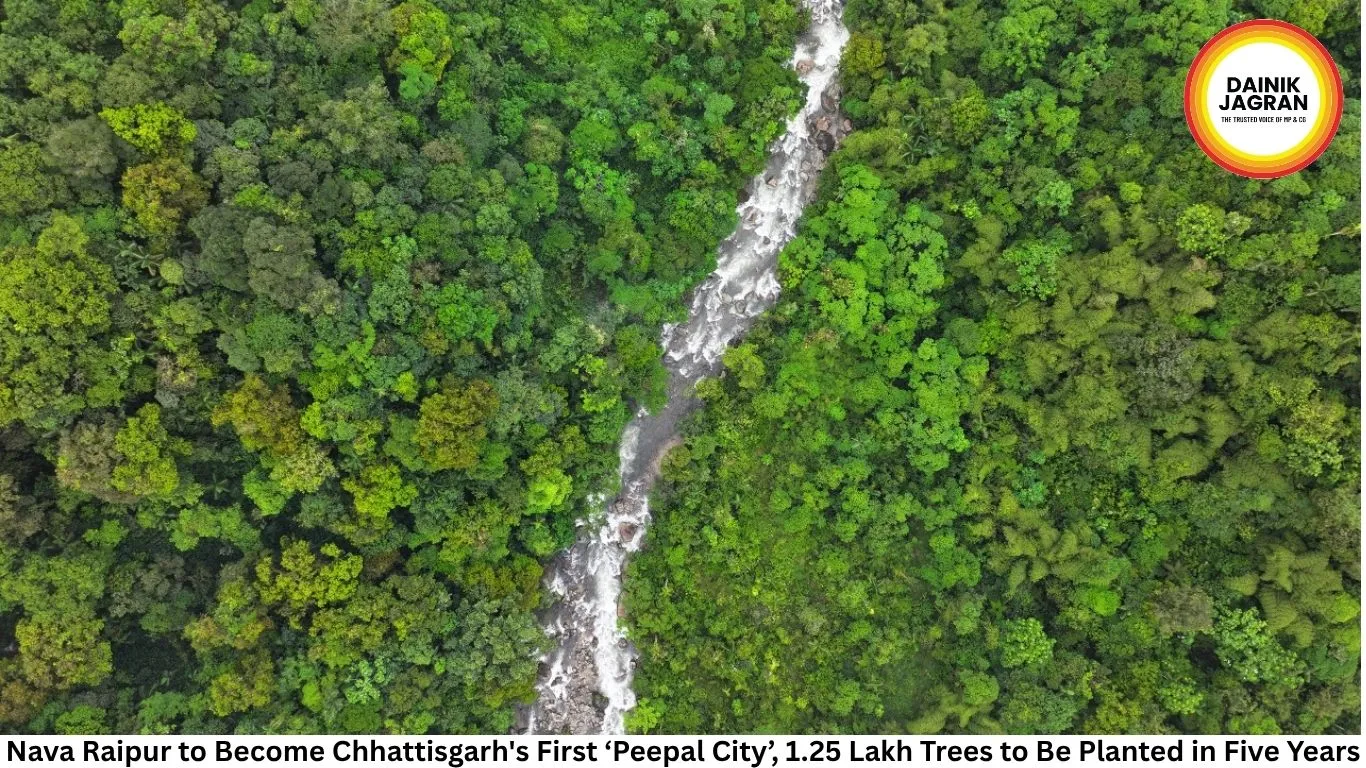
Nava Raipur to Become Chhattisgarh's First ‘Peepal City’, 1.25 Lakh Trees to Be Planted in Five Years
Digital Desk
NRDA plans Peepal Forest, plantation around 108 water bodies, and large-scale urban greening to improve air quality and ecological sustainability.
Nava Raipur Atal Nagar is set to become Chhattisgarh's first 'Peepal City', with the Nava Raipur Development Authority (NRDA) launching an ambitious five-year plantation drive to transform the city's green landscape. Under the initiative, 1.25 lakh fully developed saplings will be planted across roadsides, parks, green belts, water bodies, and government land.
The project aims to plant around 25,000 mature saplings every year, each approximately 10 feet tall, to improve survival rates and ensure faster development of green cover.
Peepal Forest and Green Corridors Planned
The campaign will primarily focus on planting Peepal trees, along with Neem and other environmentally beneficial shade-giving species.
As part of the project, a 24-acre Peepal Forest will be developed in Sector-16, complementing the existing mango grove. Another 16-acre block plantation is planned in Sector-39 (Mudhpar), while 75 acres behind the Biodiversity Park in Sector-24 will be developed with mixed plantation.
The authority also plans to undertake plantation along 108 water bodies and nearly 33 kilometres of natural water channels, aiming to strengthen both urban greenery and water conservation efforts.
Modern Nursery to Supply Saplings
To support the long-term plantation programme, NRDA has established a four-acre modern nursery in South Central Park, where Peepal saplings are being cultivated.
The nursery will supply planting material throughout the five-year campaign. In the future, it will also produce Neem, Kaner, Bougainvillea, and seasonal flowering plants for urban landscaping projects.
Focus on Larger Saplings
Unlike conventional plantation drives that rely on small saplings, the initiative will prioritise larger and well-developed plants. Officials believe mature saplings have significantly higher survival rates and can provide shade, greenery, and environmental benefits much sooner.
Environmental experts say dense roadside plantations help reduce dust, air pollution, and urban heat, while also improving the city's overall ecological balance.
Ecological and Cultural Significance
The Peepal tree holds immense ecological, medicinal, and cultural importance in India. Besides improving air quality and biodiversity, various parts of the tree—including its leaves, bark, roots, and fruits—are widely used in traditional Ayurvedic medicine. It is also regarded as a sacred tree in Indian culture.
Expected Benefits for Residents
The large-scale plantation drive is expected to deliver several long-term environmental benefits, including:
- Improved urban greenery and cleaner air
- Reduction in dust and air pollution
- Lower urban temperatures and heat mitigation
- Better protection of lakes and water bodies
- Healthier and more sustainable urban environment
With the initiative, Nava Raipur is expected to emerge as a model green city, combining urban development with environmental conservation through one of the state's largest plantation programmes.

--------
🚨 Beat the News Rush – Join Now!
Get breaking alerts, hot exclusives, and game-changing stories instantly on your phone. No delays, no fluff – just the edge you need. ⚡
Tap to join:
🟢 WhatsApp Channel: Dainik Jagran MP CG
Crave more?
🅕 Facebook: Dainik Jagran MP CG English
🅧 Twitter (X): Dainik Jagran MP CG
🅘 Instagram: Dainik Jagran MP CG
Share the fire – keep your crew ahead! 🗞️🔥
Nava Raipur to Become Chhattisgarh's First ‘Peepal City’, 1.25 Lakh Trees to Be Planted in Five Years
Digital Desk
Nava Raipur Atal Nagar is set to become Chhattisgarh's first 'Peepal City', with the Nava Raipur Development Authority (NRDA) launching an ambitious five-year plantation drive to transform the city's green landscape. Under the initiative, 1.25 lakh fully developed saplings will be planted across roadsides, parks, green belts, water bodies, and government land.
The project aims to plant around 25,000 mature saplings every year, each approximately 10 feet tall, to improve survival rates and ensure faster development of green cover.
Peepal Forest and Green Corridors Planned
The campaign will primarily focus on planting Peepal trees, along with Neem and other environmentally beneficial shade-giving species.
As part of the project, a 24-acre Peepal Forest will be developed in Sector-16, complementing the existing mango grove. Another 16-acre block plantation is planned in Sector-39 (Mudhpar), while 75 acres behind the Biodiversity Park in Sector-24 will be developed with mixed plantation.
The authority also plans to undertake plantation along 108 water bodies and nearly 33 kilometres of natural water channels, aiming to strengthen both urban greenery and water conservation efforts.
Modern Nursery to Supply Saplings
To support the long-term plantation programme, NRDA has established a four-acre modern nursery in South Central Park, where Peepal saplings are being cultivated.
The nursery will supply planting material throughout the five-year campaign. In the future, it will also produce Neem, Kaner, Bougainvillea, and seasonal flowering plants for urban landscaping projects.
Focus on Larger Saplings
Unlike conventional plantation drives that rely on small saplings, the initiative will prioritise larger and well-developed plants. Officials believe mature saplings have significantly higher survival rates and can provide shade, greenery, and environmental benefits much sooner.
Environmental experts say dense roadside plantations help reduce dust, air pollution, and urban heat, while also improving the city's overall ecological balance.
Ecological and Cultural Significance
The Peepal tree holds immense ecological, medicinal, and cultural importance in India. Besides improving air quality and biodiversity, various parts of the tree—including its leaves, bark, roots, and fruits—are widely used in traditional Ayurvedic medicine. It is also regarded as a sacred tree in Indian culture.
Expected Benefits for Residents
The large-scale plantation drive is expected to deliver several long-term environmental benefits, including:
- Improved urban greenery and cleaner air
- Reduction in dust and air pollution
- Lower urban temperatures and heat mitigation
- Better protection of lakes and water bodies
- Healthier and more sustainable urban environment
With the initiative, Nava Raipur is expected to emerge as a model green city, combining urban development with environmental conservation through one of the state's largest plantation programmes.